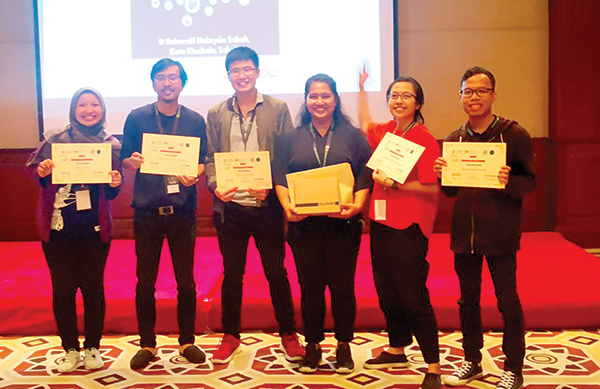
KOTA KINABALU: There is good cooperation between the United States (US) and law enforcement agencies as well as non-governmental organisations (NGOs) in Sabah and Malaysia, as a whole, on tackling wildlife trafficking issues.
“We have actually really good cooperation with law enforcements here, with the NGOs, on thinking and working together to solve them (wildlife trafficking) because this is an issue that crosses national boundaries,” said Environment, Science and Technology Officer, Will West Follmer, from the US Embassy in Kuala Lumpur.
Advertisement

He said this when met after the closing ceremony of the Zoohackthon event, “End Loop: Coding to end wildlife trafficking”, at Universiti Malaysia Sabah (UMS), here, Sunday.
Citing seizures done at the Kuala Lumpur International Airport, he noted that some of the goods seized at the airport came from Africa and were heading to Guangzhao in China.
“Wildlife trafficking is not an issue when it is taking place in only one border, but it is taking place across all borders, so it requires global cooperation to address,” he said.
He noted that the US is still one of the biggest consuming markets of all the trafficking goods, after China, Vietnam and Japan.
“We still have wildlife trafficking issues that we deal with in our own borders. We are not perfect, we see Sabah and Malaysia, as a whole, as a partner in dealing with these issues,” he said.
Meanwhile, the Zoohackthon, which is supported by the US Embassy, is a competition designed to develop new and innovative tools to fight wildlife trafficking.
This time around, Kota Kinabalu was picked along with 20 other cities worldwide for the event.
Follmer noted that the US has done a lot of work in Sabah in wildlife trafficking before and the Zoohackthon is just one of the efforts.
“We have some great partners both within the Sabah Government and a few NGOs, and now with UMS as well, in tackling wildlife trafficking issues as well as preserving Sabah’s wildlife,” he said.
He said the other reason why he picked Sabah was because he was impressed by the wildlife and biodiversity the State has to offer, from its mountain to rivers and jungles.
“These are one of the things that really makes Sabah special and I thought by having this event here will be a great way to involve the tech community in conservation efforts and to draw attention to the initiative,” he said.
The two-day event hosted by UMS saw 17 participating teams comprising 85 participants from Sabah, Sarawak and Indonesia.
“UMS is proud to organise this Zoohackathon programme and as the growth of technology and innovation today, we believe we can help to improve Sabah’s wildlife, forestry and marine problems,” said UMS Vice-Chancellor, Prof. Dr Taufiq Yap, when officiating the closing ceremony.
His speech was delivered by his Information Technology and Communications Department Director, Associate Prof. Dr Ag Asri Ag Ibrahim.
The competition required teams to come up with tools to fight wildlife trafficking within 48 hours using computer coding and technology.
First place went to Navy Pangolin Team from Indonesia who developed a software called “Pangolin” to help analysts in collecting wildlife trafficking data (text-based data) sourced from news.
Pangolin itself is an Artificial Intelligence-powered data extraction and that verification tool can automate the data extraction from the Internet. The advantage of this software is that it can cut down manual labour, cost-saving and gets smarter the more it is used.
Second place went to The Rangers team from Sarawak and third place went to Team Sarawak Advent which comprises 14-year-olds from SMK St Anthony.
The teenagers, most of whom are first time competitors, came up with a project to conserve rhinoceros by creating a personality quiz which matches them to a rhino.
“We make the application simple but interesting so people will be fascinated to use,” said the youngsters who used skills they learnt from their design and technology subject in school to design the application.
Teams from UMS also did Sabah proud when they won consolation prizes, namely Code 4W Team, Binary Team and Wo-Men Team.
Among them was Code 4W Team comprising UMS students from various faculties who came up with a wildlife price trend monitor tool which helps to predict events that can affect wildlife price trends.