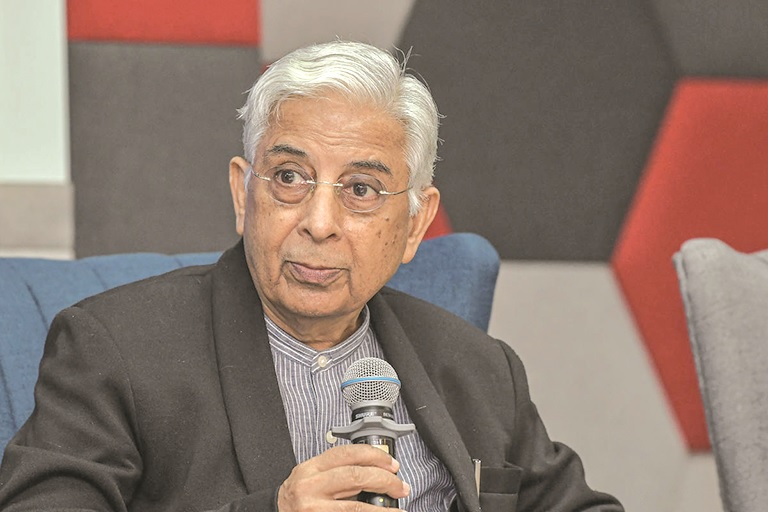
TODAY'S column is not about law or politics but a loving farewell from a retiring law teacher. In a few weeks’ time, I shall be completing my law teaching duties and ending more than 50 years of involvement with legal education.
As I walk beneath the tranquil skies of life’s evening, the memories of courses taught, minds awakened, friendships forged, and seminars and forums in which intellectual disputes were resolved amicably, shine like a hundred lanterns. They add a warm glow to the colours of my sunset.
I began my career at Institut Teknologi Mara (now Universiti Teknologi Mara) teaching the LLB (London) (External) programme.
In later years, I was seconded to the International Islamic University; appointed a Visiting Professor at Universiti Sains Malaysia; and awarded the Tunku Abdul Rahman Chair at Universiti Malaya.
I thank UiTM, UIAM, USM and UM for providing me immense challenges and opportunities for intellectual growth and the opportunity to serve.
I am grateful to many colleagues – past and present – for friendship, collaboration and inspiration.
Over the years, I learnt many lessons.
First, that education is a journey, not a destination. Second, that legal education is not only about training for careers but also about moulding character.
The noblest aim of legal education is to produce lawyers who love justice, respect liberty, defend constitutionalism and serve humanity.
A university curriculum fails in its mission if it is merely a handmaiden to the profession and has no element of service by the faculty or university to the community.
Third, a law school is not merely a place for acquiring knowledge of rules. It is a place for learning how law can be used as an instrument of social engineering and justice. Legal education should teach students not only what the law is but what the law ought to be.
Fourth, law teachers and students must sometimes stand against popular opinions and prejudices and be prepared to pay the price!
We must defend constitutional values; speak truth to power; and remember that professional success without ethical commitment is an empty achievement.
Fifth, in seeking reform of the law, we must go beyond formal content of the law to measuring its actual consequences; beyond form to functioning; beyond what the law says to what it actually does.
To my thousands of students, I wish to let you all know that it was my privilege to be associated with you. You touched my life in a nice way. I learnt many things from our interaction.
In some respect, you were my teachers. Your queries, doubts and occasional disagreements added to my understanding of the law and underlined the fact that in law there are no absolutely right answers. Much depends on one’s interpretation and reasoned argument.
Even if I did not impart much knowledge to you, I hope I shared with you some perspectives of law and life that may stand you in good stead as you wander the meadows of the law and walk the highway of life.
As a teacher, my primary aim was not to lecture to you from the mountaintop but to join you in the valleys of knowledge and walk up the slippery slopes hand in hand with you.
I wished to avoid telling you what to think; instead, I hoped to train you in how to think.
I tried to make difficult things look simple and simple things look rich. I was conscious that the law is vast; no one masters it completely.
Though I also taught the subjects of contract, tort, administrative law and media law, my favourite subjects were constitutional law and jurisprudence.
In the matter of constitutional interpretation, I emphasised that the Constitution’s provisions are glittering generalities that are inter-connected.
The Articles of the Constitution must not be seen in isolation but holistically and in the light of the Constitution’s lofty ideals and assumptions.
In the area of human rights, I submitted to you that in a rule of law society, rights are inherent.
It is power that needs legal justification. Human rights must be interpreted prismatically, not literally.
Life is larger than the law and the Articles of the Constitution cannot possibly embrace the full richness of the dignity of human beings.
The bare, black letters of the law should therefore be seen through the prism of life.
Once that is done, the lifeless, static clauses acquire colours and dimensions not visible to the ordinary eye.
A few words about achieving career success. There is no magic wand; no high-speed elevator to success. You have to climb the stairs one step at a time.
Some advice may assist in achieving high performance in your present or future job:
- Dream dreams. Dreams are the foundation of reality. Visualise what you wish to become. But as Rudyard Kipling says, do not let dreams become your master and thoughts your aim.
- Draw up an attainable plan. Set up a realistic time frame. Discipline yourself to execute the plan. Begin today. Anything that is commenced picks up its own steam.
- Develop positive attitudes. “It is your attitude, more than your aptitude, that will determine your altitude,” said Zig Zagler, the American motivational speaker. It is your will, not your skill that will determine the height of your flight. If you think you can, you indeed can.
You all have more abilities than you realise. There are within each of you, reservoirs of inner strength that await to be tapped. You can fly higher than an eagle if you have hope and determination beneath your wings.
- Work hard and diligently. Hard work never goes to waste. Approach every task with your heart and soul. Genius is 10% inspiration; 90% perspiration. Whatever you do, do well. Do ordinary jobs extraordinarily well. Soon your bosses will repose trust in you with bigger, tougher challenges.
- In those moments when you feel fear and doubt, have faith in God. “God does not impose upon a soul, a burden it cannot bear” (Holy Qur’an 2:286). Remind yourself that fears and insecurities are perfectly natural. Every human being suffers from them.
We are all specks of dust in the universe. At the same time, we are strong enough to do whatever needs to be done. Life is tough, but we are tougher. With persistence, we can convert dares into doors and adversities into opportunities.
- Do not give up easily. Persevere. If at first you do not succeed, try again. Falling down is not the same thing as failing. Rumi, the Persian poet reminds us: “What you seek is seeking you.”
Coming back to retirement, I’m conscious that legal education has changed and evolved significantly, and new challenges have emerged.
However, some enduring values remain unchanged. I hope to view retirement as a transition rather than a termination; as a new chapter in a continuing journey.
As I leave the teaching job I do so with gratitude in my heart and hope for the future.
To my students past and present, I hope your education will not only illuminate your careers but also your conscience. I will watch you with pride as you traverse the highway of life.
Emeritus Professor Datuk Dr Shad Saleem Faruqi is the former chair holder of the Tunku Abdul Rahman Foundation at Universiti Malaya.
The views expressed here are the views of the writer and do not necessarily reflect those of the Daily Express. If you have something to share, write to us at: [email protected]