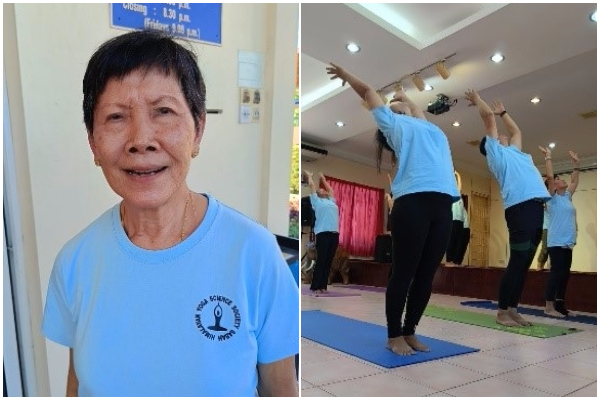
THE first thing Poh Lin does every morning, before the kettle boils and before the day makes its demands, is breathe. Not the absent, automatic kind. The deliberate kind, the kind she learned decades ago on a yoga mat, the kind that carried her through eight years of caring alone for a husband whose mind was no longer his own.
She is 80 now, living alone, and still going strong.
“What is the use of living to 100 years old if you cannot walk? I told myself, I must practise yoga,” she said, when this reporter sat down with her.
Her story is not unusual in its grief, but it is remarkable in its resilience.
Her late husband had dementia with severe behavioural problems.
For eight years she managed him alone, through nights of relentless agitation, through a violent episode that left her with a dislocated jaw and fractured facial bones, through the parade of hired caregivers who took one look at his condition and walked out.
She did it without breaking, she says, because yoga had given her something no prescription could and that is patience, calm and the ability to simply stay.
“One night, he raged until dawn while I lay beside him and somehow slept through it.
“On another afternoon, he bolted from a shopping centre and ran toward Karamunsing Complex, and I sprinted after him through the streets, calling for help that no one offered.
“At that time I was already in my 70s. Where did I get the stamina to run?” she said. “It is thanks to yoga.”
A geriatrician eventually helped manage her husband’s condition in his final years, and she remembers there were small victories, like the afternoon she dissolved a tiny tablet into his teh tarik at a coffee shop and watched him calm within 15 minutes, enough to bring him home.
“I learned to work around his moods, to find those narrow windows and I managed it entirely on my own,” she said.
After he passed, she rejoined her yoga class last year following an 11-year break. On a recent trip to China, fellow travellers younger than her began flagging while she pressed on, and they noticed.
“They came and asked me, ‘Aunty, how come you look so fresh?’” she said, smiling. “And all this is a result of yoga.”
She has osteoporosis now and arthritis in both feet, but she still walks the temple grounds regularly, unwilling to let stillness win.
Poh Lin’s account sits against a national backdrop that makes it more than just one woman’s testimony.
Malaysia is ageing faster than it can prepare for.
The National Health and Morbidity Survey 2025, released in April, found that only 14.7 per cent of Malaysians aged 60 and above are ageing well, meaning more than 85 per cent of the country’s older population are living with chronic disease, disability, cognitive decline or social vulnerability, often all at once.
Dementia now affects nearly one in 10 older Malaysians, and almost one in five live alone.
The Department of Statistics projects that those aged 65 and above will make up 14.5 per cent of the total population by 2040, placing enormous pressure on a care system already stretched thin.
The financial picture compounds it. The Employees Provident Fund has found that 58 per cent of its 54-year-old members have less than RM100,000 in savings, well short of the RM240,000 needed to sustain a modest RM1,000-a-month income over 20 years of retirement.
For a large portion of elderly Malaysians, staying healthy and staying solvent are the same problem.
It is precisely that convergence that Malaysia Hindu Sangam Sabah State Council Chairman Datuk Dr G Mohan wants policymakers to take seriously.
“You no need to spend a single cent. Zero cost. Compared to when you want to buy medicine or want to do some other things, all you have to pay. Yoga is free for you, it is a gift for the world,” he said.
Dr Mohan attended this year’s International Day of Yoga celebration organised by the Himalayan Yoga Science Society Sabah (HYSSS), an event that drew participants from four years old to 90 and reflected the practice’s reach across age, race and religion.
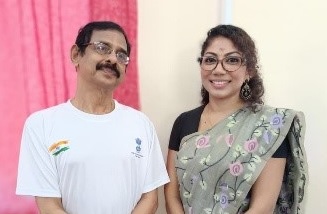
He wants the State to act on that reach formally, calling on the State Government and Jabatan Kesihatan Negeri Sabah under the Ministry of Health to introduce yoga alongside ayurvedic practice under the Traditional and Complementary Medicine framework in government hospitals, among them Hospital Duchess of Kent in Sandakan, Hospital Wanita dan Kanak-Kanak and Hospital Tuaran.
For HYSSS President, Sukumaran Vanugopal, the competitive yoga circuit that has gained traction in recent years, has left him with little patience.
World championships have been held in Saudi Arabia and New Delhi, and he watches them with something between frustration and resignation.
“Yoga is never about competition. You do not compete in yoga. You practice yoga according to your ability. You do not compete against anyone,” he said, describing what he observed at such events as closer to gymnastics than anything resembling genuine practice.
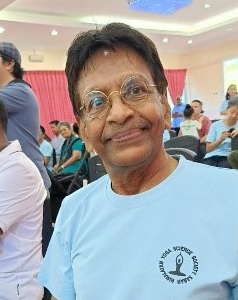
The heart of yoga, he says, is pranayama, the science of breath, a discipline he describes as the bridge between body and mind whose principles were first laid down more than 3,000 years ago and that modern science is only now beginning to verify.
That verification was the focus of a talk by Universiti Malaysia Sabah Senior Medical Lecturer Dr Vennila Gopal.
“Most people think that our emotions change our breathing, but the opposite can also be done. Changing your breathing can change your emotions, your brain and your nervous system,” she said.
The human nervous system operates in two modes, she said, the sympathetic fight-or-flight response that tightens and accelerates the body under threat, and the parasympathetic rest-and-digest state in which the body slows and heals.
The transition between the two, she said, is something a person can influence simply through how they breathe.
Slow, controlled breathing activates the vagus nerve, a calming pathway connecting the respiratory system directly to the brain, reducing heart rate and lowering stress.
Research has further confirmed that nasal breathing connects to brain rhythms governing emotion and memory, lending scientific grounding to what yoga has long prescribed.
“Every emotion we experience leaves a signature in our breathing. Every breath gives a signal to our brain. The next time you feel stressed, anxious, angry or overwhelmed, pause. Take a deep breath and exhale slowly. Do it once or twice and you will definitely feel the difference,” she said.
This reporter had the chance to test that before the morning was out.
Former HYSSS President Datin Judy Rajah led a chair yoga session to close the programme, guiding participants through gentle movements, stretches and breathing exercises performed entirely from a seated position.
Judy, a highly respected teacher with more than 30 years of experience, made it look effortless in the way that only someone who has done something for decades can.
This reporter joined in with the mild wariness of someone who has not done anything resembling exercise in longer than she would like to admit.
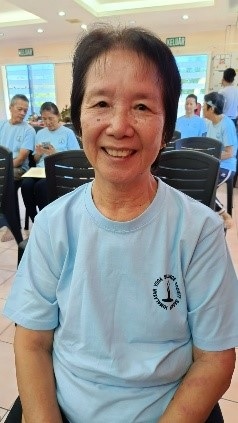
The session moved through several poses before arriving at one that gave this reporter pause … the Simhasana or Lion’s Pose.
Inhale deeply through the nose, lift the chest, lean the weight slightly forward. Then, on the exhale, open the mouth as wide as possible, thrust the tongue out and down toward the chin, open the eyes wide, fix the gaze at the tip of the nose or the centre of the eyebrows, and produce a loud, deliberate “ha” from the back of the throat.
Three to five repetitions.
A room full of people doing this simultaneously on a Sunday morning is, in the most affectionate sense, an extraordinary thing to witness, and this reporter laughed before the second repetition was done. There is no dignified version of Lion’s Pose, and that is apparently the point.
But by the third round, something shifted.
The chest, which carries the particular tightness that comes with smoking a box of cigarettes a day, felt noticeably clearer, not dramatically, but enough to register. A loosening. The sense of having exhaled something that had quietly taken up residence.
Dr Mohan, seated next to this reporter during the session, leaned over afterward and mentioned that the Simhasana was actively encouraged for patients during the Covid-19 pandemic.
The forceful exhalation and the opening of the throat were seen as beneficial for respiratory health precisely because the lungs were the organ most under threat.
For a one-box-a-day smoker who had spent the morning writing about yoga with the detached professionalism of someone who had no intention of personally taking it up, that was a quietly inconvenient thing to hear.
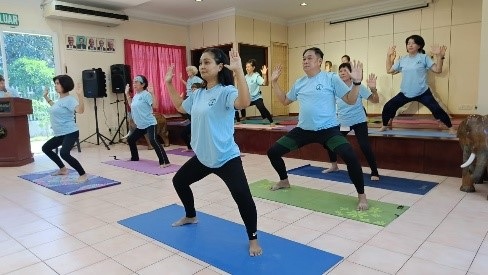
The rest of the session was gentler but no less effective.
By the end, there was a lightness this reporter had not walked in with, something in the chest and the shoulders that felt genuinely different from an hour before.
And with it, the kind of realisation that tends to arrive uninvited … that this body has been running on neglect for too long, and that putting off proper exercise is no longer a position that can be held with any real conviction.
Poh Lin already knew all of this, of course, the way people know things they have lived rather than read.
She came through grief and fractures and the long, particular loneliness of caring for someone who no longer knew her face, and she came out the other side still walking, still bending, still breathing with intention every morning before the day begins.
“I am very grateful that I am still healthy at this age. Please come for yoga class,” she said.