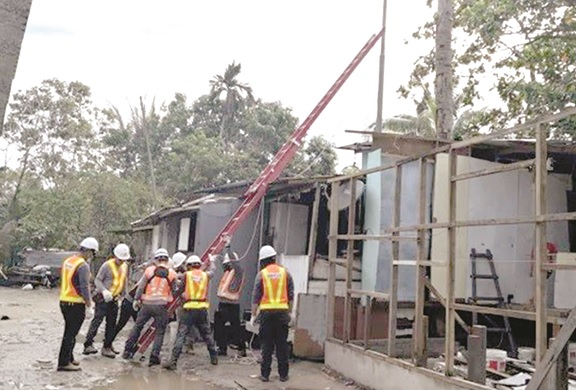
THE two-year Covid-19 nationwide lockdown resulted in the loss of income for many, but not for a Putatan contractor who was able to continue living comfortably with his family despite being unable to find work.
Sam (not his real name) has been illegally supplying water and power from his home to 10 units he erected on his acre of land, which he then rents out to surrounding labourers and squatters.
Advertisement

His secret was only revealed in the middle of this year, during an integrated operation led by Sabah Electricity Sdn Bhd to eradicate power theft and illegal wiring connection in the locality.
“Boleh-lah cukup makan (Just enough to get by),” said the 40-year-old father of three.
Even though he claimed to be a licensed contractor, he appeared to be unaware that altering his home’s power distribution board to supply to neighbouring homes is illegal.
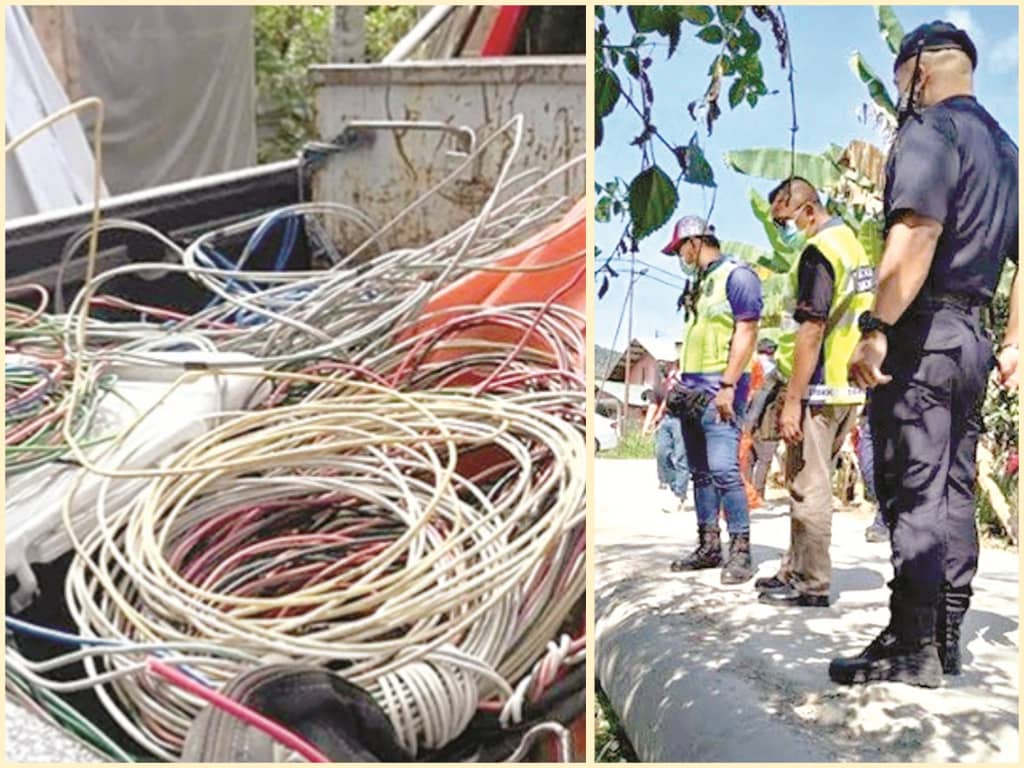 Some of the wires used for illegal wiring connection seized in Petagas (left pic). Enforcement team looking for illegal water and power connections during an integrated operation in Suang Parai.
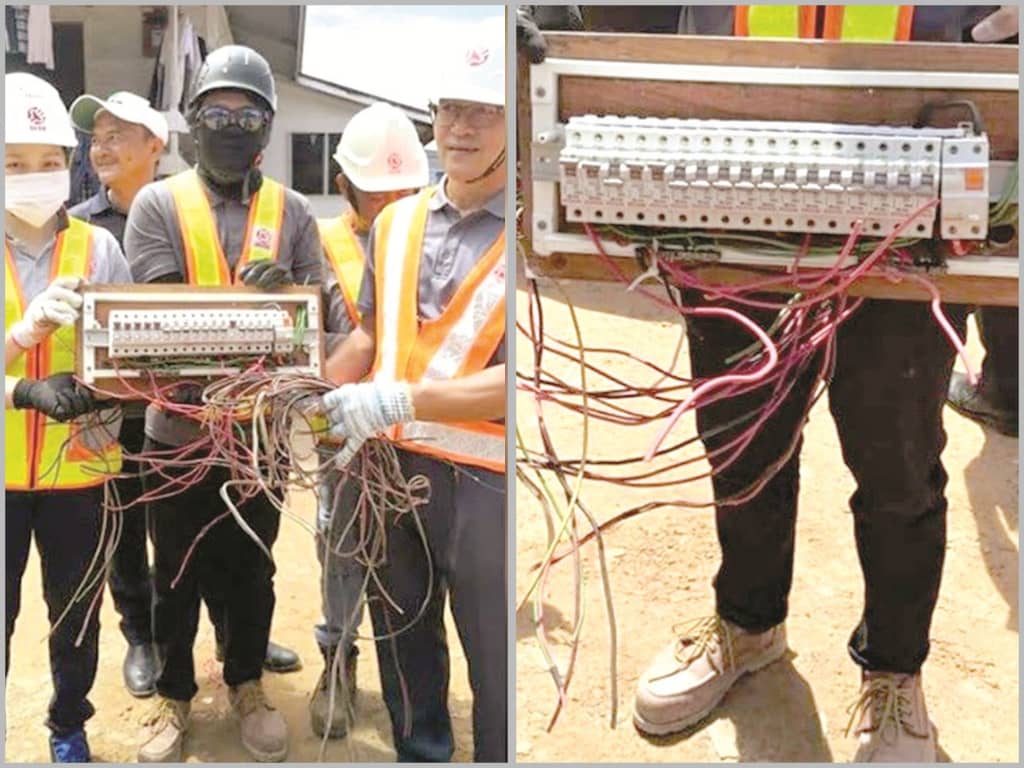 Addie and his team holding the confiscated distribution board found with more than 10 electrical circuits (left pic). The confiscated distribution board found with more than 10 electrical circuits.
When approached by the enforcement team, he simply shrugged as they dismantled his distribution board which was connected to more than 10 electricity circuits.
In Suang Parai, a settlement notorious for illegal water and wiring connections in Kota Kinabalu, Samad (not his real name) supplements his income by installing illegal pipes for a fee.
His clients include those who encounter difficulties in obtaining water legally and those who purposely steal water to avoid paying their bills.
How much does the illegal installation of pipes cost? “It depends on the area and the level of complexity,” he said.
In addition to basic plumbing skills, he said installing the pipes only requires physical fitness and a willingness to work in harsh conditions.
The millions of ringgit worth of unaccounted-for water and electricity owing to distribution system leakage or water and power thefts had been attributed to water and power thefts perpetrated by individuals such as Sam and Samad. For decades, successive State governments and law enforcement agencies struggled to tackle this drain on the economy.
In an effort to minimise revenue loss and occurrences of electrocution brought on by illegal wiring connections, Sabah Electricity Sdn Bhd announced its intentions to implement the prepaid card system in February 2022.
The system’s benefit is that each homeowner will receive a prepaid metre, allowing them to pay just for the amount of electricity they utilise.
The Ministry of Energy and Natural Resources only recently issued a licence for an operator to purchase supply from SESB and distribute it to areas that SESB cannot service owing to land and legal concerns.
Kampung Forest in Sandakan has been chosen for the prepaid card system pilot project that SESB hopes to implement by end of this year, involving some 1,000 houses in the water village.
Sam and Samad’s actions may be frowned upon by law-abiding citizens, but in the eyes of those like Siti (not her real name), who pays between RM30 and RM40 per month for the power and water supplied illegally to her rented house in Petagas, they are heroes.
“Is it wrong? We pay for it, it’s not like it’s free,” she said, dismissing the impact illegal connections may have on fire safety and revenue loss for the State.
“We are merely renting from our landlord. All we know is that we pay the monthly rental, including the utility fee,” she said.
Sally (not her real name) spends up to RM100 per month for her power supply, which is obtained through an illegal wiring connection from another resident’s house in Petagas.
“We have been trying to apply for our own power metre from SESB for years, but our application has yet to be accepted,” she claimed, saying that the lack of proper documentation is among the reasons why their application was denied.
“Why can other residents get their electricity meter approved? We simply want our application to be accepted so that we are not forced to rely on illegal wiring connections.
“I have children who are still in school; we need the lights for them to do their school assignments; how will they charge their phones and laptops if there is no electricity?” she said.
SESB General Manager (Distribution) Addie Ahmad, during an integrated operation conducted mid-year, said some people choose illegal wiring connections not because they cannot afford to pay for proper channels, but because they lack the necessary identification documents to apply for the facility.
Another factor is the land status on which the application is made.
“This is one of the reasons why SESB cannot process their power supply application,” he said.
He said illegal wiring connections have been discovered in areas which they call colonies around Sabah, adding that more than 200 such colonies had been found with Kota Kinabalu recording the highest number, followed by Sandakan, Semporna and Tawau.
Noro (not his real name), a resident of Petagas, claimed that it has been months since he paid a SESB contractor close to RM5,000 for wiring installation and metre application.
Upon being approached by the enforcement team during the integrated operation, he said, “Why don’t you take it up with the contractor?”
“I am not responsible for the lack of metre. I have paid in full for the services and been informed by the contractor that my application has been approved; I am merely awaiting the installation of the metre,” he said.
Addie does not rule out the possibility that some SESB personnel may have integrity issues but believes these instances to be isolated.
“Disciplinary measures would be taken against anyone engaged, particularly in terms of integrity,” he said when asked about the potential involvement of SESB workers in illegal wiring connection activities.