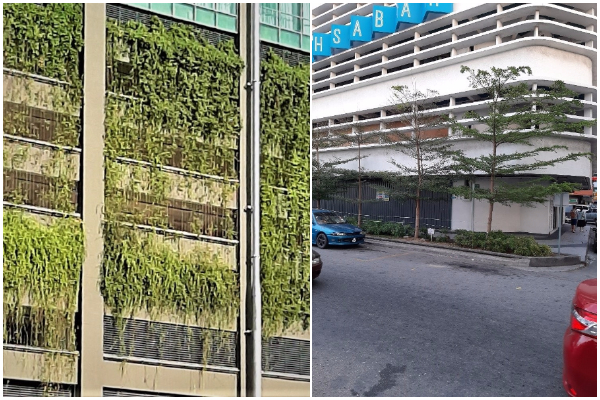
FOR years, readers of the Daily Express have followed Eskay Ong’s observations on the changing face of Kota Kinabalu through his long-running “Urban Greening” column.
As a landscape consultant, he has chronicled the city’s transformation – celebrating improvements where they occur while also questioning development that comes at the expense of trees, open spaces and liveability.
Advertisement

To Ong, the conversation about urban greenery is no longer just about beautification. As cities around the world contend with rising temperatures and the effects of climate change, he believes Sabah has an opportunity to learn from their experiences before facing similar challenges on a larger scale.
He believes the rapid expansion of shopping malls and commercial areas should not be viewed solely through an economic lens, but as part of a broader conversation about urban planning, environmental sustainability and the kind of city Sabah hopes to build for future generations.
For decades, Ong has written about the relationship between urban greenery, landscaping and the quality of life in Sabah’s towns and cities. A retired plantation consultant and landscape contractor, he has also shared his expertise through talks and presentations at Universiti Malaysia Sabah (UMS), Sabah Theological Seminary, Institut Perguruan Gaya, the Institute for Development Studies (IDS), Rotary Club, RTM and other institutions.
To understand how much greenery has been lost, Ong said it is necessary to look far beyond modern Kota Kinabalu.

“When North Borneo was colonised in 1888, there was virtually no distinction between urban and rural areas. Much of what is now Kota Kinabalu consisted of mangrove swamps, tidal forests and coastal vegetation.
“Areas such as Sembulan and Kampung Air were once covered by mangrove forests.”
Viewed from that historical perspective, he said, nearly all of the city’s original natural vegetation has disappeared as Kota Kinabalu evolved from a small seaside settlement into Sabah’s capital city.
However, Ong noted that efforts to green the city began in the early 1980s through landscape planting programmes.
“Although many trees have been planted over the years, they are still nowhere near enough to compensate for what has been lost. Kota Kinabalu needs to significantly expand its greening programme.”
More than shade
Ong believes many people underestimate the ecological value of urban trees.
“Urban trees can do wonders,” he said.
“When trees grow close together, they create their own microclimate. They reduce dehydration, lower temperatures, preserve humidity and lessen the impact of strong winds during extremely hot weather.”
If small clusters of trees can influence local conditions, he said, the cumulative effect of tens of thousands of trees throughout an entire city would be substantial.
“Many people may not notice these changes from day to day, but collectively they have a significant impact on the urban environment.”
Trees also support biodiversity, creating habitats for birds, butterflies, bees, insects, fungi, mosses and other organisms that together form healthy urban ecosystems.
“Every layer of a tree creates slightly different conditions in terms of light, humidity and airflow. These differences attract different forms of wildlife, making trees much more than ornamental features.”
Development and conservation can coexist
Ong rejects the notion that economic development and environmental conservation must always be in conflict.
“Commercial development is about generating economic returns, while conservation focuses on protecting nature. The challenge is finding the right balance.”
He acknowledged that profit naturally drives developers but believes attitudes have gradually changed over the years.
“Today, many developers, architects, engineers and local authorities have become much more aware of the importance of conservation.”
He pointed to examples where road alignments were adjusted to preserve mature trees rather than removing them altogether.
“There is no necessity for development to destroy everything in its path.”
He believes the same thinking should be applied to shopping malls and commercial developments.
Rather than leaving narrow spaces between buildings unused, Ong said they could be transformed into densely planted “green lungs” that improve air quality, reduce heat and create more pleasant public spaces.
“It is entirely possible to create mini forests between commercial complexes.
“Imagine if all the available spaces from Sutera Harbour right up to the Sabah International Convention Centre were fully planted. Kota Kinabalu would become a much greener city.”
Learning from greener cities
Ong believes Sabah can learn valuable lessons from cities that have successfully integrated greenery into urban development.
He said landscaping should not be treated as the final stage of a project after buildings have already been completed.
“Developers naturally focus on constructing buildings because that is their business. But greening should never become a secondary consideration.”
Instead, he advocates continuous investment in urban landscaping through regular replanting, introducing greater plant diversity, maintaining cleanliness and strengthening recycling initiatives.
He also believes local authorities should continuously monitor the health of public landscapes, identify areas that are deteriorating and intervene before problems become more serious.
For Ong, creating a greener city is not a one-off exercise but an ongoing commitment requiring careful planning, adequate investment and consistent maintenance.
A city built for the future
As extreme heat becomes an increasingly common feature of cities around the world, Ong believes greenery should no longer be viewed as decoration but as essential urban infrastructure.
Trees cool neighbourhoods, improve air quality, support biodiversity, reduce pollution and make cities healthier and more liveable.
“The available spaces are already there,” he said.
“The question is whether we choose to use them wisely.”
For Ong, the issue extends well beyond shopping malls or commercial development.
Ultimately, it is about whether Kota Kinabalu chooses to become a city built primarily of concrete – or one where development and nature continue to grow side by side.