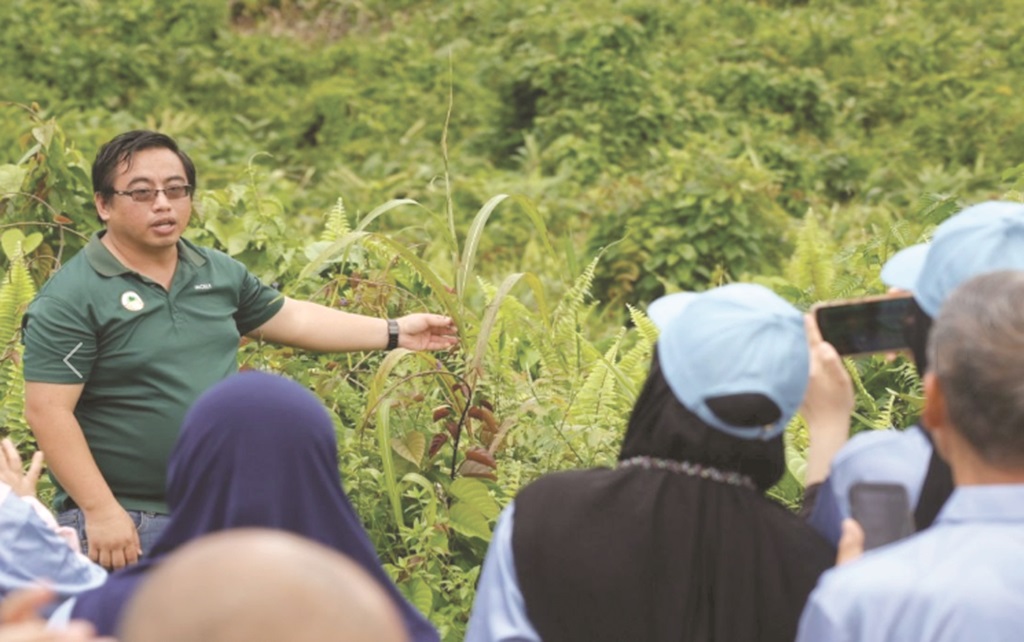
LAHAD DATU: A forest area once devastated by major fires during the El Niño phenomenon and decades of logging is steadily returning to life through the Orang-utan Habitat Forest Restoration Project in Lower Kawag, within the Ulu Segama-Malua Forest Reserve.
The initiative, undertaken by the Malaysian Palm Oil Green Conservation Foundation (MPOGCF) in collaboration with the Sabah Forestry Department, aims to restore degraded forest areas to improve orang-utan habitats while strengthening biodiversity conservation efforts in Sabah.
Sabah Forestry Department Forest Conservation Officer Jackly Ambrose said about 90 per cent of the 6,000-hectare forest had been degraded following major fires during the 1983, 1997 and 1998 El Niño episodes, compounded by intensive logging activities carried out between 1980 and 2007.
“In the past, logging was carried out using conventional methods and forest management was not as advanced as it is today. After the fires, the condition of the forest deteriorated further and required gradual restoration efforts,” he told reporters during a visit to the project site here.
He said the restoration project, which began in 2019, is being implemented over a 10-year period until 2029 with RM10 million in funding from MPOGCF, covering 2,500 hectares in Lower Kawag.
Jackly said the third phase, which commenced this year and will run until 2029, covers 332 hectares, making it one of the largest phases of the project, with a target of planting 132,800 tree saplings.
“The project builds on the first phase, which covered 25 hectares in 2019, and the second phase involving 200 hectares, which is now nearly 90 per cent complete.
“To date, 225 hectares have been successfully restored with MPOGCF, and the third phase will further expand the restored area,” he said.
Jackly said restoration efforts began with the planting of native pioneer tree species such as Laran, Binuang and Talisai to establish canopy cover before introducing hardwood species from the Dipterocarpaceae family, including Kapur and Seraya.
He said monitoring of the second-phase site showed trees planted since 2022 had recorded healthy growth, with the project also receiving international recognition through the Preferred by Nature (PbN) certification under the Ecosystem Restoration Verification Standard Version 3.1 for implementing degraded forest landscape restoration, in accordance with international best practices.
Apart from restoring the forest, Jackly said the project has enhanced the quality of orang-utan habitats and created wildlife corridors for species such as elephants, helping to reduce human-wildlife conflicts in nearby plantation areas.
Meanwhile, Lower Kawag Forestry Area Forest Ranger Ramlan Sakong said a joint monitoring conducted with Kinabatangan Orang-utan Conservation Programme (Hutan) in August last year had found that orang-utan density in Lower Kawag to range between one and 3.5 individuals per square kilometre, following the implementation of the restoration project.
He said more than 20 mammal species had also been recorded, including 12 threatened species such as banteng, elephants and sun bears, as well as over 180 bird species, including rare and endemic species such as pittas, the Bornean ground cuckoo and several hornbill species.
To broaden public awareness and community participation, the project has engaged 114 members of the Kampung Tampenau Nursery Community, comprising residents from Tambunan, Penampang and Ranau, to supply tree saplings for planting activities.
The initiative has not only encouraged greater community participation in forest conservation but also created income-generating opportunities through the production of tree saplings.
One of the participants, Fololita Palandis, 39, said most participants were housewives who now earned additional income by selling saplings at between RM5 and RM7 per polybag, depending on the species and order quantity.
“In the past, we used to supplement our household income by selling woven bags and handicrafts. Now, the sale of tree saplings has become another source of income that helps support our families, especially our children’s expenses,” she said.
She said they had also been trained to identify forest tree species such as Laran, Binuang and Seraya, as well as nursery propagation and seedling management techniques before the saplings were transferred to restoration sites.
According to her, each participant was capable of producing up to 200 saplings a day, while during the project’s second phase, the community supplied 80,000 saplings to support the forest restoration programme.