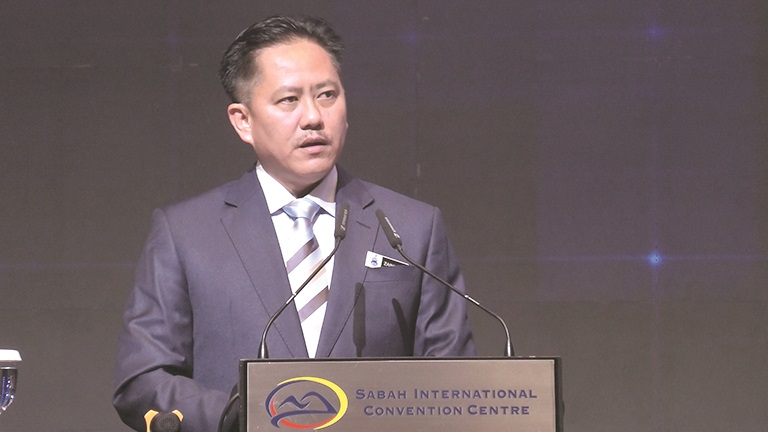
Kota Kinabalu: Success of the Sabah Maju Jaya (SMJ) 2.0 Development Plan depends on the commitment, capability and teamwork of the entire civil service in delivering the State’s development agenda, said new State Secretary Datuk Zainudin Aman
(pic).
He said the SMJ 2.0 Roadmap is founded on the principle that the success of a government is measured not by the policies it announces, but by the extent to which those policies improve the lives of the people.
Speaking when officiating at the Sankalpa Sabah 2030 Programme: Sabah Maju Jaya 2.0 Strategic Implementation Forum at the Sabah International Convention Centre (SICC) on Tuesday, he said the spirit of shared responsibility must guide the public service.
He said the culture of working in isolation, or the silo mentality, should be replaced with a collaborative approach that positions every ministry, department and agency as a strategic partner in advancing the State’s development agenda.
“Strategic collaboration must be strengthened among ministries and agencies at both the state and federal levels.
“While expanding synergies with the private sector, academia and the community to ensure that every development initiative is implemented in a more coordinated, efficient and impactful manner.”
He also emphasised the need to strengthen strategic communication through transparent performance reporting, the use of monitoring dashboards and effective data sharing.
“This will ensure that every policy and initiative can be monitored, evaluated and continuously improved,” he said.
Zainudin said rapid technological advancement, particularly in Artificial Intelligence (AI), has transformed the global landscape and the way the public sector carries out its daily responsibilities.
“As such, SMJ 2.0 recognises digitalisation and AI as strategic enablers that will strengthen administrative efficiency, enhance productivity and transform the way we plan, make decisions and deliver services to the people,” he said.
He said the achievements under SMJ 1.0 had shown that clear policies backed by effective implementation could deliver tangible benefits to the State and its people.
“For SMJ 2.0, Key Performance Indicators (KPI) will not be assessed based on the quality of reporting, but on the extent to which they improve the well-being of the people of Sabah,” he said.
Zainudin also said following his meeting with Chief Secretary to the Government Tan Sri Shamsul Azri Abu Bakar on Monday, several key matters were agreed to strengthen public service delivery and the implementation of Sabah’s development agenda.
Among them was the implementation of the Bureaucratic Red Tape Reform in project management through the Review, Keep and Boost (RKB) concept to expedite project management processes in Sabah.
Agreement was also reached on the creation of nearly 300 posts involving 26 agencies under the implementation of the Malaysia Agreement 1963 without requiring a Self Audit of Establishment and Organisation.
He further emphasised that meetings between the Federal and State Governments on development projects would be jointly chaired by the Chief Secretary to the Government and the State Secretary to review implementation progress and resolve outstanding issues.
He called on all Permanent Secretaries and Heads of Departments to prioritise the implementation of the Review, Keep and Boost approach by identifying at least one existing work procedure that could be improved.
He also urged every ministry and department to have a strategic plan, ISO certification, an Anti-Bribery Management System and Good Regulatory Practice, while integrating AI into work processes to improve the efficiency of public service delivery.
Zainudin said SMJ 2.0 is built on three pillars covering economic growth through agriculture, industry and tourism, human capital and people’s well-being, and infrastructure connectivity and green sustainability, supported by five enablers and three focus areas comprising the blue economy, AI adoption and inclusive development.
He urged all ministries, departments and agencies to align their strategies, initiatives and KPI with the roadmap to ensure its effective implementation.
Also present were SMJ Secretariat Coordinating Chief Executive Officer Datuk Datu Rosmadi Datu Sulai, senior officials from the State Government and representatives from various agencies.