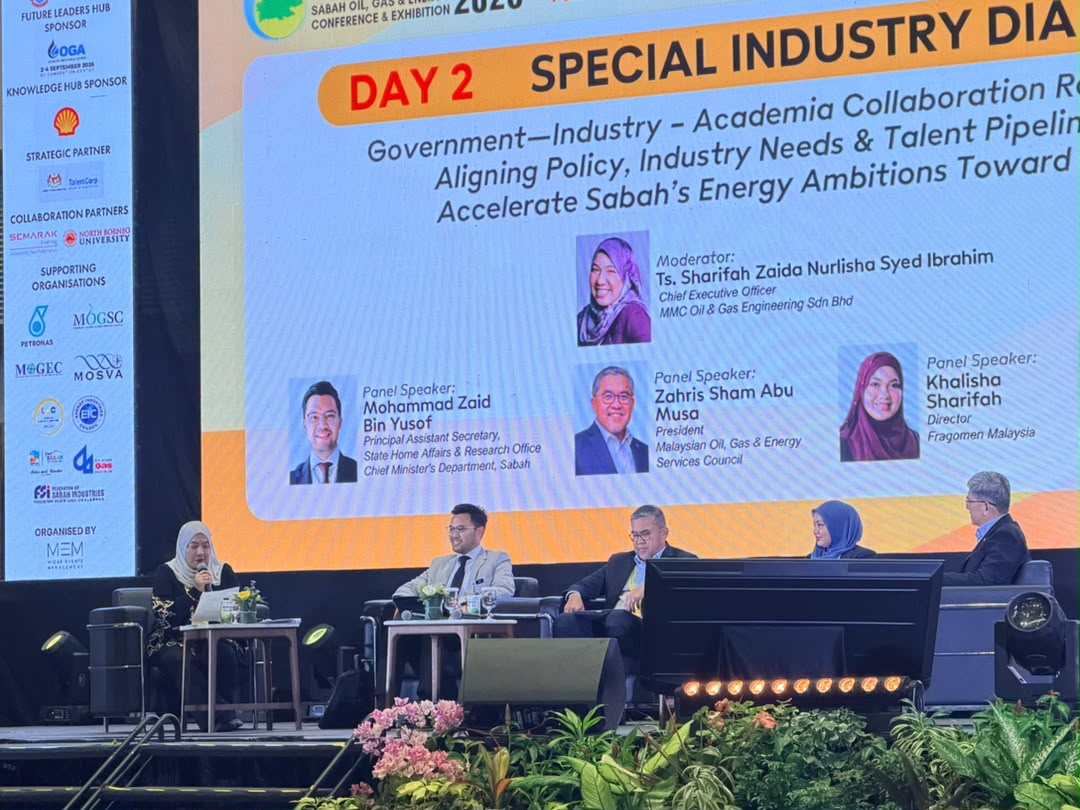
Kota Kinabalu: Sabah’s long-term energy ambitions under the Sabah Energy Roadmap and Master Plan 2040 (SE-RAMP 2040) will depend on execution discipline, talent development and stronger alignment between government, industry and academia.
The special industry dialogue, titled Government-Industry-Academia Collaboration Roundtable: Aligning Policy, Industry Needs & Talent Pipelines to Accelerate Sabah’s Energy Ambitions Toward 2040, was moderated by MMC Oil & Gas Engineering Sdn Bhd CEO Sharifah Zaida Nurlisha Syed Ibrahim.
.jpg)
State Home Affairs and Research Office (Chief Minister’s Department) Principal Assistant Secretary Mohd Zaid Yusof, said Sabah’s policy framework is designed to balance investment facilitation with safeguarding local employment through immigration and labour control mechanisms.
He said the State’s approach is grounded in constitutional provisions that prioritise Sabahans in the labour market where suitable local talent is available.
“For as long as there is unemployment, there should not be a work pass issued to anyone, so that is the fundamental of why we are safeguarding these areas,” he said during a panel discussion at the 13th Sabah Oil, Gas and Energy Conference and Exhibition (SOGCE), here, recently.
Mohd Zaid said efficiency in inter-agency coordination is essential to avoid delays that can affect investment and project delivery.
He emphasised that administrative speed is a key factor for industry competitiveness, saying “Time is money”.
He said Sabah has benchmarked work pass processing at around 14 working days and continues to pursue further improvements through digitalisation and closer collaboration between agencies.
Mohd Zaid also said the State Government is strengthening its workforce development ecosystem through Pomigas (Petroleum, Oil and Gas Information Management and Application System).
Pomigas is an online talent and industry matching platform developed in collaboration with Petronas to build a structured database of skilled Sabahans, connect employers with local talent and align training institutions with industry demand for the oil, gas and energy sectors.
He said the platform is part of wider efforts to improve upskilling and ensure more Sabahans are prepared for technical and professional roles in the sector.
.jpg)
Malaysian Oil, Gas and Energy Services Council (MOGSC) President Zahris Sham Abu Musa said the success of SE-RAMP 2040 will ultimately depend on consistent execution and strong stakeholder alignment throughout its 15-year implementation period.
“At the end of the day, it all depends on the execution and the alignment of the stakeholders,” he said, adding that policy continuity is critical regardless of changes in government.
Zahris said Sabah has the necessary resources and technology to advance its energy agenda, but stressed that implementation gaps and coordination challenges could limit outcomes.
He proposed a model linking work pass approvals to companies’ commitments to develop Sabahan talent, where firms would be assessed based on structured programmes to train and promote local workers.
.jpg)
Technological Association of Malaysia President Tung Chee Kuan said talent remains the most critical enabler of Sabah’s energy transformation, warning that infrastructure and investment alone are insufficient without a skilled workforce.
“You can have everything, but if your talent is not there, everything is just nothing,” he said.
He said future industry needs will require cross-disciplinary capabilities combining engineering, artificial intelligence, digital systems, sustainability, project management and commercial skills, driven by rapid technological change.
Tung said the shift away from traditional silo-based engineering is already underway, making curriculum reform and stronger Stem and TVET participation urgent priorities.
.jpg)
Fragomen Malaysia Director Khalisha Sharifah, speaking from an immigration advisory and workforce mobility perspective, said efficient talent movement is increasingly a key consideration for investors in the energy sector.
She said companies frequently raise concerns over processing times for work passes, particularly for urgent deployment of technical specialists.
While acknowledging Sabah’s safeguards to protect local employment, she suggested exploring simplified mechanisms to facilitate mobility for West Malaysians and Sarawakians working in Sabah, alongside protections for Sabah workers.
“We’re still Malaysian,” she said, highlighting the importance of enabling domestic knowledge transfer and technical collaboration.
Khalisha also proposed a fast-track approval pathway for urgent and critical technical roles, similar to arrangements in other parts of Malaysia where qualifying applications can be processed within three to five working days.
In response, Mohd Zaid said Sabah’s immigration safeguards remain anchored in its legal framework, but the State Government is committed to continuous improvement through closer collaboration with industry, academia and federal agencies.
He said initiatives such as Pomigas reflect ongoing efforts to strengthen talent matching, improve workforce planning and reduce inefficiencies, while maintaining regulatory oversight and supporting long-term investment growth.
Mohd Zaid Sabah’s approach seeks to balance protection of local employment with the need to remain competitive and attractive to investors in the energy sector.