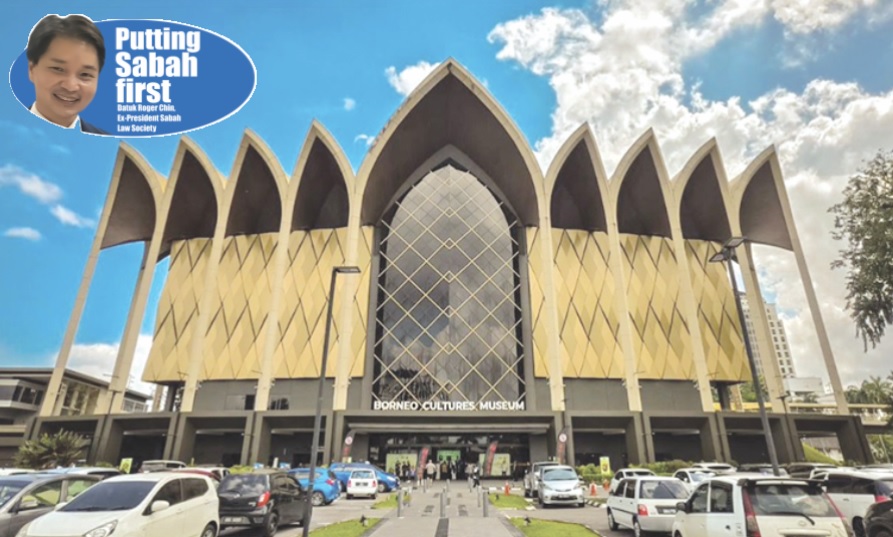
RECENTLY, I found myself wondering why Sarawak was willing to spend so much money on a museum.
At first glance, it seems like an unusual priority. Most governments confronting development challenges would naturally focus on roads, ports, airports, water supply systems, power generation, industrial parks, digital connectivity, and investment promotion.
Advertisement

These are the things that create jobs, facilitate economic activity, and produce measurable economic returns. A museum, by comparison, appears to occupy a much lower place on the hierarchy of development priorities.
Yet the more I reflected upon it, the more I came to the conclusion that the Borneo Cultures Museum in Kuching may be one of the most important development projects undertaken in Borneo over the past decade.
Not because it is a museum, and not because it is an impressive building, but because it reveals something important about how Sarawak appears to understand development. The museum reflects an appreciation that successful societies are not built solely through physical infrastructure.
They are also built through institutions that preserve memory, strengthen identity, cultivate belonging, and remind people that they are part of a larger story.
Benedict Anderson and the Building of Communities
That observation brought to mind the work of Benedict Anderson and his influential book Imagined Communities. Anderson argued that nations and communities are held together not merely by geography, political boundaries, or economic interests, but by a shared belief among people that they belong to the same collective story.
Most members of a society will never meet one another. They will never know one another personally and will often have very different experiences, backgrounds, and aspirations.
Yet they continue to regard themselves as part of the same community because they share common institutions, common symbols, common histories, and common aspirations about the future.
The phrase “imagined community” is often misunderstood because it suggests something fictional or artificial. Anderson’s point was quite the opposite. He was attempting to explain how communities are created and sustained across vast populations whose members will never know one another personally.
The bonds that hold societies together do not emerge automatically from geography, nor do they emerge automatically from economic growth.
They are cultivated over time through education, culture, public institutions, shared experiences, collective memory, and the stories that societies tell about themselves. In other words, communities do not simply exist. They are built, maintained, strengthened, and renewed across generations.
When viewed through this lens, many of Sarawak’s recent initiatives begin to make far more sense. The Borneo Cultures Museum is not simply a repository of artefacts.
It is an investment in memory and identity. It is a declaration that the stories, cultures, languages, and traditions of Sarawak deserve to be collected, preserved, and passed on to future generations.
The Sarawak Playbook
What strikes me about Sarawak is not any single project or initiative. Rather, it is the pattern that emerges when those initiatives are viewed collectively.
The museum is one example. Efforts to preserve indigenous cultures are another. The continued emphasis on Sarawak’s history and heritage is another.
Discussions about major cultural and performing arts institutions form part of the same pattern.
Considered individually, each initiative may appear relatively modest. Considered collectively, however, they suggest that Sarawak is engaged in a long-term project of community building.
The objective is not simply to preserve artefacts or celebrate traditions. The objective appears to be ensuring that future generations of Sarawakians possess a clear understanding of who they are, where they came from, and what binds them together despite their differences.
The significance of this extends far beyond culture. Societies with a strong sense of identity are generally better able to retain talent, encourage civic participation, sustain public institutions, and pursue long-term goals because people are naturally more willing to invest themselves in a place when they feel that they belong to it.
Confidence, after all, does not emerge solely from economic growth. It emerges when a society develops a clear understanding of who it is and where it wishes to go.
This is where I believe Sarawak has grasped something that Sabah has not yet fully appreciated. Sarawak appears to understand that communities do not build themselves.
The significance of this becomes clearer when one considers how often Sabah’s development debates focus almost exclusively on physical infrastructure.
We rightly discuss roads, electricity, water supply, ports, airports, industrial parks, and investment because these are essential foundations of economic growth.
Yet far less attention is devoted to the institutions that create belonging, civic pride, and a shared sense of purpose.
As a result, we often find ourselves discussing the symptoms of social fragmentation without examining whether we have invested sufficiently in the infrastructure that holds communities together.
The Assumption Sabah Has Made
Sabah, by contrast, appears to have made a different assumption. For many years, we have largely assumed that a strong Sabahan identity would emerge naturally from our history, geography, diversity, and shared experiences.
We have assumed that because Sabah exists as a political entity, a strong sense of community would inevitably follow. Yet history rarely works that way.
Communities require maintenance. They require institutions. They require investment. They require public spaces, cultural symbols, and shared experiences that continually reinforce the idea that despite our many differences, we remain part of the same collective project.
This is not to suggest that Sabah lacks identity. Far from it. Sabah possesses one of the richest cultural landscapes in Southeast Asia.
Our indigenous traditions, languages, histories, and diversity provide foundations that many societies would envy. The question is not whether those foundations exist.
The more important question is whether we have invested sufficiently in the institutions that transform those foundations into a stronger and more cohesive Sabahan identity.
The Problem Beneath Many Other Problems
The more I reflect on Sabah’s challenges, the more I suspect that many of the issues we discuss separately may actually be connected. We often debate brain drain, talent retention, civic participation, tourism branding, youth engagement, public confidence in institutions, and the challenge of creating a stronger international profile for Sabah as though they are entirely separate problems requiring entirely separate solutions. Yet there are times when I wonder whether they may all stem, at least in part, from the same underlying issue.
A society that possesses a strong and confident identity finds it easier to persuade its people that they are participating in a collective project worth investing in. A society that lacks that confidence often struggles to inspire the same level of commitment.
Fifty years ago, Sabah had fewer resources, less infrastructure, fewer economic opportunities, and far less wealth than it does today.
Yet many Sabahans would probably argue that there was a stronger sense of collective identity and common purpose than exists today. If that observation is even partially correct, then it suggests that community is not something that automatically strengthens as societies become more prosperous.
Like roads, schools, and public institutions, it must be maintained, renewed, and deliberately invested in. Otherwise, prosperity may continue to grow while the bonds that hold a society together gradually weaken.
Perhaps this helps explain why so many of our brightest young people leave and never return. Perhaps it helps explain why civic participation often appears weaker than it should be.
Perhaps it helps explain why Sabah, despite possessing extraordinary natural and cultural assets, sometimes struggles to project a clear identity to the outside world. These may not be entirely separate problems.
They may simply be different manifestations of the same challenge, namely whether Sabah has invested enough in building and sustaining a strong sense of community.
The Waterfront Opportunity
This is why debates about places such as the Kota Kinabalu waterfront are far more important than they first appear.
Every generation inherits a limited number of opportunities to shape how future generations will perceive their home, and once those opportunities have passed, they are seldom recovered.
The waterfront represents one of those opportunities because it remains among the most visible and strategically important public spaces in Sabah.
Decisions made there will influence not only the physical appearance of Kota Kinabalu but also the story that future generations inherit about who we were and what we considered important.
There is nothing wrong with commercial development. Shopping centres, office towers, hotels, and mixed-use projects all have legitimate roles to play in a growing economy.
However, cities are rarely remembered because they built one more shopping complex or generated a slightly higher rental yield from a prime piece of land. They are remembered for the institutions, landmarks, and public spaces that express who they are.
Fifty years from now, very few people will remember which development generated the highest commercial return in 2026. Future generations will, however, remember whether this generation possessed the imagination to create something that became part of Sabah’s identity.
For this reason, I have long believed that Sabah should think far more ambitiously about cultural infrastructure. A world-class performing arts centre overlooking the sea would not simply be another building.
It would create a permanent home for Sabahan music, theatre, dance, literature, indigenous traditions, and contemporary creative expression.
It would provide a platform through which Sabah could tell its story to itself and to the world. More importantly, it would create a space where Sabahans from every district and every background could encounter a shared narrative and develop a stronger sense of belonging to a common community.
Building More Than an Economy
Perhaps this is the lesson that Sarawak’s experience ultimately offers. The lesson is not that Sabah should copy Sarawak. Every society must find its own path, and every society must build institutions that reflect its own history and circumstances.
Nor is the lesson that museums, performing arts centres, and cultural institutions are somehow more important than roads, schools, hospitals, utilities, or economic development.
The real lesson is that these things are not competing priorities. Physical infrastructure creates the conditions for prosperity, while identity creates the conditions for community.
One enables people to move, trade, work, and build businesses. The other gives them reasons to care about the place in which they do those things.
The strongest societies understand that both forms of infrastructure matter and that neither can fully substitute for the other.
As Sabah continues to pursue economic growth, improve infrastructure, attract investment, and create opportunities for future generations, we should certainly continue those efforts.
However, we should also ask whether we are devoting sufficient attention to the infrastructure of community itself. We should ask whether we are investing enough in the institutions that build belonging, confidence, civic pride, and a shared sense of purpose. We should ask whether we are paying enough attention to the idea of Sabah itself.
Perhaps the greatest mistake Sabah has made over the past several decades is assuming that economic development alone would be sufficient to sustain a strong sense of community.
Economic growth undoubtedly improves living standards and expands opportunities, but it does not automatically strengthen the bonds that connect people to one another or to the place they call home.
Those bonds require their own forms of investment through culture, education, public institutions, shared spaces, and the preservation of collective memory. Without such investment, a society may become wealthier and more developed while simultaneously becoming less connected to itself.
The Borneo Cultures Museum matters not because it is a museum, but because it reflects an understanding that communities, like economies, require investment if they are to flourish.
Sarawak appears to have recognised that identity is not something that automatically emerges from development. It is something that must be cultivated alongside development. If there is one lesson Sabah should take from that experience, it is that communities do not build themselves.
They must be nurtured, strengthened, renewed, and invested in by every generation. The societies that understand this often discover that the greatest infrastructure they ever built was not a road, a bridge, or a building, but a community that believed in itself and was prepared to build its future together.
The views expressed here are the views of the writer and do not necessarily reflect those of the Daily Express. If you have something to share, write to us at: [email protected]