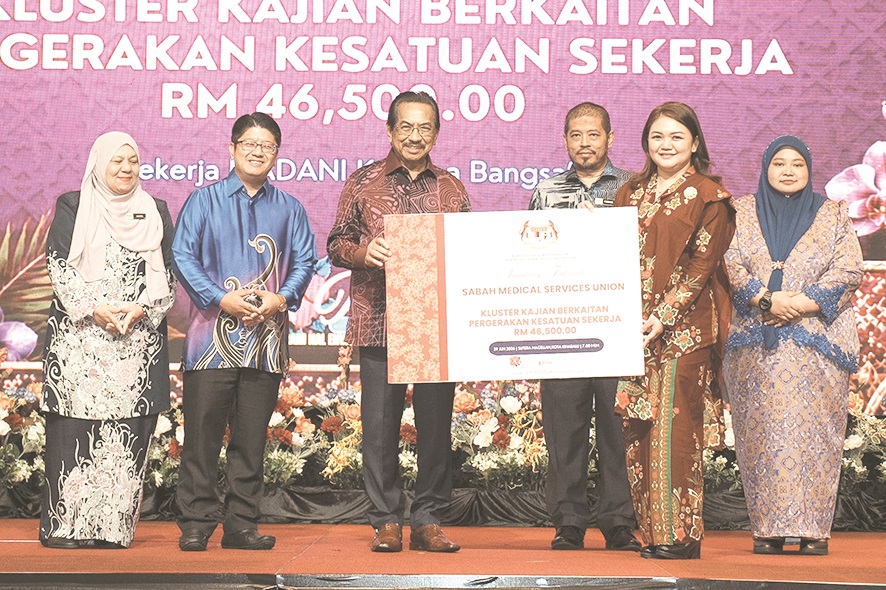
Kota Kinabalu: A total of 38 trade unions in Sabah received RM310,000 in grants under the 2026 Trade Union Affairs Programme (PHEKS), aimed at strengthening organisational governance, leadership development and skills enhancement among union members in line with the Sabah Maju Jaya (SMJ) 2.0 development agenda.
The grant presentation ceremony was officiated by Sabah Head of State Tun Datuk Seri Panglima (Dr.) Musa Haji Aman.
Chief Minister Datuk Seri Hajiji Mohd Noor said the grants reflected the government’s commitment to developing a skilled, productive and competitive workforce capable of meeting the demands of Sabah’s growing economy
(pic).
He said strengthening human capital through skills training, reskilling and Technical and Vocational Education and Training (TVET) was essential to prepare Sabahans for high-value employment opportunities created through new investments and the growth of strategic industries.
“The state government remains committed to ensuring Sabahans are equipped to fill quality jobs created through new investments and the expansion of strategic economic sectors, while producing more engineers, technologists, skilled technicians, data scientists, artificial intelligence (AI) specialists and industry leaders,” he said.
His speech was delivered by Deputy Chief Minister and Minister of Industrial Development and Entrepreneurship, Datuk Ewon Benedick. Hajiji said the rapidly evolving employment landscape required trade unions to embrace digitalisation, support workforce upskilling initiatives and comply with international standards to remain relevant.
He said the human capital agenda was central to SMJ 2.0, which places TVET at the forefront of workforce development for key sectors including energy, oil and gas, the blue economy, tourism, advanced manufacturing and green technology.
“TVET is no longer an alternative pathway. It has become an essential avenue for preparing the skilled workforce required by future industries,” he said. Hajiji said the Madani Government had allocated RM6.1 million for the nationwide implementation of PHEKS this year, with RM310,000 channelled to 38 trade unions in Sabah.
He urged recipients to utilise the grants responsibly to strengthen organisational management, enhance members’
competencies and implement programmes that would deliver long-term benefits to workers.
He also stressed that technological advances, automation and artificial intelligence were reshaping the world of work, making continuous learning and skills upgrading increasingly important for the workforce.
Meanwhile, Hajiji said the government has always recognised the important role of trade unions as a bridge connecting the aspirations of workers, employers and the government, while serving as one of the catalysts for stable industrial relations and boosting investor confidence.
He said such collaboration would help boost productivity, strengthen investor confidence and support Sabah’s long-term economic growth.
Hajiji expressed his gratitude to workers across various sectors, describing them as the backbone of the state’s development, and reaffirmed the government’s commitment to prioritising local talent development under the SMJ 2.0 roadmap.
The 2026 PHEKS grants will finance programmes focused on strengthening governance, leadership development and skills enhancement among trade union members.