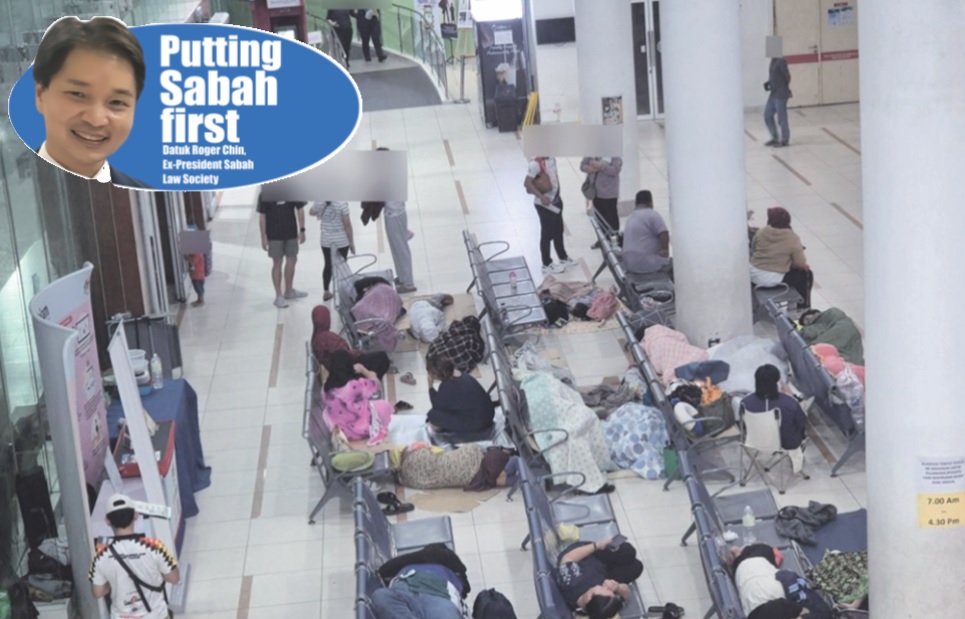
SOME of the most heartbreaking photographs to emerge from Queen Elizabeth Hospital did not show doctors saving lives or nurses rushing between beds. They showed families — elderly spouses sleeping on the floor, relatives resting on benches, and children waiting through the night because they had nowhere else to go while standing by their loved ones.
Those images quickly spread across social media, prompting frustration, sympathy and criticism in equal measure. They painted the picture of a healthcare system under enormous pressure and naturally led many Sabahans to ask whether our hospitals simply needed to be bigger.
Advertisement

To its credit, the Sabah Health Department responded swiftly and candidly. It explained that patients in the Emergency and Trauma Department are treated according to medical urgency under the triage system rather than by queue numbers, and that many of those seen resting in the hospital were not patients at all, but family members and caregivers who had travelled long distances from the Interior and other parts of Sabah because they simply could not afford repeated journeys home.
Those explanations deserved to be heard because they provided context that the photographs alone could not convey.
Yet while they answered many immediate questions, they also pointed towards a much larger one – are we asking the right question in the first place?
Perhaps We Have Been Looking at the Wrong End of the Problem
Whenever hospitals become congested, the instinctive response is entirely understandable. We call for more beds, more wards, more doctors, more nurses and larger hospitals. Sabah undoubtedly needs all of these, and the planned expansion of Queen Elizabeth Hospital is therefore both timely and necessary.
However, infrastructure alone cannot solve a problem that extends beyond the hospital itself.
Hospital congestion is not created only because patients arrive.
It is also created because too many patients return after they have left.
Hospitals are designed to provide acute care, not long-term recovery. When acute-care beds become occupied by patients who could safely be managed elsewhere with appropriate support, the entire healthcare system becomes less efficient.
That distinction changes the way we should think about healthcare. A hospital is not simply a place where patients are admitted and treated. It is one part of a much longer continuum of care that begins long before admission and continues long after discharge. If that continuum breaks down once patients leave hospital, the consequences inevitably return to the hospital itself.
None of this diminishes the extraordinary work performed every day by our doctors, nurses and allied healthcare professionals. On the contrary, reducing avoidable readmissions would allow them to devote more time, attention and resources to patients whose conditions genuinely require hospital care. Supporting patients after discharge is therefore not an alternative to strengthening hospitals; it is one way of making hospitals work even better.
The Forgotten Journey Between Hospital and Home
For many patients, particularly the elderly, those recovering from strokes, individuals living with chronic illnesses, and those who are frail or bed-bound, leaving hospital does not mean they are well. It simply means they are well enough to continue recovering elsewhere.
That “elsewhere” is usually the family home.
It is there that husbands, wives, sons, daughters and siblings suddenly become wound-care nurses, physiotherapists, medication supervisors and full-time caregivers, often without training, experience or sufficient support. They must learn how to prevent pressure injuries, administer medication correctly, manage catheters, care for feeding tubes, assist with mobility and recognise the early signs that something is going wrong.
Many families rise magnificently to this challenge. Others struggle, not because they lack love or commitment, but because they have been asked to perform tasks that would challenge even trained healthcare professionals.
This challenge is particularly acute in Sabah. Many patients return not to neighbourhoods located minutes from a hospital, but to rural communities and Interior districts where transport is more difficult, access to follow-up care is limited and family members often shoulder caregiving responsibilities with few available support services.
When complications develop, the outcome is painfully familiar. Wounds become infected. Pressure sores worsen. Medications are missed. Caregivers become exhausted. Conditions deteriorate until another visit to the Emergency Department becomes unavoidable.
Perhaps the greatest opportunity lies with patients who are already known to be at the highest risk of readmission — the bed-bound, immobile and medically frail. These are often the very patients who occupy hospital beds for prolonged periods, are repeatedly brought back to the Emergency Department when problems arise at home, and consume significant hospital resources through entirely predictable cycles of deterioration and readmission. Preventing even a proportion of these avoidable readmissions would immediately ease pressure on emergency departments and inpatient wards while delivering better outcomes for patients and their families.
The hospital becomes crowded once again, not because the first treatment failed, but because recovery after discharge was never adequately supported.
Modern Healthcare Does Not End at the Hospital Door
Healthcare systems across the world have increasingly recognised that hospitals cannot solve these challenges alone. Countries such as Singapore, Australia and the United Kingdom have invested in transitional care, community nursing and hospital-at-home programmes because they understand a simple but powerful principle: hospitals exist to treat acute illness, but recovery often happens far more effectively at home when appropriate clinical support continues after discharge.
This approach is not about replacing hospitals, nor is it about shifting responsibility onto families. It is about ensuring that the right care is delivered in the right place at the right time. Patients benefit because they recover in familiar surroundings. Families benefit because they receive guidance and professional support. Hospitals benefit because beds become available more quickly for those who genuinely require acute care. Society benefits because scarce healthcare resources are used more effectively.
There is also a compelling economic argument. Every preventable hospital readmission consumes precious medical resources, extends waiting times and increases healthcare expenditure. By contrast, timely intervention in a patient’s home is often considerably less costly than another hospital admission. Better patient outcomes and better stewardship of public resources are therefore not competing objectives; they reinforce one another.
A Sabah Proposal Worth Serious Consideration
Encouragingly, Sabah does not need to begin this conversation from scratch. One Sabah-based provider, Blue Swan Home Care, has developed a proposal for a structured transitional home care pathway that seeks to complement, rather than replace, the public healthcare system.
The proposal envisages coordinated post-discharge support that may include doctor and nurse home visits, wound and pressure sore management, medication supervision, catheter and PEG care, mobility assistance, caregiver education and ongoing clinical monitoring for patients who face the greatest risk of avoidable readmission.
Importantly, it does not propose universal government-funded home care. Instead, it suggests a two-track model comprising a private-pay pathway for families who are able to fund such services themselves, together with a carefully targeted pilot programme for selected B40 and high-risk patients where the potential public benefit is greatest.
The proposal is particularly compelling because it focuses on precisely the group of patients where the greatest gains are likely to be achieved. It is not intended for every patient discharged from hospital. Rather, it concentrates on those who are bed-bound, immobile or medically complex, where timely intervention at home has the greatest potential to prevent avoidable deterioration, unnecessary ambulance transfers and repeat hospital admissions.
Equally significant is the proposal’s emphasis on evidence rather than aspiration. It recommends evaluating measurable outcomes such as hospital readmission rates, emergency department returns, wound healing, pressure injury outcomes, hospital bed-days avoided and caregiver satisfaction before any decision is made about broader implementation. That is precisely how sound public policy should be developed.
Whether this proposal ultimately becomes the preferred model is, of course, a matter for policymakers and healthcare professionals. What is beyond dispute, however, is that it addresses an aspect of healthcare that deserves far greater attention than it has received.
While structured transitional home care remains relatively new in Sabah, it is by no means a new concept internationally. More developed healthcare systems, including those in Australia, have increasingly recognised that caring for suitable patients safely at home after discharge is not simply good medicine; it is an essential part of managing hospital capacity.
Sabah now has the rare advantage of having a home-grown proposal developed locally, by people who understand our healthcare landscape and the unique challenges of serving urban centres, rural communities and the Interior. Rather than waiting years for others to show the way, Sabah has an opportunity to leapfrog traditional models of care, pioneer a practical transitional home care pathway and position itself as a leader for the rest of Malaysia.
A Pilot Programme Could Provide the Answers
To be clear, transitional home care is not a substitute for continued investment in public hospitals. Sabah still needs additional beds, more doctors, more nurses, upgraded facilities and better infrastructure.
The question is therefore not whether we should continue investing in hospitals. We should.
The real question is whether we can also reduce the number of patients who unnecessarily return to them.
Not every important healthcare reform requires billions of ringgit or years of construction. Some of the most meaningful improvements begin with carefully designed pilot programmes that allow policymakers to test an idea, measure its impact and expand it only if the evidence justifies doing so.
A transitional home care pilot involving carefully selected high-risk patients would allow Sabah to determine whether structured post-discharge support can reduce avoidable readmissions, improve patient outcomes and ease pressure on hospital resources.
If successful, the programme could be expanded progressively. If it proves less effective than anticipated, valuable lessons will nevertheless have been learned. Either outcome would represent evidence-based policymaking at its best.
The Missing Link
The recent events at Queen Elizabeth Hospital reminded Sabah of the extraordinary dedication of our healthcare professionals and the unwavering devotion of families who remain beside their loved ones through long and difficult nights.
They also reminded us of something even more fundamental. Healthcare should never be measured solely by what happens inside a hospital. It should also be measured by what happens after a patient leaves it.
Queen Elizabeth Hospital undoubtedly needs more beds. Sabah undoubtedly needs more doctors, nurses and better facilities. But if we truly wish to reduce congestion, we must also ensure that patients do not leave hospital only to return a few days later because the support they needed at home was never there.
Every day that a frail, bed-bound or immobile patient is able to recover safely at home instead of returning to the Emergency Department is not merely a victory for that family. It is one more hospital bed available for the next patient whose condition genuinely requires acute hospital care. That is how stronger hospitals are built—not only by adding more beds, but by ensuring fewer patients need to return to them.
Sabah has never been afraid to lead. If we already have a home-grown solution to one of our most pressing healthcare challenges, perhaps the time has come not simply to adopt it, but to show the rest of Malaysia what is possible.
The views expressed here are the views of the writer and do not necessarily reflect those of the Daily Express. If you have something to share, write to us at: [email protected]