EVERY time Sabahan-born Delon Lee returns home, he notices another change to Kota Kinabalu’s skyline.
After spending more than 18 years building a career outside Sabah, Lee has returned to the State between two and five times a year over the past 12 years. Watching the city evolve from afar has given him a unique perspective – one that combines a Sabahan’s affection for home with the analytical eye of a data and artificial intelligence specialist.
“What strikes me most isn’t simply the economic growth,” he said.
“It’s the sheer number of shopping malls that have appeared across Kota Kinabalu.”
Growing up in the 1990s and early 2000s, Lee recalled that shopping in Kota Kinabalu revolved around familiar landmarks like Wisma Merdeka and Centre Point Sabah.
“Today, there are dozens of gleaming shopping complexes – from Imago Shopping Mall to Suria Sabah – all competing for the same shoppers.
Advertisement

“As a Sabahan looking at these changes from both inside and outside the state’s economy, I can’t help asking whether this expansion represents genuine prosperity or whether we’re beginning to see an unsustainable retail glut that could eventually threaten the health of our retail sector.”
The question, he said, has become increasingly relevant not only for retailers but also urban planners, investors and policymakers as Sabah continues to modernise.
Lee, who is the Data & AI Practice Lead, APAC at Huawei Technologies Ltd, believes the answer is far more complex than simply counting the number of malls.
“We first need to understand what retail oversupply actually means,” he said.
“Retail oversupply happens when the amount of retail space significantly exceeds the consumer demand needed to sustain it profitably. That’s when you begin seeing higher vacancy rates, falling rental yields and frequent tenant turnover.”
Yet Sabah, he stressed, presents a much more nuanced picture.
“Looking only at the number of malls can be misleading.”
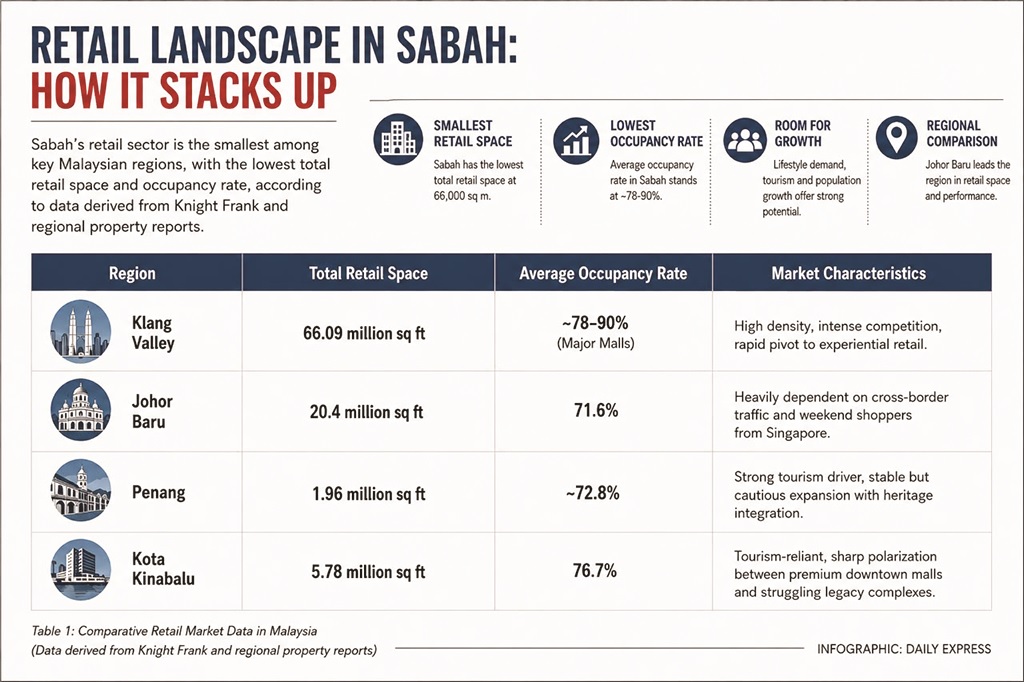
According to Knight Frank Malaysia, Kota Kinabalu had approximately 5.78 million square feet of retail space at the end of 2021, with an average occupancy rate of around 76.7 per cent.
“On paper, those figures don’t immediately suggest a crisis,” Lee said.
“But averages often hide what’s really happening underneath.”
A tale of two retail worlds
Rather than a market collapsing under too many shopping centres, Lee believes Sabah is witnessing a widening gap between malls that have successfully reinvented themselves and those still operating on business models developed decades ago.
“If you look at malls like Imago and Suria Sabah, they’re performing very well, with occupancy rates estimated at between 80 and 90 per cent.
“Why? Because they aren’t simply places where people go to buy something anymore.”
Instead, he said, they have become destinations.
“People visit them for dining, entertainment, social interaction and experiences that simply can’t be replicated online.”
He pointed to Imago’s efforts to incorporate Sabahan culture through traditional Magunatip bamboo dance performances that welcome visitors, while Suria Sabah capitalises on its waterfront location and panoramic sea.
“These malls understand that today’s consumers don’t just spend money. They spend time.”
That philosophy, he said, represents one of the biggest changes taking place in retail worldwide.

By comparison, many older shopping centres continue serving customers through a largely transactional model.
“Centre Point Sabah was once the heart of shopping in Kota Kinabalu. Today it remains relevant, but its role has changed considerably.”
The mall has gradually evolved into a centre for affordable fashion, mobile phone retailers and local businesses after many premium brands migrated elsewhere.
Likewise, Wisma Merdeka continues attracting loyal customers through money changers, textile shops, tailoring services and specialty retailers.
“These malls still serve an important purpose,” Lee said.
“But they were built for a generation of consumers whose shopping habits were very different.”
He believes the issue facing Sabah is therefore not simply one of oversupply.
“It’s an oversupply of a particular type of retail space.
“We have plenty of traditional transactional retail, but demand remains strong for lifestyle-oriented, experience-driven and tourist-friendly destinations.”
Tourism changes everything
Unlike many cities in Peninsular Malaysia, Kota Kinabalu’s retail economy cannot be viewed independently of tourism.
“Tourism fundamentally changes the equation.”
Visitors shop differently from residents.
“They’re looking for local products, authentic experiences, memorable dining and places that reflect Sabah’s identity.”
That explains why malls situated in strategic tourist locations continue enjoying relatively healthy visitor numbers.
“When international tourism stopped during the pandemic, we saw just how dependent many retailers were on visitor spending.
“It reminded us that Sabah’s retail market isn’t driven solely by local purchasing power.”
Instead, he said, tourism has become one of the industry’s most important economic pillars.
“This is why I don’t think we should simply ask whether Sabah has too many malls.
“We should be asking whether we’re creating the kinds of retail environments that both locals and tourists actually want.”
When more malls don’t mean more growth
While shopping mall developments often symbolise economic progress, Lee cautioned that continued expansion eventually reaches a point where it produces diminishing returns.
“The construction of a new shopping mall undoubtedly creates jobs, attracts investment and stimulates economic activity.
“But once the market becomes saturated, the dynamics begin changing.”
Instead of creating entirely new spending, additional malls begin competing for the same customers.
“Rather than expanding the economic pie, everyone starts fighting over the same slice.”
The result is retail cannibalisation.
“Foot traffic shifts from one mall to another. Sales move rather than grow. Profit margins become thinner across the entire market.”
That, Lee said, is precisely why vacancy rates begin rising in underperforming developments.
“If enough tenants leave, you risk creating what many economists refer to as ‘zombie malls’ – large buildings that remain open but are significantly underutilised.”
Such properties continue incurring substantial operating costs despite attracting fewer shoppers.
“The longer this continues, the more difficult it becomes for owners to maintain the asset, and eventually surrounding property values can also be affected.”
Lee believes there is another consequence that receives far less attention.
“It’s also about opportunity cost.”
Money invested in redundant retail developments could potentially have been channelled into industries capable of generating stronger long-term economic returns.
“For Sabah, that might mean infrastructure, technology, sustainable tourism, digital industries or innovation hubs.
“Those sectors arguably create greater economic resilience than another conventional shopping mall.”
Investors are already looking elsewhere
Lee believes the investment community has already begun responding to changing consumer behaviour.
“Across Malaysia, we’re seeing increasing interest in industrial and logistics real estate.”
The rapid growth of e-commerce has significantly increased demand for warehouses, fulfilment centres and distribution facilities.
“From an investor’s perspective, logistics assets currently offer more predictable returns than speculative retail developments.”
As online shopping continues expanding, investors are becoming increasingly cautious about financing traditional mall projects.
“Banks also become more selective because they want stronger evidence that a project can sustain healthy occupancy before approving major financing.”
Rather than building another conventional shopping mall, Lee believes future developments should integrate multiple complementary functions.
“The projects most likely to succeed are mixed-use developments combining residential living, hotels, offices, co-working spaces and carefully curated retail.”
Shopping, he said, would become only one component within a much larger urban ecosystem.
If the first challenge facing Sabah’s retail industry is adapting to changing consumer expectations, the second – and perhaps even bigger – challenge is preparing for a future where artificial intelligence quietly shapes almost every aspect of the shopping experience.
For Lee, this transformation has already begun.
“As someone working in data and AI, I don’t see artificial intelligence as something that’s coming in the distant future,” he said.
“It’s already changing how people shop. The question is whether our malls are ready for it.” According to Lee, the traditional role of a shopping mall as a place where people simply browse stores and make purchases has fundamentally changed.
“Today’s customer journey rarely begins inside the mall.”
Instead, consumers often spend hours researching products online before stepping into a physical store.
“They compare prices, read reviews, watch videos and seek recommendations on social media.
“Sometimes they visit a shop only to see and touch the product before buying it online. Other times, they research online first and then come into the store to make the purchase.
“The digital and physical worlds are no longer separate—they’re becoming one seamless experience.”
That shift, he said, means successful malls can no longer think of themselves as merely landlords renting out retail space.
“They have to become technology platforms as much as shopping destinations.”
Rise of intelligent malls
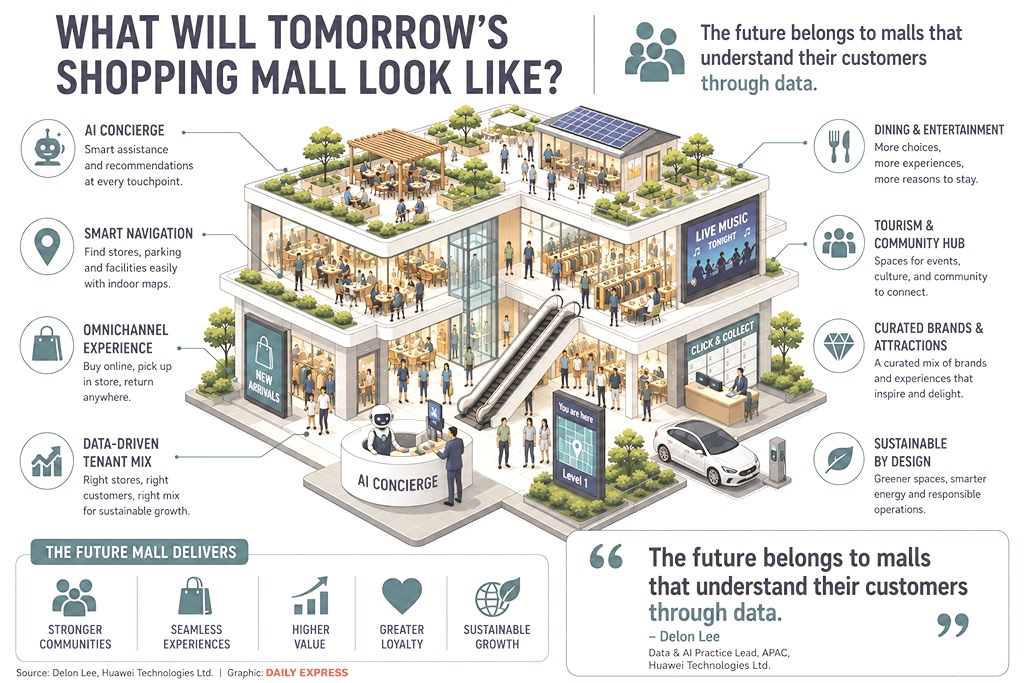
LEE believes the next three to five years will see Sabah’s leading malls evolve into intelligent retail ecosystems powered by data.
“The future isn’t about replacing people with AI.
“It’s about using AI to make the shopping experience more convenient, more personalised and more enjoyable.”
One of the biggest changes, he said, will be hyper-personalisation.
“Imagine walking into a shopping mall where, with your consent, the system already understands your shopping preferences through your loyalty membership and previous purchases.
“Instead of everyone receiving the same advertisements, each shopper receives recommendations that are relevant to them.”
A family looking for children’s clothing would receive different promotions from someone interested in outdoor equipment or luxury cosmetics.
“The experience becomes much more personal instead of one-size-fits-all.”
Lee believes such personalised engagement will become increasingly important as retailers compete not only with neighbouring malls but also with global e-commerce platforms.
“Online retailers already know what customers like.
“If physical malls want to remain competitive, they also need to understand their customers – not to invade privacy, but to improve the customer experience.”
AI behind the scenes
Artificial intelligence, Lee explained, will influence much more than marketing.
It will also transform how shopping malls are managed.
“In the past, leasing decisions were often based on experience, intuition or historical performance.”
In the future, he said, those decisions will increasingly be supported by predictive analytics.
“AI can analyse foot traffic patterns, consumer spending habits, tourism trends, demographic changes and even social media sentiment.”
Instead of guessing which brands should occupy prime retail space, mall operators will have access to evidence-based insights.
“They’ll know which categories are growing, what consumers are searching for and how visitor behaviour changes throughout the year.”
This allows malls to respond more quickly to changing market conditions.
“The tenant mix becomes dynamic rather than static.”
Lee said such insights could significantly reduce the risk of vacant shop lots while improving the overall shopping experience.
Helping tourists discover Sabah
For Sabah, where tourism remains one of the state’s strongest economic drivers, Lee believes AI could dramatically improve visitor experiences.
“Our tourists come from different countries, speak different languages and have different shopping interests.”
Artificial intelligence can bridge those differences.
“I can imagine multilingual AI shopping assistants helping visitors navigate malls, recommend restaurants, locate local handicrafts or suggest activities based on individual interests.”
Instead of relying solely on static directories, tourists could receive real-time recommendations tailored to their needs.
“A visitor from South Korea may be interested in completely different products compared with someone from Europe or Australia.
“AI allows those recommendations to become much more relevant.”
He also sees opportunities for Sabah to showcase its own identity more effectively.
“When tourists visit Sabah, they’re not necessarily looking for another international shopping experience they could find anywhere else.
“They’re looking for something uniquely Sabahan.”
Technology, he said, should complement rather than replace local culture.
“Imagine an AI assistant recommending authentic handicrafts made by local artisans, directing visitors to cultural exhibitions or introducing them to Sabahan cuisine.
“That’s where AI becomes a tool for promoting our local identity rather than replacing it.”
Blending online and offline shopping
Lee expects omnichannel retailing to become standard practice rather than an optional service.
“We’ll see much greater integration between physical stores and digital platforms.”
Services such as Buy Online, Pick Up In Store (BOPIS) are likely to become commonplace.
Consumers may purchase products online before collecting them at convenient locations within shopping centres.
Automated return kiosks could simplify exchanges, while digital showrooms allow customers to browse products that are not physically stocked.
“The physical store doesn’t disappear.
“It becomes part of a much larger customer journey.”
Retailers, he said, would be able to offer wider product selections without requiring significantly larger retail spaces.
Can older malls reinvent themselves?
The biggest challenge, however, may not be adopting new technology.
It may be reinventing ageing retail spaces built for another generation.
Lee believes legacy malls such as Centre Point Sabah and Wisma Merdeka still possess valuable strengths.
“They’re centrally located, they’re familiar to generations of Sabahans and they continue serving loyal customer bases.”
But survival, he said, will depend on adaptation.
“I think we’ll increasingly see adaptive reuse.”
Rather than relying solely on traditional retail, portions of older malls could be transformed into co-working spaces, educational centres, healthcare facilities, entertainment venues or logistics hubs supporting last-mile e-commerce delivery.
“The definition of a shopping mall is changing.”
Successful developments, he said, will focus less on selling products and more on creating reasons for people to gather.
“People can buy almost anything from their phones today.
“What they can’t download are experiences.”
Entertainment, wellness, food, community events and cultural activities will therefore occupy increasingly larger roles within shopping centres.
Building malls that reflect Sabah
Lee believes Sabah possesses one advantage that many cities cannot easily replicate – its culture.
“Our retail spaces should reflect who we are.”
Rather than copying shopping concepts from larger metropolitan cities, Sabah’s malls should embrace local heritage, indigenous culture, arts, crafts and eco-tourism experiences.
“That’s something online shopping can never replace.”
As a Sabahan returning home regularly over the past decade, Lee said he remains optimistic about the industry’s future.
“I don’t think the retail glut is a death sentence.
“I see it as a wake-up call.”
For developers, investors and policymakers, the challenge is no longer deciding whether to build more shopping malls.
The challenge, he said, is building better ones.
“The malls that survive over the next five years won’t necessarily be the biggest. They’ll be the smartest.”
“They’ll understand their customers through data, create experiences people genuinely value, embrace AI responsibly and celebrate what makes Sabah unique.
“If we can do that, our shopping malls won’t simply remain places to spend money.
“They’ll become vibrant community spaces that support tourism, strengthen local businesses and showcase the very best of Sabah.”
For Lee, that is the future worth investing in.


.png)