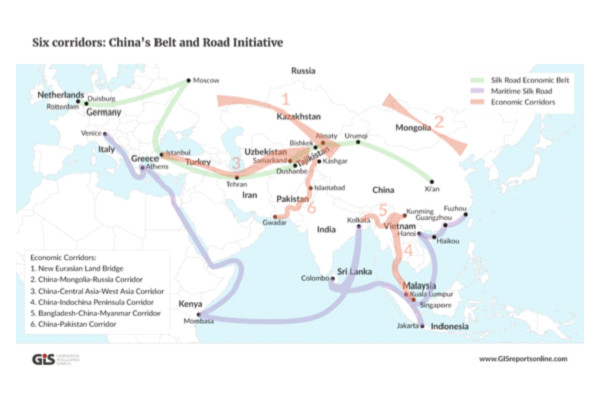
Kota Kinabalu: Malaysia and other Asean countries have taken the correct strategic position to be engaged in the Belt Road Initiative (BRI), says Malaysia Maritime Silk Road Research Society Advisor Datuk Yong Teck Lee.
He said the ongoing trade war between America and China is having an unprecedented major negative impact on the global economy.
Economists and analysts, he said are unanimous in their assessments that the trade war started by the US is hurting economies and ordinary people, including that of the US.
The crude way that the US, under the Trump administration, tore apart international agreements has shown to the rest of the world that American leadership is no longer reliable.
It is to be recalled that several Asian and Pacific countries, including Malaysia, were pressured by America to overcome domestic reservations to accept the US-led Trans-Pacific Partnership Agreement (TPPA) in 2016.
TPPA was a trade pact signed in 2016 between Australia, Brunei, Canada, Chile, Japan, Malaysia, Mexico, New Zealand, Peru, Singapore, Vietnam and the United States. After a new US President took office in 2017, the US unilaterally left the TPPA which, it must be remembered, was initiated and led by the US in the first place.
“This unpredictability of the US in world leadership was mentioned by the Prime Minister (Malaysia) as a reason for the not relying too much on American leadership.
“It is therefore timely that the One Belt, One Road policy initiative by China in 2013 at Kazakhstan and Jakarta has begun to bear fruits for the economies along the Belt Road regions.
“There is no other multi-national economic plan in sight that can stimulate the economies of so many countries,” said Yong in a statement.
He said the formation of the AIIB (Asian Infrastructure Investment Bank), a multilateral development bank, under the Belt Road Initiative is a practical and welcome mechanism to allow Asian countries to invest in their own infrastructure and productive economy. The AIIB consists of 97 countries, including most Asian countries, Canada, UK, Germany, Saudi Arabia, Australia, Russia with a portfolio of close to USD 100 trillion.
In spite of the relentless onslaught of western media campaign against the Belt Road concept, a closer look at the Belt Road initiative by the countries concerned have convinced these countries to stay with the Belt Road policy led by China.
The Philippines, for example, even though it is a close ally of America, trade and investment deals worth USD12.6 billion when the Philippines President, Rodrigo Duterte, was in Beijing for the Second Belt Road Forum last month initiated by the Chinese President, Xi Ji Ping.
In spite of the prevalence of the American news in the Philippines, Duterte has gained substantially in the Philippines mid-term elections this week.
Malaysia, too, managed to overcome earlier concerns that the good China-Malaysia relations might be affected by the issue of the East Coast Railway Link (ECRL) and other China investments in Malaysia. By the time of the Second Belt Road Forum, attended also by PM Tun Dr Mahathir Mohamad, the ECRL issue was settled successfully in a win-win manner.
It was reassuring to both Malaysians and China that the Prime Minister had declared Malaysia’s full support for the Belt Road Initiative.
The success of the Belt Road Summit in Beijing last month was the only global event that has injected energy into the economic growth of Asia, including South East Asia. Malaysia, which has seen its biggest fall in the stock market below the benchmark of 1,600 points and faced with ringgit depreciating, has taken the right path to forge closer economic ties with China.
There is no issue of debt trap in Malaysia’s economic ties to China.
“For instance, even at its earlier cost of RM65.5 billion, the cost of the ECRL is only 7 per cent of the total national external debt. This means that 93 per cent of the current national debt of RM924.9 billion has nothing to do with China or the Belt Road Initiative.
“Indeed, Bank Negara figures show that 55.5 per cent of Malaysia’s national debt is denominated in US dollars, 31.2 per cent in Ringgit, 2.2 per cent in Japanese Yen (excluding the RM7.3 billion in Samurai bonds) taken by Malaysia in March this year, and 11.3 per cent others,” he said.
He said the post-election support of the Belt Road initiative by the Malaysian government echoes the example of Sri Lanka which had a similar change of government in 2015.
winning party had also pledged to review China investment, particularly on the Hambantota international Port.
In some ways, Sri Lanka’s Hambantota port was like Malaysia’s ECRL – both were election issues and both were retained on a win-win basis with China by the newly elected government.
According to western media, Sri Lanka was not able to pay the China loan taken for the construction of the port and that China had seized the port with the motive to turn it into a naval base.
In fact, the newly elected Sri Lanka government not only found no improper elements in the construction and the financing package but that the port has been able to repay its loans from its container terminal business.
was reported that the loan for the port amounted to only 1.5pc of Sri Lanka’s external debt. Ownership never changed hands from Sri Lanka to China.
The oft repeated criticism of Belt Road policy is that it is a debt trap disguised as a loan to ensnare poor countries. The allegation is that China gives loans to poor countries to build infrastructure assets such as ports and railways.
When these countries cannot pay back the loan, China will seize the assets. This false narrative has been repeated so many times that some people have begun to fall for it.
“What are infrastructure loans? The worry is that government loans are a burden on future generations. However, infrastructure expenditure is capital expenditure. It is an investment on infrastructure that will create new wealth for more people by increasing the productive capacity and GDP of the nation. “The development of infrastructure such as highways, railways, sea ports, air ports, telecommunications, energy generation, water supply contribute towards uplifting the economy.
“It is apparent to all that wherever a highway was built, the areas on both sides of the highway became regions of economic activities. Shops, houses, recreation centres are built. Jobs are created. Poverty reduced. With accessibility, education, health care and social services became more readily available to the rural population. Basically, quality of life improved. This is what the Belt Road Initiative is all about,” he said.
Instead of seeing the noble side to this innovative Belt Road Initiative, the US Vice President chose to call the Belt Road as “constricting belt, one way road” at last November’s Apec (Asia Pacific Economic Conference) at Papua New Guinea.
It did not occur to the visiting US Vice President that at that Apec conference, the China President opened a China-funded new road and new school, both of which open up a bright future for more people of the poor nation. This is in contrast to the US President (who went to Vietnam to meet North Korean leader in February) who tried to sell arms to Vietnam.
Trump has notoriously said to his Vietnam host: “I appreciate the fact that you’re looking at our military equipment. We make the best military equipment in the world by far, whether its jet fighters or missiles or rockets or anything you want,” said Trump.
“It is therefore to be concluded that Malaysia and other Asead countries have taken the correct strategic position to be engaged in the Belt Road Initiative,” added Yong.