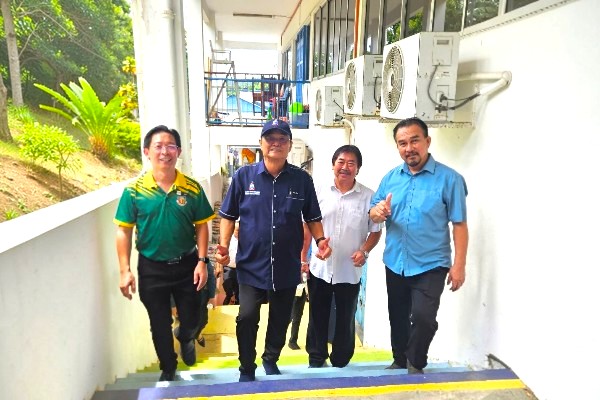
SANDAKAN: The State Government remains committed to improving education infrastructure, particularly at national-type Chinese schools, in line with the Sabah Maju Jaya agenda, Technical Advisor (Energy) to the Chief Minister, Datuk Jim Lim, said.
Speaking at the Santunan Ramah Mesra programme at SJK(C) Tai Tong on Saturday, he said the State Government had stepped up support for Chinese education under the leadership of Chief Minister Datuk Seri Hajiji Noor.
Jim said the allocation for non-Muslim religious bodies, mission schools, Chinese independent schools and national-type schools increased from RM70 million in 2025 to RM90 million this year.
He said the State also established a RM5 million Special UEC Scholarship Fund in 2025, recognised the Unified Examination Certificate (UEC) for applications to the Sabah State Scholarship (BKNS), and expanded the scheme this year while raising the overall BKNS allocation to RM101 million.
“The Chief Minister has consistently emphasised that no child should be left behind in education, and through the Sabah Maju Jaya agenda, the State Government has introduced various initiatives including school assistance programmes, scholarships and targeted support for vernacular schools,” he said.
Jim said the Government had also provided substantial funding for non-government and Chinese schools, including support linked to UEC recognition and dedicated scholarship programmes.
He said SJK(C) Tai Tong, established in 1933 and now serving 475 pupils, faced pressing infrastructure issues including ageing buildings, rusted roofs, outdated electrical systems and deteriorating facilities.
“Education is the most important investment for Sabah’s future, and the State Government under the Chief Minister is fully committed to improving school infrastructure and ensuring quality education for all, and we will work closely with SJK(C) Tai Tong, the PIBG and the community to address these pressing needs,” he said.
The programme, organised by the school’s Board of Management, Parent-Teacher Association (PIBG) and Alumni Association, also included site visits and engagement sessions aimed at strengthening cooperation to improve education in here.