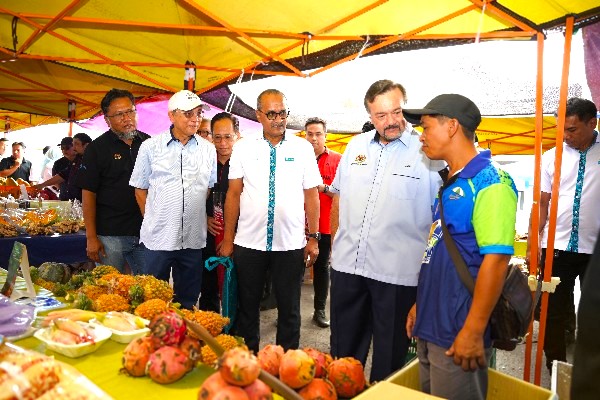
PAPAR: The Ministry of Finance (MOF) will work closely with the State Government to ensure the implementation of the targeted diesel subsidy meets the needs of the people, particularly, those in rural and interior areas.
Second Finance Minister Datuk Seri Amir Hamzah Azizan said the collaboration is important because Sabah’s circumstances differ from peninsula and any policy implementation must take local realities into account.
He said the government understood the challenges faced by Sabah residents and businesses, including those who rely on diesel-powered vehicles to transport goods and carry out economic activities.
“It is not only in Sabah but throughout the country. What is important is that we work with the State Government because they have a better understanding of the situation in Sabah.
“Through this cooperation, we can identify the most suitable mechanisms to assist those who genuinely need help,” he said, after a working visit at Tamu Papar, here, Sunday.
Amir Hamzah said the Government had taken into account various forms of vehicle ownership in implementing the targeted diesel subsidy, including cases where vehicles registered under one individual’s name are actually used by other family members.
He said the government had previously introduced flexibility through a quota transfer mechanism, with online applications already open, to ensure diesel subsidies reached the actual users.
“When we strengthened the targeted diesel subsidy, only the registered owner of the vehicle was eligible to receive the subsidy quota. However, we understand that some vehicles are purchased under a child’s name through bank financing but are used by parents or siblings.
“Therefore, the Government allows the transfer of subsidy quotas to the actual users so that the benefits reach those who are entitled to them. This will ensure that the subsidy reaches the person who genuinely uses the vehicle and is entitled to the benefit. This is the government’s approach to targeted subsidies.
“As we continue to receive feedback from various stakeholders and State government, we will review and make the necessary refinements, if necessary, so as to ensure its implementation remains effective and meets the people’s needs” he said.
Elaborating, Amir said the targeted diesel subsidy is aimed at ensuring government assistance reach eligible recipients while reducing subsidy leakages.
“When it comes to the subsidy policy, we need to understand that it is designed to reduce subsidy leakages in the country because we want the fuel subsidy to reach our people, not to those who are not entitled to receive it. That is the primary objective.
“What is equally important is how we implement the targeted subsidy. For diesel, for example, the government has provided a mechanism that allows eligible vehicle owners to apply for additional 100 litres under BUDI Diesel in their diesel subsidy quota, bringing the total to 300 litres,” he said.
As of July 4, 2026, Amir said nearly 200,000 diesel vehicle owners nationwide have been approved to receive the 300-litre quota.
“We have also taken into consideration the use of vehicles such as pick-up trucks and jeeps, which are widely used by traders and rural communities.
“So far, the implementation of the diesel subsidy has proceeded smoothly without any major disruptions, and the government will continue to review feedback received (from various quarters and the State Government) to ensure no eligible group is left out from receiving the benefits,” he said.
Under the current approach, Amir said the government has also expanded the categories of eligible vehicles by including pick-up trucks and jeeps as these vehicles are widely used by traders to transport goods and passengers.
“That is why the diesel subsidy differs from the RON95 fuel subsidy, as it takes into account the different patterns of fuel usage, which may be higher,” he said.