Advertisement
Advertisement
Advertisement
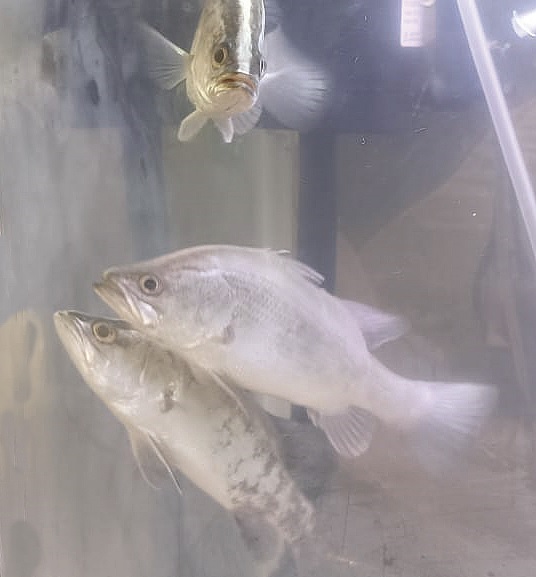 Sea bass fries released at 1.5 inches last June are now seven inches long and ready for harvest in December.
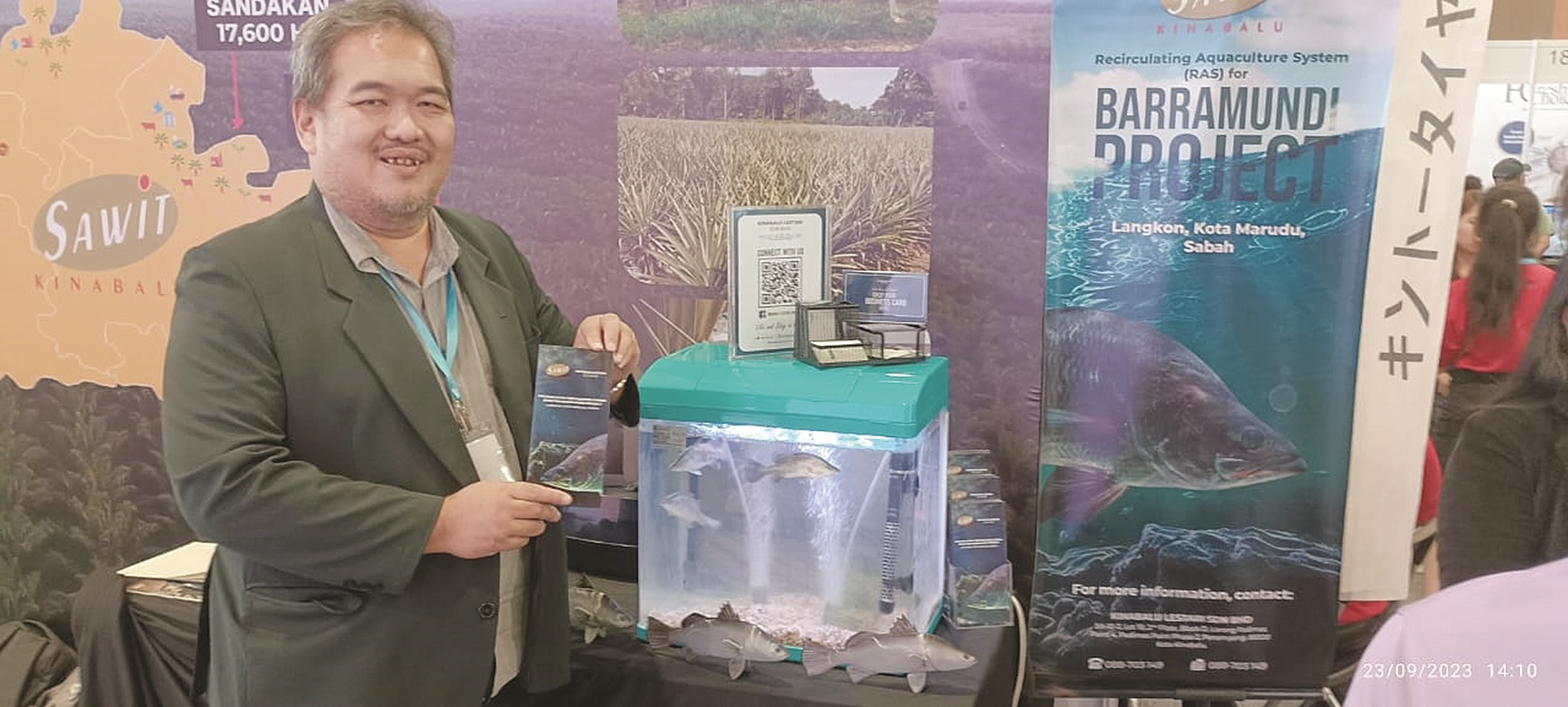
“It is a little bit different from other people, from other designs, ours are designed to fit into a 20-ft shipping container, in the sense that wherever you wish to locate your aquaculture operation, we can easily deploy the set up according to your location, it’s not fixed to a place. So that is the biggest advantage of this system,” Irwin reckoned.
Solar power & zero carbon footprints
He cited meeting two environmental pillars.
“Besides net zero water footprint, the recirculating system, the mobile plant can actually run on solar energy in the sense that during day time when there is sunlight you can actually power the filtration system using about 90sq metres of your roof top.
“In that sense it is a very efficient system, we are very confident, upon scaling up the system we are going to achieve zero carbon footprint aquaculture, that is the second long term aim that we plan to achieve.”
Pooling the strengths of Sawit, UMS & Lestari for triple wins
The project is not a silo operation but one of pooling the strengths and support of two key partners.
“It is a collaboration is with one of the best government linked companies in Sabah, which is Sawit Kinabalu Group,” noted Irwin, Manager of Kinabalu Lestari Sdn Bhd – a subsidiary of Sawit Kinabalu.
“Sawit Kinabalu Group by nature they are involved in plantations, oil mills and refineries and therefore they have abundance of palm oil based by-products, for example, palm kernel cake or palm kernel shells, the company has already signed an MoU with the Universiti of Malaysia Sabah in order for us to develop 100pc sustainable fish feeds, derived from palm oil-based products which is by default, palm kernel cake or palm kernel shell,” Irwin explained.
“So we hope this project is going to give us three big wins,” he said.
“Win Number One, which is net zero water footprints, we are recycling 100pc of our water so we do not pump in unnecessary additional water because water is a precious resource.”
“Win Number Two, we plan to achieve net zero carbon footprint aquaculture.
“Number Three, we want to achieve it using 100pc sustainable feeds.”
Address food, poverty and job skills
“One of the most important objectives of this project is to help State Government to achieve two items,” Irwin said.
“Item One, self sufficiency for food supply. Item Two, to help eradicate poverty.
“The project is located in Kota Marudu, which together with the districts in the vicinity like Pitas, Tongod, Kudat and Kota Belud, are actually some of the poorest districts in Sabah, so this project aims to help alleviate poverty by giving them the opportunity to get involved in the project that offers skilled employment,” Irwin noted a higher economic objective.
“We plan to offer skilled or semi skilled employment instead of just unskilled labour and the team members who join the company would have exposure into the RAS System, plant management, management of feeds, animal husbandry so on and so forth,” he articulated the vision and mission.
“So I invite more stakeholders, people who are interested, to be in touch with us in the project.”
Economic professor advisor
A key advisor of the project is Professor Dr Alin James, an economics lecturer at the Universiti Malaysia Sabah.
“Professor James and myself go back a long way, he knows sustainability is always down in my heart, and I will not embark on any project without sustainability in mind,” Irwin said.
Uphold environmental sustainability
“The main pillar of this project is always governed by sustainability and moving forward, I think more projects should think along that line,” he reckoned.
Asked for his thoughts on sustainability, Irwin said.
“My understanding of sustainability is three-pronged:
“Number One, it has to achieve an environmental sustainability, meaning we should not harm nature more than what we have done because what we have already done to the environment is terrible enough, the location that the project is based well within the boundaries of designated areas for aquaculture operation, there is no encroachment whatsoever into any mangrove reserve or riparian reserves,” Irwin pointed out.
“On top of that our partner – Sawit Kinabalu, is a MSPO (Malaysian Sustainable Palm Oil) certified company, therefore we have to adhere to very, very strict requirements of MSPO because any complication from our project is going to be reflected directly into their MSPO certification,” he explained.
“Things like no tolerance for child labour, there should not be any hunting of wildlife species in that area so on and so forth and of course, very strict coastal land use policy that we have to follow and adhere to. So, this is sustainability to us Number 1.”
Uphold financial sustainability
“Sustainability Number Two – the second pillar of sustainability to us is actually financial sustainability. Now that we realised that financial sustainability is easier said than done, that is why this project is being built in four stages because we do not want to undertake huge amounts of loans or even undertake investments from people or from parties which have got uncertain sources of funds.
“We want to make sure that we invest in this project using funds that are 100pc certified to be legal and certified to be clean, and because of that reason, we are applying for any form of grants and fortunately we received a grant from the Government of Malaysia for food security and this project fits into the food security agenda of Malaysia and technology advancement or the speciality of this project fits into the Sabah State Government’s Hala Tuju Sabah Maju Jaya roadmap,” Irwin elaborated.
Pass on knowledge/ skills sustainability
“The third form of sustainability that I want to implement in the company is expertise and skills as this company is founded by two Sabah businessmen, we have the commitment to make sure that our skills and our knowledge is being passed on – sustainability to the next generation of aquaculture operators, entrepreneurs, accountants, like myself, and of course my partner Lester Lee as an engineer.”
He added: “We want to continue this sustainability, we want to get out of our comfort zone, we want to make sure that the locals continue to have the opportunity, continue to have themselves exposed to the best in the industry, we pride ourselves as the leader of the industry, some of this expertise we do not hold back, we wish to pass on the knowledge, pass on the expertise so that the growth and advancement and development of aquaculture can be sustainably developed into the next generation lets say in IoT (Internet of Things) or even in other areas that the industry may bring them forward to.”
When everything was about shrimps and groupas 10 years ago
Irwin said historically the project idea dated back 10 years ago when the Federal Government asked laymen like him to forward proposals on direction to move the country forward, when everything on aquaculture was about groupas and shrimps then.
Irwin says he remembers he and Lester proposed barramundi aquaculture was a good project but it was not picked up but the Sabah Government did after a presentation to GLC (government linked companies) in 2020, Sawit Kinabalu stepped forward and followed up with a MoU on the RAS signed on April 19, 2021 witnessed by Chief Minister Hajiji.
“After the initial proposal was approached and provided to the Performance Management And Delivery Unit (Pemandu) under the Prime Minister’s Department 10-12 years ago during Najib’s administration, people realised that that there was a huge potential the in aquaculture, but their thinking on the Federal side was all on shrimps and groupas then,” he said.
Turning to sea bass after Covid white flag food distress
Eventually, it’s the vision and strengths of a State GLC (Sawit Kinabalu), Kinabalu Lestari and State based Borneo Marine Research Institute of Universiti Malaysia Sabah (UMS) which saw the importance of food security, inspired by the White Flag Campaign from hungry jobless folks to signal distress during Covid and suddenly the Recirculating Aquaculture System barramundi project, made sense, people started noticing what sea bass is which brought it from the backwaters to the front.
“Our partner the Borneo Marine Institute UMS in Sabah is one of the institutions which created some of the most ground breaking research, for instance the hybreed grouper, so we wanted to continue that trend and since Sabah already made that breakthrough, why not make a breakthrough in recirculating aquaculture system that could be mobilised anywhere in the world, in Sabah itself or in Borneo.”
Once again, this project is a classic example of the power of pooling the strengths of everybody to make things happen.
Lestari founders’ accumulated experience over 25 years
Sawit Kinabalu and Borneo Marine Institute aside, co-founders of Kinabalu Lestari Sdn Bhd, Irwin Wong and engineer Ir Lester Lee together had accumulated 25 years of experience and active involvement each in the fisheries and aquaculture industry supply chain in Sabah and internationally.
“So we decided to use these expertise and knowledge that we have accumulated to design and fabricate the very first mobile RAS Plant and deployment for this project,” Irwin explained the birth of Kinabalu Lestari.
“There were scepticism, there were doubts in the beginning, there were even people asking, shouldn’t we be paying some consultants from Australia to do it, I said ‘no’, I would rather fail in my attempt than rely on some expensive expertise, I would rather fail and know the reason rather than fail not knowing the reason, so we decided to embark on this meaningful journey with the support of this engineering team, fabrication team and the mobile RAS Plant came from dream into prototype in eight months.
“There’s no pipes designed for it, there is no tubings designed for it, everything has to be fabricated, everything has to be designed and it was a long process but I assure all that that every single step is worth all the sweat and blood, we ae happy to say that is the design that belongs to Sabahans and would be more than happy to share with the rest of the folks in Sabah let alone even in Malaysia and even in the regions,” Irwin elaborated.
Many things make sea bass desirable
So what is sea bass? Why is it desirable?
“Sea bass is a very versatile fish in the sense that it can thrive in fresh water, it can also thrive in seawater meaning to say that it is very suitable for all sorts of environments, it can thrive on zero PPT (parts per thousand salinity), it can also thrive on 27 PPT which is marine salt water, zero PPT is fresh water,” Irwin explained.
“Sea bass by nature is a white-fleshed fish preferred by the international market, it has got very huge followings in markets like Australia and New Zealand for fish-and-chips, for fish steaks and even for grilled fish.
“A second thing about seabass is it has got very suitable food conversion ratio, I always explain to the people that if you take 2kg of feeds, if you get 2kg of feeds to
get 1kg of meat, then you are in trouble but it has been shown to thrive at about 1.2kg of feeds to achieve 1kg of flesh.”
Efficient food conversion to meat
“Which means that in open sea cage format / environment, open sea cage format is a disadvantage in that it is subject to waves, ie if you have very strong currents, 30pc of the feeds maybe washed away but recirculating aquaculture does not have that issue because it is not in the open sea, it is in a contained tank so your feed wastage is a lot less.
“So with that in mind, 1.2kg of feeds to 1kg of flesh could be brought down to possible 1kg of feeds to 1 kg of flesh which is very efficient as compared to any other species of fish,” Irwin noted.
“Furthermore, one of the key importance of barramundi is that the fact that currently most of it sold in the market is actually imported so it doesn’t bring any benefit to the country or the state except we are losing that foreign exchange,” Irwin said.
An important fact
“So the most important fact for the state of Sabah is actually the fact that most of the oil and gas activities carried out in Sabah and Sarawak and the fish supplied to the offshore crew in oil rigs are mostly procured from overseas, therefore, it leads to cash outflows again from the country.
“So rather than relying on another country to rear the fish, process the fish to Sabah or Sarawak only to be sent to oil rigs to be enjoyed by our oil and gas workers, the spinoffs is better felt if it were actually cultured in Sabah, produced in Sabah, processed in Sabah, using sustainable technology and it can also help the oil and gas operators in achieving the ESG (environment, social, governance) goals,” Irwin concluded.
Sea bass fries released at 1.5 inches last June are now seven inches long and ready for harvest in December.
“It is a little bit different from other people, from other designs, ours are designed to fit into a 20-ft shipping container, in the sense that wherever you wish to locate your aquaculture operation, we can easily deploy the set up according to your location, it’s not fixed to a place. So that is the biggest advantage of this system,” Irwin reckoned.
Solar power & zero carbon footprints
He cited meeting two environmental pillars.
“Besides net zero water footprint, the recirculating system, the mobile plant can actually run on solar energy in the sense that during day time when there is sunlight you can actually power the filtration system using about 90sq metres of your roof top.
“In that sense it is a very efficient system, we are very confident, upon scaling up the system we are going to achieve zero carbon footprint aquaculture, that is the second long term aim that we plan to achieve.”
Pooling the strengths of Sawit, UMS & Lestari for triple wins
The project is not a silo operation but one of pooling the strengths and support of two key partners.
“It is a collaboration is with one of the best government linked companies in Sabah, which is Sawit Kinabalu Group,” noted Irwin, Manager of Kinabalu Lestari Sdn Bhd – a subsidiary of Sawit Kinabalu.
“Sawit Kinabalu Group by nature they are involved in plantations, oil mills and refineries and therefore they have abundance of palm oil based by-products, for example, palm kernel cake or palm kernel shells, the company has already signed an MoU with the Universiti of Malaysia Sabah in order for us to develop 100pc sustainable fish feeds, derived from palm oil-based products which is by default, palm kernel cake or palm kernel shell,” Irwin explained.
“So we hope this project is going to give us three big wins,” he said.
“Win Number One, which is net zero water footprints, we are recycling 100pc of our water so we do not pump in unnecessary additional water because water is a precious resource.”
“Win Number Two, we plan to achieve net zero carbon footprint aquaculture.
“Number Three, we want to achieve it using 100pc sustainable feeds.”
Address food, poverty and job skills
“One of the most important objectives of this project is to help State Government to achieve two items,” Irwin said.
“Item One, self sufficiency for food supply. Item Two, to help eradicate poverty.
“The project is located in Kota Marudu, which together with the districts in the vicinity like Pitas, Tongod, Kudat and Kota Belud, are actually some of the poorest districts in Sabah, so this project aims to help alleviate poverty by giving them the opportunity to get involved in the project that offers skilled employment,” Irwin noted a higher economic objective.
“We plan to offer skilled or semi skilled employment instead of just unskilled labour and the team members who join the company would have exposure into the RAS System, plant management, management of feeds, animal husbandry so on and so forth,” he articulated the vision and mission.
“So I invite more stakeholders, people who are interested, to be in touch with us in the project.”
Economic professor advisor
A key advisor of the project is Professor Dr Alin James, an economics lecturer at the Universiti Malaysia Sabah.
“Professor James and myself go back a long way, he knows sustainability is always down in my heart, and I will not embark on any project without sustainability in mind,” Irwin said.
Uphold environmental sustainability
“The main pillar of this project is always governed by sustainability and moving forward, I think more projects should think along that line,” he reckoned.
Asked for his thoughts on sustainability, Irwin said.
“My understanding of sustainability is three-pronged:
“Number One, it has to achieve an environmental sustainability, meaning we should not harm nature more than what we have done because what we have already done to the environment is terrible enough, the location that the project is based well within the boundaries of designated areas for aquaculture operation, there is no encroachment whatsoever into any mangrove reserve or riparian reserves,” Irwin pointed out.
“On top of that our partner – Sawit Kinabalu, is a MSPO (Malaysian Sustainable Palm Oil) certified company, therefore we have to adhere to very, very strict requirements of MSPO because any complication from our project is going to be reflected directly into their MSPO certification,” he explained.
“Things like no tolerance for child labour, there should not be any hunting of wildlife species in that area so on and so forth and of course, very strict coastal land use policy that we have to follow and adhere to. So, this is sustainability to us Number 1.”
Uphold financial sustainability
“Sustainability Number Two – the second pillar of sustainability to us is actually financial sustainability. Now that we realised that financial sustainability is easier said than done, that is why this project is being built in four stages because we do not want to undertake huge amounts of loans or even undertake investments from people or from parties which have got uncertain sources of funds.
“We want to make sure that we invest in this project using funds that are 100pc certified to be legal and certified to be clean, and because of that reason, we are applying for any form of grants and fortunately we received a grant from the Government of Malaysia for food security and this project fits into the food security agenda of Malaysia and technology advancement or the speciality of this project fits into the Sabah State Government’s Hala Tuju Sabah Maju Jaya roadmap,” Irwin elaborated.
Pass on knowledge/ skills sustainability
“The third form of sustainability that I want to implement in the company is expertise and skills as this company is founded by two Sabah businessmen, we have the commitment to make sure that our skills and our knowledge is being passed on – sustainability to the next generation of aquaculture operators, entrepreneurs, accountants, like myself, and of course my partner Lester Lee as an engineer.”
He added: “We want to continue this sustainability, we want to get out of our comfort zone, we want to make sure that the locals continue to have the opportunity, continue to have themselves exposed to the best in the industry, we pride ourselves as the leader of the industry, some of this expertise we do not hold back, we wish to pass on the knowledge, pass on the expertise so that the growth and advancement and development of aquaculture can be sustainably developed into the next generation lets say in IoT (Internet of Things) or even in other areas that the industry may bring them forward to.”
When everything was about shrimps and groupas 10 years ago
Irwin said historically the project idea dated back 10 years ago when the Federal Government asked laymen like him to forward proposals on direction to move the country forward, when everything on aquaculture was about groupas and shrimps then.
Irwin says he remembers he and Lester proposed barramundi aquaculture was a good project but it was not picked up but the Sabah Government did after a presentation to GLC (government linked companies) in 2020, Sawit Kinabalu stepped forward and followed up with a MoU on the RAS signed on April 19, 2021 witnessed by Chief Minister Hajiji.
“After the initial proposal was approached and provided to the Performance Management And Delivery Unit (Pemandu) under the Prime Minister’s Department 10-12 years ago during Najib’s administration, people realised that that there was a huge potential the in aquaculture, but their thinking on the Federal side was all on shrimps and groupas then,” he said.
Turning to sea bass after Covid white flag food distress
Eventually, it’s the vision and strengths of a State GLC (Sawit Kinabalu), Kinabalu Lestari and State based Borneo Marine Research Institute of Universiti Malaysia Sabah (UMS) which saw the importance of food security, inspired by the White Flag Campaign from hungry jobless folks to signal distress during Covid and suddenly the Recirculating Aquaculture System barramundi project, made sense, people started noticing what sea bass is which brought it from the backwaters to the front.
“Our partner the Borneo Marine Institute UMS in Sabah is one of the institutions which created some of the most ground breaking research, for instance the hybreed grouper, so we wanted to continue that trend and since Sabah already made that breakthrough, why not make a breakthrough in recirculating aquaculture system that could be mobilised anywhere in the world, in Sabah itself or in Borneo.”
Once again, this project is a classic example of the power of pooling the strengths of everybody to make things happen.
Lestari founders’ accumulated experience over 25 years
Sawit Kinabalu and Borneo Marine Institute aside, co-founders of Kinabalu Lestari Sdn Bhd, Irwin Wong and engineer Ir Lester Lee together had accumulated 25 years of experience and active involvement each in the fisheries and aquaculture industry supply chain in Sabah and internationally.
“So we decided to use these expertise and knowledge that we have accumulated to design and fabricate the very first mobile RAS Plant and deployment for this project,” Irwin explained the birth of Kinabalu Lestari.
“There were scepticism, there were doubts in the beginning, there were even people asking, shouldn’t we be paying some consultants from Australia to do it, I said ‘no’, I would rather fail in my attempt than rely on some expensive expertise, I would rather fail and know the reason rather than fail not knowing the reason, so we decided to embark on this meaningful journey with the support of this engineering team, fabrication team and the mobile RAS Plant came from dream into prototype in eight months.
“There’s no pipes designed for it, there is no tubings designed for it, everything has to be fabricated, everything has to be designed and it was a long process but I assure all that that every single step is worth all the sweat and blood, we ae happy to say that is the design that belongs to Sabahans and would be more than happy to share with the rest of the folks in Sabah let alone even in Malaysia and even in the regions,” Irwin elaborated.
Many things make sea bass desirable
So what is sea bass? Why is it desirable?
“Sea bass is a very versatile fish in the sense that it can thrive in fresh water, it can also thrive in seawater meaning to say that it is very suitable for all sorts of environments, it can thrive on zero PPT (parts per thousand salinity), it can also thrive on 27 PPT which is marine salt water, zero PPT is fresh water,” Irwin explained.
“Sea bass by nature is a white-fleshed fish preferred by the international market, it has got very huge followings in markets like Australia and New Zealand for fish-and-chips, for fish steaks and even for grilled fish.
“A second thing about seabass is it has got very suitable food conversion ratio, I always explain to the people that if you take 2kg of feeds, if you get 2kg of feeds to
get 1kg of meat, then you are in trouble but it has been shown to thrive at about 1.2kg of feeds to achieve 1kg of flesh.”
Efficient food conversion to meat
“Which means that in open sea cage format / environment, open sea cage format is a disadvantage in that it is subject to waves, ie if you have very strong currents, 30pc of the feeds maybe washed away but recirculating aquaculture does not have that issue because it is not in the open sea, it is in a contained tank so your feed wastage is a lot less.
“So with that in mind, 1.2kg of feeds to 1kg of flesh could be brought down to possible 1kg of feeds to 1 kg of flesh which is very efficient as compared to any other species of fish,” Irwin noted.
“Furthermore, one of the key importance of barramundi is that the fact that currently most of it sold in the market is actually imported so it doesn’t bring any benefit to the country or the state except we are losing that foreign exchange,” Irwin said.
An important fact
“So the most important fact for the state of Sabah is actually the fact that most of the oil and gas activities carried out in Sabah and Sarawak and the fish supplied to the offshore crew in oil rigs are mostly procured from overseas, therefore, it leads to cash outflows again from the country.
“So rather than relying on another country to rear the fish, process the fish to Sabah or Sarawak only to be sent to oil rigs to be enjoyed by our oil and gas workers, the spinoffs is better felt if it were actually cultured in Sabah, produced in Sabah, processed in Sabah, using sustainable technology and it can also help the oil and gas operators in achieving the ESG (environment, social, governance) goals,” Irwin concluded.