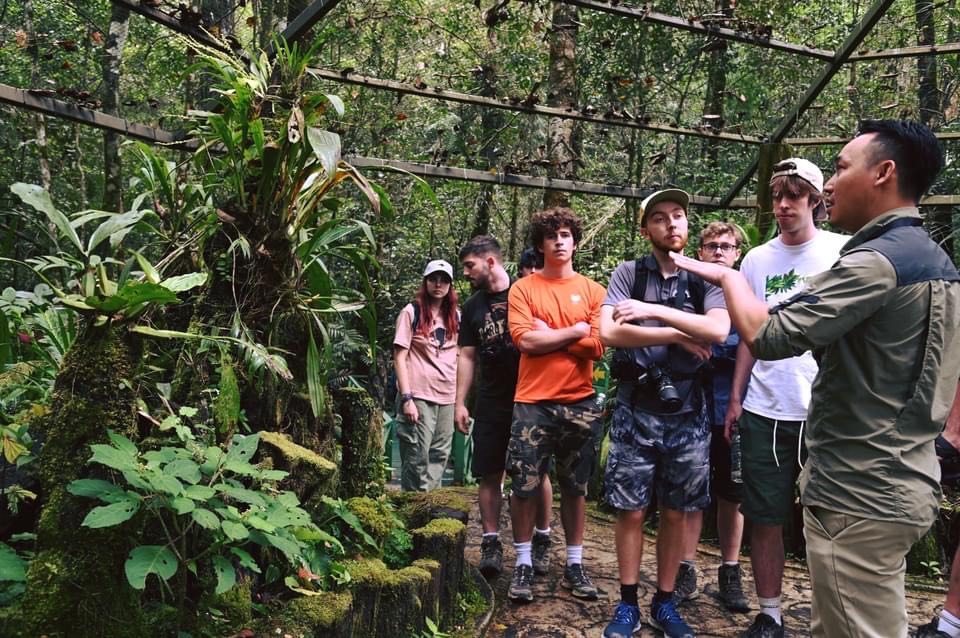
RANAU: Conservation and preservation of biodiversity in the World Heritage Site of Kinabalu Park caught the attention of university students from Swansea University, United Kingdom.
Coming from various backgrounds, this group of 25 third-year Biology students had a learning visit to Kinabalu Park over the weekend, where they had an insight to Sabah’s environment protection and conservation initiatives.
These students led by Dr. Aisling Devine, were welcomed by Sabah Parks Ecology Research Officer Vanielie Terrence Justine on Saturday (Sept 28). The objective was to learn more about the flora and fauna in Kinabalu Park, which is a Unesco World Heritage Site.
They are also here to learn about the biodiversity, conservation and protection of the environment in the area.
Vanielle, who led the briefing prior to the tour, shared about Sabah Park’s establishment history, their works for the park, the types of flora and fauna biodiversity as well as past and ongoing scientific researches that are being carried out.
Information on conservation and rehabilitation initiatives were also shared during the visit while question and answer sessions were conducted in between talks.
The students were very much interested to know about Sabah Park’s role in protecting the unique and diverse biodiversity in this heritage site, and asked a lot on the methods of conservation, species identification and recording, as well as rehabilitation of plants, wildlife and insects.
They were also brought to visit the Kinabalu Global Geopark exhibition gallery and given an introduction to the biological, geological and cultural aspects within the Kinabalu Park.
The gallery gave a comprehensive picture of the relations between nature and human history in the area, stressing much on geological heritage and local cultures.
Before the study tour ended, the students had the opportunity to learn about Mount Kinabalu’s Botanical Garden, where they were shown the various endemic species of flora and fauna found in Kinabalu Park.
Among the species which received much attention were the orchids, begonia and pitcher plants.
Park officials in charge of research and education told the students about the unique characteristics of each species and their roles in the ecosystem.
Towards the end, the Swansea University entourage returned with new information and experience following the study tour.
They thanked Sabah Parks for the time and knowledge shared throughout the programme, and promised to come back in the future.