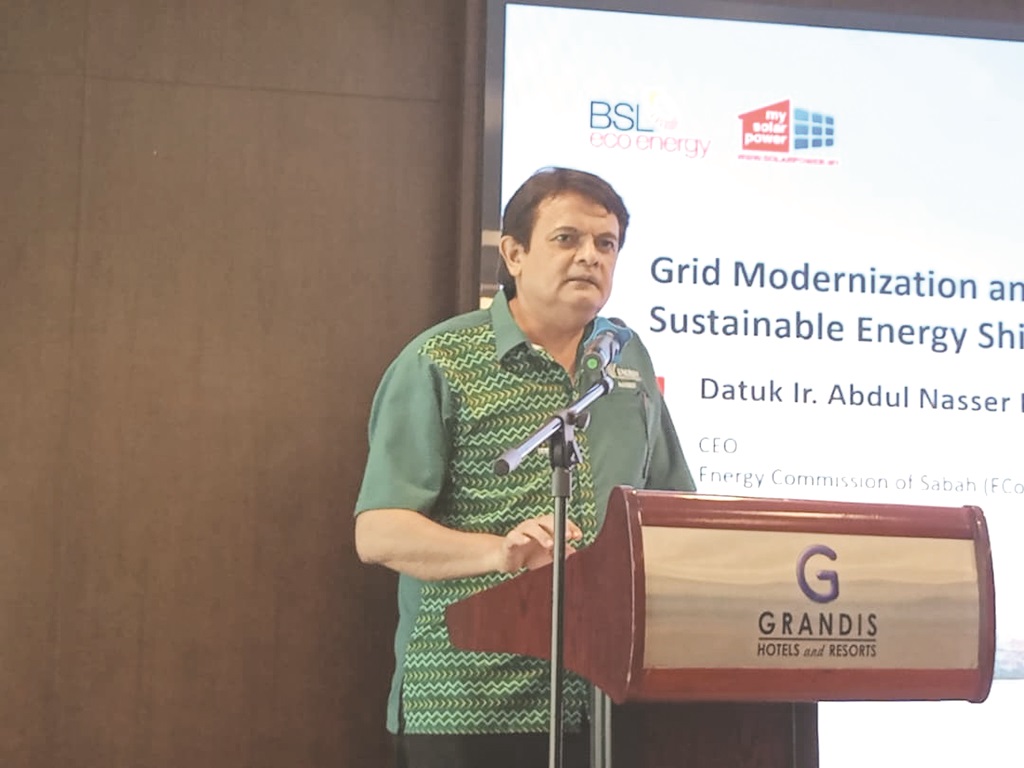
Kota Kinabalu: The Energy Commission of Sabah (ECoS) is positioning battery energy storage as independent electricity grid infrastructure instead of tying it to individual renewable energy projects, in a move aimed at strengthening grid stability and accelerating Sabah’s clean energy transition.
Its Chief Executive Officer Datuk Ir Abdul Nasser Abdul Wahid said the approach would provide greater flexibility in integrating renewable energy into the grid while ensuring a secure, reliable and affordable electricity supply.
He said battery storage should be viewed as an integral part of the electricity network rather than simply another technology.
“At ECoS, we see battery storage not simply as another technology, but as part of the electricity network itself.
“It strengthens grid stability, supports voltage and frequency control, provides operating reserves and enables a greater share of renewable energy to be integrated without compromising system reliability,” he said during the Powering Sabah’s Low Carbon Future Workshop.
Abdul Nasser said ECoS had therefore adopted a strategy whereby battery energy storage systems (BESS) would be developed as independent grid infrastructure instead of being attached to specific renewable energy projects.
“This allows storage to support electricity generated from different renewable sources across the grid, providing greater flexibility for the entire electricity system,” he said.
Abdul Nasser said Sabah had already gained valuable operational experience through the 100MW/400MWh Lahad Datu Battery Energy Storage System, which demonstrated the role storage could play in improving grid stability and supporting renewable energy integration on the East Coast.
Building on that experience, ECoS has launched a Request for Proposal (RFP) for two additional BESS projects, each with a capacity of 100MW/200MWh, targeted for commissioning by 2028.
According to Abdul Nasser, the projects will adopt a capacity payment model, where revenues are linked to the availability and performance of the storage system instead of the amount of electricity discharged.
“This provides greater revenue certainty, improves bankability and creates a simpler commercial framework for investors,” he said.
He added that the programme would also involve Sabah Government-linked companies (GLCs) while creating opportunities for Sabah-based contractors, consultants and service providers throughout the project lifecycle.
Abdul Nasser stressed that Sabah’s transition to clean energy was not merely about replacing one source of generation with another, but about creating an integrated electricity system.
“The transition to clean energy is not about replacing one technology with another.
“It is about building an electricity system where renewable energy, battery storage, stronger networks and sound planning work together to deliver reliable and affordable electricity,” he said.
While conventional generation would continue to play a role during the transition, he said Sabah would progressively reduce its dependence on conventional fuels as more renewable energy and battery storage projects come on stream under the Sabah Energy Roadmap and Master Plan 2040 (SERAMP 2040).
He said the State Government provides the strategic direction for the energy sector, ECoS oversees the regulatory framework and long-term planning, while Sabah Electricity is responsible for planning and operating the electricity system.
“The success of Sabah’s clean-energy transition will depend on continued collaboration between government agencies, developers, financiers, technology providers and industry partners,” he said.


.png)