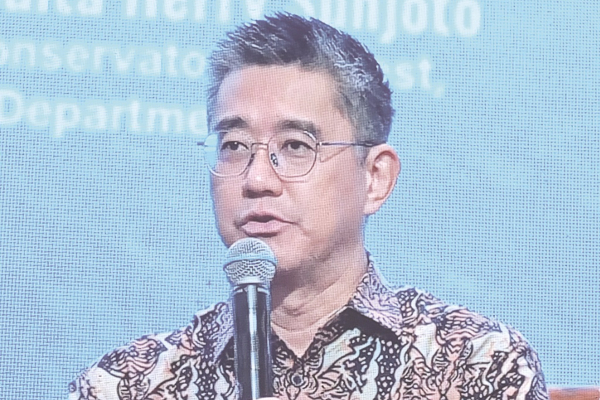
Kota Kinabalu: Sabah should prioritise developing its midstream palm oil industry instead of focusing on downstream manufacturing, said Kuala Lumpur Kepong Berhad (KLK) Chief Sustainability Officer Ku Kok Peng.
Speaking during the Forestry and Nature-positive Food Economy session at the Sabah Asia Pacific Impact Investing for Sustainable Development Summit 2026, here, recently, he said structural disadvantages against Indonesia have made downstream investments less competitive.

Advertisement

He said the State has significant opportunities to strengthen its position in sustainable palm oil by capitalising on growing demand for certified products, particularly from China and Europe, while expanding value-added midstream activities.
“I think midstream is where the story for Sabah really is at this point in time. I’m not discounting further downstream, but I think at this point in time, midstream really is where Sabah should pay attention,” he said, recently, here.
Ku said China, in particular, presents a major opportunity as demand for sustainably certified palm oil continues to rise.
“China is the first one. The RSPO-certified volumes in China have now touched almost 12 per cent, and that is a tipping point, which means the market is open to certified oil from anywhere,” he said.
He said Sabah is well positioned to benefit through its jurisdictional certification initiative, which aims to certify the entire State under the Roundtable on Sustainable Palm Oil (RSPO) standard.
According to him, Europe also remains an important market, although its priority is ensuring products are free from deforestation.
“What is very interesting is that recently both the RSPO and the Malaysian Sustainable Palm Oil (MSPO) certification have been accepted by the Dutch National Competent Authority as private control systems under the European Union Deforestation Regulation (EUDR),” he said.
While this does not automatically make producers EUDR-compliant, Ku said it would likely reduce the frequency and timing of audits, lowering compliance risks for certified producers.
However, he noted that entering the United States market would require Sabah to address labour and human rights concerns.
“The US market looks a lot at human rights above all else. We still have some ways to go in managing migrant workers that have not been regularised,” he said.
He said Sabah would need to demonstrate that issues such as labour exploitation and child labour are effectively addressed before gaining wider access to the American market.
Ku also explained why he believes downstream manufacturing is currently less attractive for Sabah.
He said Indonesia enjoys a significant competitive edge because its export levy structure effectively lowers domestic feedstock prices, giving downstream manufacturers there about a 13.5 per cent cost advantage.
“That makes it more compelling for downstream activity to happen in Indonesia rather than Malaysia. It overcomes many of the advantages we have in logistics and services,” he said.
He added that Indonesia’s downstream processing capacity is now almost 10 times larger than Malaysia’s, enabling producers there to compete more aggressively on price.
Malaysia also faces additional challenges after losing preferential tariff treatment enjoyed until 2014, while Indonesia continues to benefit from such arrangements and is expected to implement a free trade agreement with the European Union ahead of Malaysia.
“This creates another disadvantage, potentially up to a four to five per cent tariff difference, making further downstream development in Sabah even more difficult,” he said.
Earlier in his presentation, Ku defended the sustainability credentials of the palm oil industry, saying oil palm occupies only 0.6 per cent of global agricultural land but supplies almost 40 per cent of the world’s vegetable oils and fats, making it the world’s highest-yielding oil crop.
He also said palm oil production operates on a largely circular economy model, with biomass, empty fruit bunches and treated wastewater being reused, while advances in biomethane technology are creating new opportunities to reduce emissions and generate renewable energy.