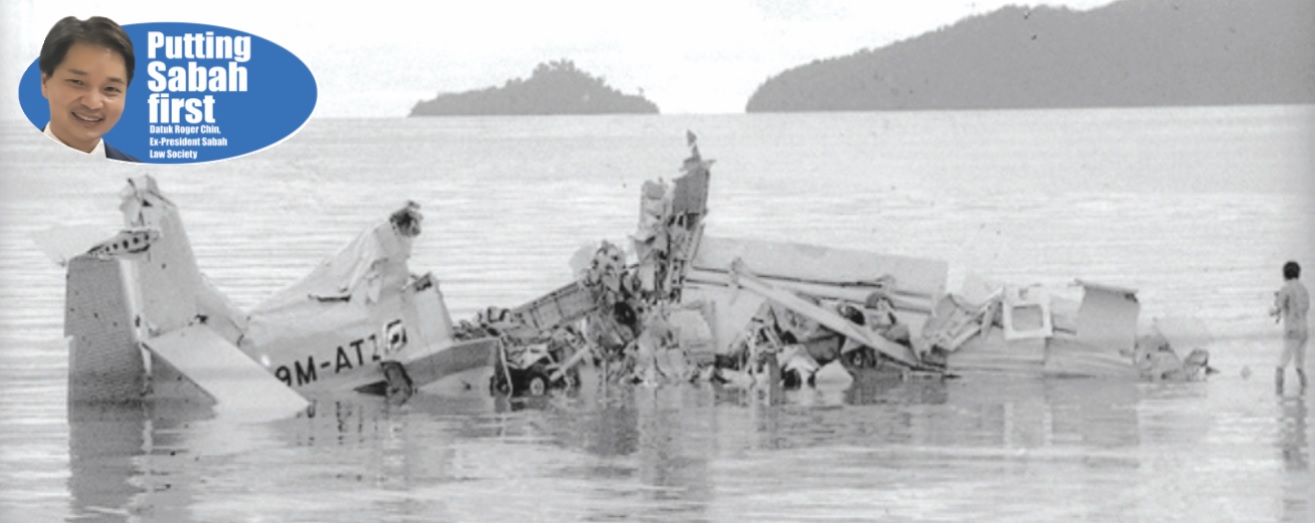
A Defining Moment in Sabah’s History Nearly fifty years after the Double Six Tragedy, Sabah continues to grapple with a question that can never be answered.
The question is not why the aircraft crashed, nor whether the tragedy could have been prevented. Rather, it is whether Sabah’s political future might have unfolded differently had 6 June 1976 been an ordinary day.
Few events in Sabah’s history have exercised such a lasting influence over the State’s political consciousness. The tragedy claimed the lives of Chief Minister Tun Fuad Stephens and several members of his Cabinet and administration at a time when Sabah was still in the formative years of its journey within the Malaysian Federation. In human terms, the loss was immense. In political terms, the consequences were profound, for the tragedy removed a generation of leaders who were actively engaged in defining Sabah’s future during a critical stage of its development.
Most discussions of the Double Six Tragedy focus on what happened. The more interesting and perhaps more important question concerns what never had the opportunity to happen thereafter. The tragedy forces Sabahans to reflect on one of the great unanswered questions of their modern history - what would Sabah look like today had those leaders survived and been given the opportunity to pursue their vision over the course of decades rather than months?
The answer can never be known with certainty. Yet the question itself remains important because it invites reflection on how political communities are built, how institutions evolve and how history is shaped not only by events that occur but also by possibilities that disappear.
Beyond the Loss of Individuals
There is a natural tendency to view the Double Six Tragedy primarily through the lens of personal loss. Such a perspective is entirely understandable. The lives lost included some of the most prominent political figures of their generation, and the emotional impact of the tragedy continues to be felt by many Sabahans.
Yet from a historical perspective, the significance of the event extends beyond the individuals involved. The true issue is not simply that Sabah lost a Chief Minister and several Cabinet members. The more profound issue is that Sabah lost a leadership generation at a time when the State was still defining its political identity, institutional culture and long-term direction.
In 1976, Sabah had been part of Malaysia for only thirteen years. Many of the political arrangements, constitutional understandings and federal-state relationships that later became familiar were still evolving. The State was not merely administering existing institutions; it was helping to shape them. Leadership during such periods carries a significance that is often appreciated only in retrospect.
When a society loses key leaders during a formative stage of its development, the consequences extend beyond the immediate political vacuum. Institutional memory is disrupted, political momentum is interrupted and emerging visions of the future are left untested. The question therefore is not simply whether Tun Fuad Stephens would have been an effective Chief Minister. The more important question is whether the collective leadership of that generation might have been able to establish a sustained political project capable of shaping Sabah for decades to come.
It is this possibility, rather than any specific policy or decision, that gives the Double Six Tragedy its enduring significance.
Would Sabah Be Different Today?
The question most frequently asked in discussions about the Double Six Tragedy is whether Sabah would be different today had Tun Fuad Stephens and his colleagues survived. Although no definitive answer is possible, it is difficult to avoid the conclusion that the State’s political development would almost certainly have taken a different path.
This does not necessarily mean that Sabah would today be wealthier, more autonomous or more politically influential. Such claims belong to the realm of speculation and cannot be established with any certainty. Historical outcomes are rarely determined by a single event or individual. They are shaped by a complex interaction of leadership, institutions, economic conditions and broader political realities.
What can reasonably be said, however, is that different leaders make different decisions, establish different priorities and create different political cultures. Leadership matters most during periods of institutional formation, when the fundamental direction of a society remains unsettled. Sabah in 1976 was precisely such a society. The decisions taken during that period would influence not only immediate political outcomes but also the character of the institutions and political traditions that would emerge in the decades that followed.
The more persuasive argument, therefore, is not that Sabah would necessarily have achieved better outcomes, but that it would likely have evolved differently because a different generation of leaders would have been shaping its development during a critical period in its history.
Had the tragedy not occurred, the most likely differences would not necessarily have been found in a single policy, constitutional arrangement or political decision.
Rather, they may have been reflected in the gradual emergence of stronger institutions, greater continuity in political leadership, a clearer articulation of Sabah’s interests within the Federation and a more coherent long-term vision for the State’s development. These are the kinds of outcomes that often emerge when a political community is afforded stability and continuity over an extended period. Over time, such continuity can shape not only institutions and policies but also the political culture, public expectations and collective sense of purpose that define a State’s trajectory.
The Challenges Tun Fuad Stephens Would Have Faced
Any assessment of what might have been must also acknowledge the challenges that Tun Fuad Stephens would almost certainly have encountered had he survived.
There is often a tendency to view historical figures through the lens of nostalgia and to assume that they would have overcome the difficulties that later generations struggled to resolve. Such assumptions risk oversimplifying the realities of governance.
Had Tun Fuad Stephens survived, he would almost certainly have confronted many of the issues that continue to shape Sabah today. Questions relating to the balance between state autonomy and federal authority would have remained central to his administration. The management of natural resources, particularly the extent to which Sabah benefited from its own wealth, would likely have featured prominently in political discourse.
Economic disparities between urban and rural communities, infrastructure deficits, educational opportunities and the challenge of creating sustainable employment would also have demanded sustained attention. In addition, the complexities of governing one of Malaysia’s most diverse societies would have required careful political management. These were not problems unique to any particular administration; they were structural challenges that every Sabah leader would eventually be required to confront.
Managing relations with the Federal Government would have required a delicate balance between protecting state interests and maintaining constructive national partnerships. The pursuit of greater autonomy has always required not merely political conviction but also negotiation, compromise and strategic judgment. Likewise, economic development would have required difficult choices concerning resource allocation, investment priorities and the balance between short-term needs and long-term growth.
The broader political environment would also have imposed constraints. The decades that followed 1976 witnessed increasing political centralisation at the national level, and it would be unrealistic to assume that any Sabah leader could simply have pursued every aspiration without encountering resistance or institutional limitations.
For these reasons, there is no basis for believing that an alternative history in which Tun Fuad Stephens survived would necessarily have been free from political difficulties or disagreements. The challenges would have remained substantial. The difference lies not in the absence of obstacles, but in the possibility that those obstacles would have been confronted by a different generation of leaders pursuing a different vision for Sabah.
The Sarawak Experience
The most instructive comparison is not between Tun Fuad Stephens and any subsequent Sabah leader. It is between Sabah and Sarawak.
Both States entered Malaysia with distinct constitutional safeguards, unique identities and aspirations for self-government. Both possessed abundant natural resources and occupied special positions within the constitutional architecture of the Federation. Yet over the decades their political trajectories evolved in markedly different ways.
Whatever one’s political views may be, it is difficult to deny that Sarawak benefited from a degree of leadership continuity that allowed successive administrations to cultivate a coherent narrative of Sarawakian interests and gradually embed that narrative within state institutions and public consciousness. Different leaders occupied office at different times, but there remained a discernible continuity in the articulation of Sarawak’s long-term objectives.
The constitutional and political confidence that Sarawak displays today did not emerge overnight. It was the product of decades of institutional development, leadership continuity and the gradual construction of a coherent narrative about Sarawak’s interests within the Federation. The lesson is not that Sarawak possessed better leaders. The lesson is that Sarawak possessed the opportunity for successive leaders to build upon one another’s work.
This continuity produced effects that extended far beyond electoral politics. It enabled institutions to mature, policy objectives to develop over decades rather than electoral cycles and a shared understanding of Sarawak’s place within Malaysia to become increasingly entrenched. Over time, Sarawak was able to negotiate more confidently with the Federal Government, pursue long-term developmental strategies and secure greater recognition of its constitutional position and rights under the Malaysia Agreement 1963.
It is perhaps unsurprising that discussions of the Double Six Tragedy frequently return to questions of state rights, natural resources and the Malaysia Agreement 1963. Whether these issues would ultimately have evolved differently under Tun Fuad Stephens can never be known.
Nevertheless, their continued prominence reflects a broader belief among many Sabahans that the State’s constitutional position, economic interests and relationship with the Federation might have developed differently had the tragedy not occurred. The significance of the tragedy therefore lies not in any single issue, but in the possibility that an entire approach to Sabah’s political development was interrupted before it could mature.
The point is not that Sarawak’s path was perfect, nor that Sabah would necessarily have replicated it. The significance of the comparison lies in demonstrating what continuity can achieve when a political community is afforded sufficient time to develop a coherent sense of purpose, a stable institutional culture and a sustained political project capable of transcending individual leaders.
The question raised by the Double Six Tragedy is whether Sabah was denied the opportunity to develop something similar.
More Than an Historical Event
Perhaps the most profound consequence of the Double Six Tragedy is that it transformed a historical event into a political memory.
For many Sabahans, the tragedy is no longer simply about an aircraft crash that occurred in 1976. It has become a symbol of interrupted possibilities. Every debate about state rights, autonomy, development, representation, resource ownership or Sabah’s place within the Federation is, in some measure, also a debate about whether the aspirations of an earlier generation were ever fully realised.
In this sense, the tragedy has become woven into Sabah’s understanding of itself. It forms part of a broader narrative about identity, self-government and the continuing effort to define Sabah’s place within Malaysia. The event endures not because its details remain disputed, but because it has come to symbolise larger questions about what Sabah was, what Sabah became and what Sabah might yet become.
The Opportunity That Disappeared
Viewed through this lens, the most significant consequence of the Double Six Tragedy may not have been the loss of particular individuals, policies or negotiations. The deeper consequence may have been the interruption of a political journey before its destination became visible.
Political visions are not realised within a single term of office. They require decades of refinement, adaptation and institutionalisation. The strongest political cultures are not built through isolated achievements but through continuity of purpose across successive generations of leadership.
The Sarawak experience illustrates this point. Its political development was not the achievement of any single leader but the product of successive generations building upon foundations laid by their predecessors.
The Double Six Tragedy deprived Sabah of the opportunity to discover whether its own founding generation might have achieved something comparable. Perhaps they would have succeeded. Perhaps they would have failed. Perhaps Sabah would still have encountered many of the same challenges it faces today. Whether such a trajectory would ultimately have succeeded remains beyond the reach of historical certainty.
What can be said, however, is that the tragedy prevented history from conducting the experiment. An entire generation of leadership disappeared before its long-term vision could be tested.
The Unanswered Question
The true significance of the Double Six Tragedy therefore lies not merely in the lives that were lost, but in the future that was never allowed to unfold.
The Sarawak experience demonstrates what continuity can achieve. It demonstrates how institutions mature, how political cultures develop and how a shared sense of purpose can, over time, shape the destiny of a State. Whether Sabah would have travelled a similar path can never be known.
What can reasonably be said is that Sabah would almost certainly have been different. Different leaders would have confronted the defining questions of their era.
Different decisions would have been made. Different institutions might have emerged and different political traditions may have taken root.
Whether those differences would have produced a stronger Sabah remains a matter of speculation. What is more difficult to dispute is that they would almost certainly have produced a different Sabah.
Yet the comparison with Sarawak leaves behind a question that remains as relevant today as it was nearly fifty years ago.
If Sarawak became what it is through decades of continuity, institutional memory and a sustained political vision, what might Sabah have become had 6 June 1976 been an ordinary day?
History offers no answer. Yet perhaps that is precisely why the question continues to matter.
The views expressed here are the views of the writer and do not necessarily reflect those of the Daily Express. If you have something to share, write to us at: [email protected]