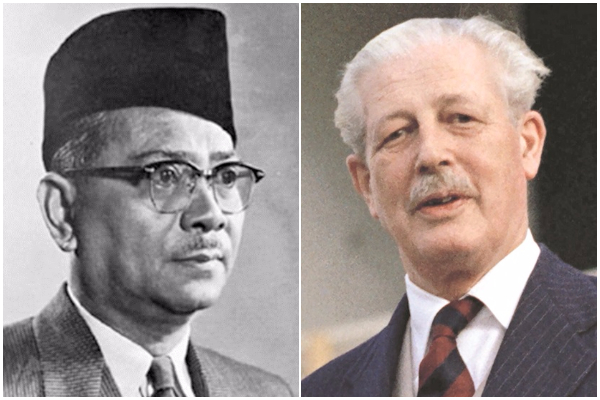
HAROLD Macmillan also thought the colonial officers to be out of touch with the reality of the post imperial world Britain found itself in.
Author Matthew Jones notes that Macmillan was palpably irritated when he saw the telegram from the North Borneo Governor, Goode, expressing his reservations on the idea of Greater Malaysia:
“I am rather shocked by this telegram and the attitude it reveals. Does he realize, (a) our weakness in Singapore, (b) our urgent need to hand over the security problem there. The whole mood is based on a false assessment of our power. If this is CO point of view, we shall fail. What are we to do?” (Matthew Jones, Conflict and Confrontation in Southeast Asia, 1961-1965 (Cambridge: Cambridge University Press, 2002, p..85))
Writes Stockwell: “The CO became identified with a fastidious interpretation of trusteeship obligations which [the other ministers] found irksome.”
Macmillan also had to deal with the demands from the Tunku on the terms on which he would agree to a merger with Singapore, primarily, the inclusion of the Borneo territories to sweeten the deal.
The first series of talks between the British and Malayan governments took place in London in November, 1961 (The London Talks I), where Macmillan signaled the acceptance of the Tunku’s proposal for merger in May of 1961.
Mindful of Britain’s obligations to the crown colonies of Sarawak and North Borneo, he proposed that a commission of enquiry be set up to ascertain the views of the Borneo people to the Malaysia proposal.
Following the talks, the commission of enquiry was formed with Lord Cameron Cobbold as the Chair, with two members from Malaya, and two British members.
The Commission toured Sarawak and North Borneo in the months of February and March 1962, interviewing over 4000 people and associations, then met again in London to draw up its report, which was then submitted to the Greater Malaysia Committee in May 1962. The two prime ministers were handed the report on the 21st of June, 1962.
Some historians suggest that Britain insisted on a commission of enquiry because the two territories were held ‘on trust’ by the British, and their sovereignty could be not handed over without their consent. Others say, as Macmillan himself put it, it was owing to the ‘traditional British tenderness for minority groups’ that their consent needed to be sought. Others view it as an attempt to persuade the international community that the consent of the peoples involved was in fact sought.
The Tunku, on the other hand, took a dim view of this: “While I agree that the wishes of the local people should not be ignored, this will over-emphasize the need for consultation with the people of the Borneo Territories who are at the moment not sufficient advanced in their political outlook to give an unbiased opinion of their own as they are very much under the influence of the British Colonial administrators.”
However, what is often overlooked is that during the intervening period there was much horse trading and to-ing and fro-ing between the Malayan and the British members of the Commission. The British members leaned toward protection for the two states, but at the time it appeared that they were more concerned with the time and the way to hand over sovereignty, and the tenure of the governors in the interim period. The Malayans insisted on a strict timetable for the handover and maintained that it was impractical to retain the governors.
Looking from a perspective sixty or so years on, author Zainnal Ajamain takes the view that the Cobbold Commission and the subsequent Inter-Governmental Commission was a subterfuge by the British to ensure that the Borneo states would be given sufficient safeguards. “The whole process in the formation of the Federation of Malaysia appears to cater for this purpose – to fulfill the Queen’s Obligation.” (Zainnal Ajamain, The Queen’s Obligation (Kota Kinabalu: Zainnal Ajamain, 2015).
Events prior to the agreement on the formation appear to support Ajamain’s view. Ghazali Shafie in his Memoir on the Formation of Malaysia (Penerbit UKM, 1998) describes the process:
“Every member of the cabinet Committee threw up his hands after reading the recommendations made by the British members. After some very serious scrutiny with me clarifying the British viewpoints as I understood them, the Committee unanimously concluded that they were unacceptable……the Tunku said it would be impossible for him to accept such a situation without losing face with his own people.
“MacMillan (sic) personally handled the matter and in his reply to the Tunku said that it was all a misunderstanding. He pointed out that he and the Tulnku had agreed to the creating of an independent commission to ascertain the views of the Borneo territories and make recommendations.
“On July 28, 1962 MacMillan sent to the Tunku a note which was entitled, ‘Suggested Plan for Malaysia’. It came like a breath of fresh air….The gist of MacMillan’s suggested plan was that the two Prime Ministers would declare their intention to conclude a formal agreement which should provide for the transfer of sovereignty on August 31, 1963 and for the safeguards for the special interests of North Borneo and Sarawak…”
Shafie reported that the Tunku called on MacMillan at 11 a.m. on Tuesday July 17, 1962. He added that he was informed by Kadir Shamsuddin (aide to the Tunku) that the two Prime Ministers wanted the Cobbold Report, accompanied by an agreed statement on Malaysia, published as soon as possible.
After the first ministerial meeting, Shafie added, somewhat cryptically and without any elaboration:
“It seemed all went well but
I was somewhat taken aback that the British side had planted a paper containing their recommendations that on the creation of Malaysia, Sarawak and North Borneo would be admitted.” (my emphasis).
(Memoir, pp. 246 -251).
Ajamain’s argument in his book is that in the case of the Borneo territories, the British deliberately played with the exigencies felt by both parties; the British had wanted the merger between Singapore and Malaya to happen first while the Tunku was keen to have confirmation that the Borneo Territories would be included at the same time. Both sides were aware of the impending changes in the political weather both locally and within the proposed federation.
He writes; “On the last day of the talks (London Talks II – 28, July to 31, July, 1962) Macmillan compromised with the Tunku, and agreed that sovereignty over the two territories would be transferred on 31st August 1963 whereby the Federation of Malaysia including Singapore would come into being. Included in this ‘Chequers Formula’ was a condition that there should be ‘safeguards’ for the special interests of Sarawak and North Borneo”.
Years later, Jo Samad in Sabah’s Rocky Road to Malaysia, (SIRD, 2026) confirms the existence of an original document marked ‘Secret’, now declassified, entitled, “Agreement on the setting up of the Federation of Malaysia” dated, 31 August, 1962 and signed by both Macmillan and the Tunku.
To Samad, this was critical evidence that the formation of Malaysia had been ‘predetermined by the British and Malayan governments well before the signing of MA63.
The ‘safeguards’ for the Borneo territories were to be thrashed out in the Inter-Governmental Committee (IGC) chaired by Lord Lansdowne, and subsequently incorporated in the Malaysia Agreement 1963, under Article VIII.
The whole premise of Ajamain’s book is that the political leaders of both Sabah and Sarawak, but more so of Sabah had failed to avail the states of their rights that were spelled out in the Inter-Governmental Report and the Federal Constitution both of which are entrenched in the Malaysia Agreement of 1963. He quotes the British historian A.J. Stockwell on the Malaysia Agreement:
“The Malaysia Agreement 1963 allocates powers and apportions responsibilities, acknowledges majority interests and safeguards minority rights, enshrines public service and reduces opportunities for corruption and arbitrary rule.
In short, the Constitution of Malaysia is an elaborate set of contracts concluded after prolonged and elaborate multi-lateral negotiations.”
In retrospect, then, though it had appeared that Macmillan had sacrificed the two territories in order to retain control over the Base in a Singapore that would be safely parked within a federation, he had wittingly or unwittingly given to the Tunku a gift horse, or rather, a Trojan Horse, in the safeguards for the Borneo territories that were inserted in the Federal Constitution, and thus inviolable.
In his book, The Macmillans, Richard Davenport-Hines in a very detailed assessment of Macmillan’s character, suggests that he was forced to adopt an alter-ego, which he calls ‘the Face’ to deal with the suffocating attention from his overbearing mother, and other emotional upsets, like his wife’s betrayal with his colleague, Robert Boothby. He quotes Anthony Sampson on the Prime Minister’s character:
It does appear that the ‘Chequers Formula’ was agreed to by the Tunku under such a sleight of hand as it were by the veteran politician.
Perhaps that was why Macmillan had sounded somewhat self-satisfied in his diary entry on November 22, 1961 after meeting with the Tunku:
“Meeting with the Tunku and the Malayans, to sign the agreement wh(sic) has been reached about Greater Malaysia and the Singapore Base. The defence part of the agreement is quite satisfactory wh is better than we expected.”
Perhaps, and purely perhaps, Macmillan had at the back of his mind, thought that he had sufficiently provided for the future of the Borneo territories in Malaysia, as he sounded confident and self-assured in pronouncing the birth of Malaysia in his speech on the 9th of July, 1963, with his usual suave, understated-style and witticism:
“The Federation of Malaysia will be born on the 31st of August, but we are about now to sign the birth certificate. The agreement which we have reached among us is the product of much anxious thought, careful consultation and keen argument. These processes continued up to the last possible moment….(laughter).
He then pronounced sagely on the nature of nations, and circumspectly and with a most delicate air in the manner in which the British excel, slipped in a caution: “ that happiness and prosperity depend on the people and ‘the quality of their leadership’:
“Nations, like the human beings who comprise them, do not depend for their happiness and prosperity on legal documents, although it is very convenient to have them. National happiness and prosperity are determined, partly of course, by natural resources, but more still by the hearts and wills of the people and by the quality of their leadership, and in all these respects, Malaysia is well endowed.”
The hint, if any, is in the last paragraph; that national prosperity and happiness do not depend on legal documents, ‘although it is very convenient to have them’ but on their leaders.
Thus were the Crown Colonies, Sarawak and Sabah, for better or for worse cast adrift with the Federation of Malaya amid a sea of simmering political and racial tension into an uncertain future, fortified with the ‘safeguards’ under the Malaysia Agreement 1963.
In the final analysis, it may not too farfetched to say that the Suez fiasco led, albeit indirectly, to the formation of Malaysia.
The views expressed here are the views of the writer and do not necessarily reflect those of the Daily Express. If you have something to share, write to us at: [email protected]