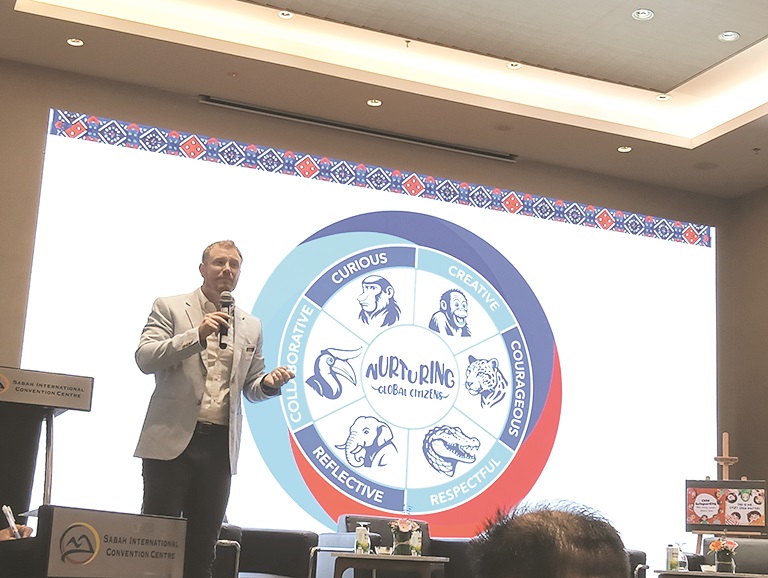
Kota Kinabalu: Organisations working with children must move beyond treating safeguarding as a compliance exercise and instead embed it as a culture that guides every decision, policy and action, said Kinabalu International School (KIS) Principal Sam Gipson.
Delivering his keynote titled “Building a Protective Community” at the Child Safeguarding Conference here, Gipson said safeguarding should not be viewed as a standalone task or administrative requirement but as a shared organisational mindset rooted in values, behaviour and collective responsibility.
“Many organisations tend to respond to child protection concerns in a purely operational manner, focusing on immediate interventions and procedures,” he said.
He cautioned that this approach can become reactive if it is not anchored in a deeper cultural framework.
“A protective community is one that safeguards children. Safeguarding is not simply a job; it is a culture,” he said, adding that when safeguarding is treated only as a process, it risks becoming fragmented and inconsistent across different cases and teams.
Instead, Gipson said safeguarding must begin with clearly defined organisational values that shape how individuals think, communicate and act in situations involving children.
He said values are not abstract principles but practical tools that influence daily decision-making.
He highlighted values such as curiosity, creativity, collaboration, courage, reflection and respect as essential foundations for safeguarding practice, noting that these behaviours help teams avoid assumptions and encourage a more holistic assessment of risk.
He said curiosity ensures professionals listen to multiple perspectives before drawing conclusions, while collaboration ensures safeguarding responsibilities are shared rather than placed on a single individual.
Gipson also emphasised the importance of courage in making difficult decisions that may not always be popular but are necessary for a child’s long-term safety.
Reflection, he added, ensures organisations learn from each case rather than simply moving on after immediate issues are resolved.
He also highlighted the importance of establishing a shared safeguarding language within organisations, particularly in diverse or multilingual environments, to ensure consistency in understanding, communication and response.
“Do you have an agreed-upon language or buzzwords in your organisation?
“A common language with shared definitions is one of the most powerful tools for building culture and safeguarding children,” he said.
Gipson said that at KIS, safeguarding principles are embedded directly into policies and systems, ensuring values are not merely symbolic but actively guide procedures and decision-making across the institution.
He emphasised that every policy within the school begins with its guiding statements, reinforcing a consistent cultural framework that runs through all operational areas.
This, he said, helps ensure safeguarding is not treated as an isolated function but is integrated into everyday institutional practice.
On practical implementation, he encouraged organisations to align their systems closely with their values and to regularly revisit their mission and guiding statements during meetings and decision-making processes, particularly when handling sensitive child protection matters.
He also urged organisations to consider how artificial intelligence could be used responsibly to strengthen safeguarding frameworks, including reviewing and refining policies to ensure alignment with organisational values and improving consistency across documentation.
However, he cautioned that safeguarding cannot rest on individuals alone, underlining that protecting children is a collective responsibility requiring participation from the entire community.
“We are not superheroes. We are pieces of a puzzle.
“Each person has a role, and only together can we see the full picture,” Gipson said.
He further emphasised that every member of a community — from teachers and parents to support staff, drivers and school leaders – plays a critical role in identifying and responding to potential risks, even when the signals appear small or disconnected.
He said strong safeguarding systems depend on collaboration, communication and trust, and warned against the danger of making assumptions when information is incomplete.
In many cases, he said, key insights only emerge when different individuals contribute separate observations that collectively reveal the wider picture.
“A truly protective community is one where safeguarding is not centralised in one team or individual but is instead distributed across the entire organisation, ensuring concerns are identified early and acted upon effectively.
“Protecting children is everyone’s responsibility,” he said.