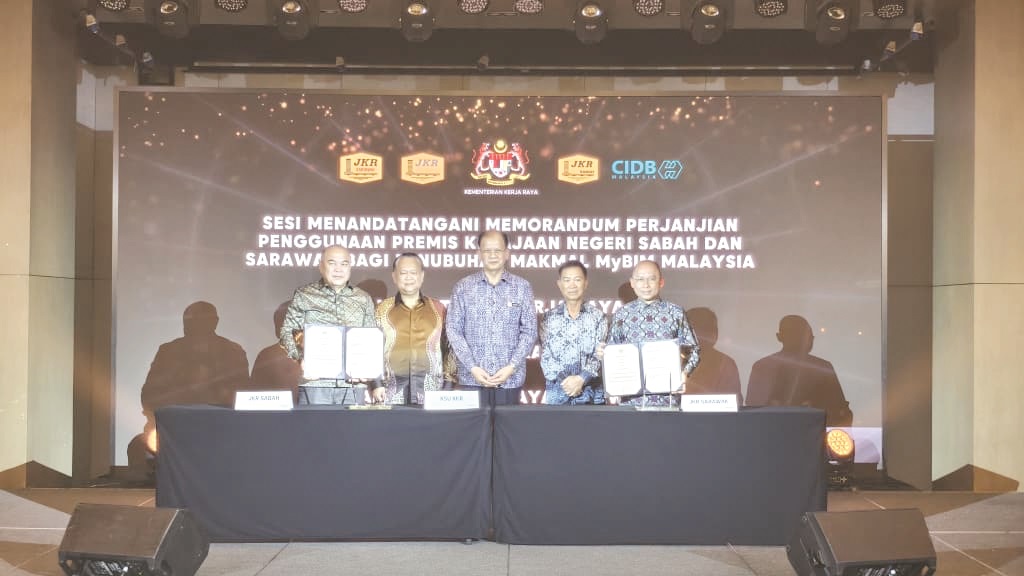
Kota Kinabalu: Works Minister Datuk Alexander Nanta Linggi has called for a new culture of collaboration across government agencies to accelerate infrastructure delivery, stressing that the biggest challenge facing the country today is no longer planning but execution.
Launching the Malaysia Public Works Strategic Collaboration Programme 2026 at Le Méridien here, he said delays caused by land acquisition, utility relocation, inter-agency coordination and slow decision-making should no longer be accepted as reasons for stalled projects.
Advertisement

“People do not judge us based on our excuses. They judge us based on results,” he said.
Alexander said ministries, departments, technical agencies, utility companies and all stakeholders must abandon silo working and make collaboration a daily practice to ensure issues that can be resolved through discussion are no longer allowed to drag on for months or years.
He said infrastructure should not be viewed merely as roads, bridges or buildings, but as the foundation for economic opportunities, access to education and healthcare, public safety and investor confidence.
“When a road is completed, what we are really building are employment opportunities, better mobility and the future of a community,” he said.
Advertisement

He also urged a shift in measuring success, saying the ministry should no longer focus solely on the number of projects approved or kilometres of roads constructed.
Instead, he said success should be measured by whether people enjoy safer journeys, lower logistics costs, greater investment opportunities and an improved quality of life.
Alexander described Sabah and Sarawak as occupying a special place in Malaysia’s development agenda, saying development in Borneo should be regarded as a national priority rather than a regional one.
He said major projects such as the Pan Borneo Highway, Sarawak-Sabah Link Road (SSLR), the proposed Trans Borneo Highway and other strategic infrastructure initiatives serve as bridges that connect opportunities, strengthen the economy and reinforce national unity.
The minister also commended the Ministry of Works (KKR), Public Works Department (JKR), Malaysian Highway Authority (LLM), Construction Industry Development Board (CIDB), and the Sabah and Sarawak governments for the progress achieved over the past two years.
He cited advances in the Pan Borneo Highway, SSLR, digitalisation initiatives and cross-agency collaboration as proof that significant challenges can be overcome when agencies work as one team.
However, he cautioned against complacency, saying success brings greater responsibility and Malaysia must continue improving efficiency, innovation and reform to remain competitive as other countries accelerate their own transformation.
Alexander said digital transformation is no longer optional, with KKR strengthening the adoption of Building Information Modelling (BIM), artificial intelligence (AI), asset digitalisation and data analytics throughout the infrastructure lifecycle to improve planning and project delivery.