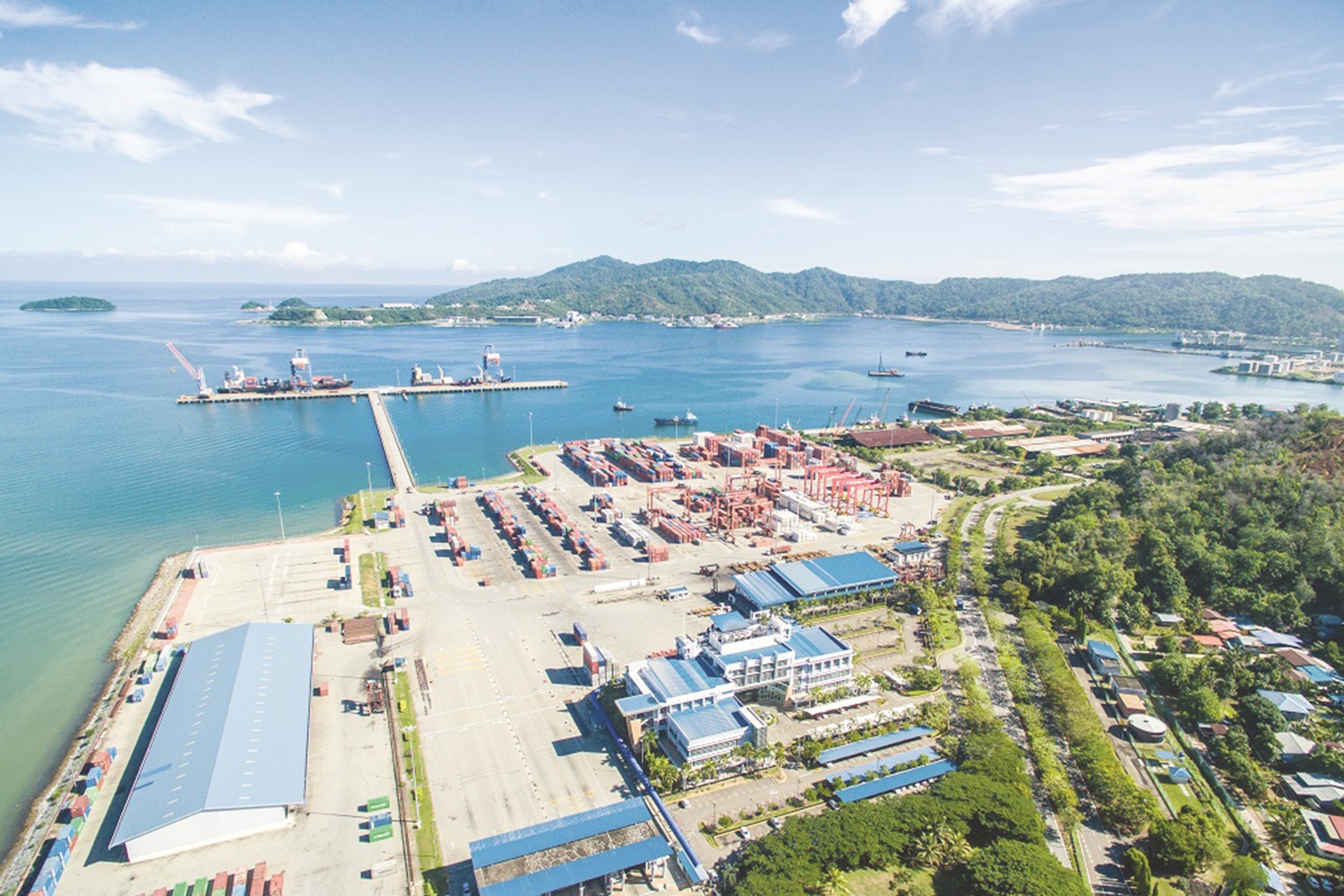
Kota Kinabalu: The State Government said it is premature to conduct a formal performance review or audit of DP World Sabah’s management of Sepanggar Bay Container Port (SBCP) as the port’s expansion project has yet to be completed.
Deputy Chief Minister and Industrial Development, Entrepreneurship and Transport Minister Datuk Ewon Benedick said the strategic partnership between Sabah Ports Sdn Bhd (SPSB) and DP World Sabah was intended to improve port efficiency and position SBCP as a transhipment and trade hub for the Bimp-Eaga region and intra-Asean.
Advertisement

Responding to questions from Tanjung Aru Assemblyman Datuk Junz Wong during the State Legislative Assembly sitting on Monday, Ewon said the port expansion project, originally scheduled for completion in February 2025, had been delayed and granted five extensions of time.
He said DP World Sabah assumed management of the port in September 2024 when the expansion project was expected to have been completed or nearing completion.
“Given that the expansion project is still ongoing and the port continues to face capacity constraints, it is premature and inappropriate to conduct any formal performance review or audit of DP World Sabah’s management in relation to making SBCP a transhipment hub at this stage,” he said.
Ewon said the Sabah Ports Authority (LPPS), as the regulator, continuously monitors operational performance indicators, including average berth waiting time (ABWT), container dwell time and yard utilisation.
Advertisement

He said the average berth waiting time improved significantly from 66 hours during the 10 months before DP World Sabah’s takeover, between December 2023 and September 2024, to 20.24 hours during the subsequent 10 months from October 2024 to July 2025.
He said the improvement was achieved through higher productivity, better berth planning and, for the first time, the simultaneous operation of four quay cranes.
However, Ewon acknowledged a recent increase in vessel waiting time, attributing it to container yard utilisation reaching 101 per cent following higher throughput, the temporary loss of 10 per cent of storage space for expansion works and delays caused by terminal gate upgrading.
On yard utilisation, he said DP World Sabah increased storage capacity by 41 per cent from 6,800 TEUs to 9,574 TEUs through yard reorganisation and higher container stacking after taking over operations.
He said the additional capacity had nevertheless been outpaced by increased cargo volumes driven by Sabah’s economic growth, resulting in average yard utilisation exceeding 70 per cent and reaching 100 per cent during peak periods.
To ease congestion, Ewon said the Government was converting the existing roll-on/roll-off area into temporary storage for empty containers, had secured a commitment from contractor WCT-CCCC to complete a new four-acre container yard by December 2026 and was in the process of acquiring an adjacent 14-acre site for temporary container storage.
On container dwell time, he said the average increased from four days between January and October 2024 to 5.1 days up to June 2026, mainly due to higher container throughput, congestion at the terminal gate and maximum utilisation of the container yard.
He added that container release procedures involving importers, shipping agents and enforcement agencies, as well as other commercial factors beyond the port operator’s control, also contributed to longer dwell times.
“DP World Sabah is implementing various operational improvements, including optimising port planning, strengthening coordination with customers and relevant agencies, and improving container handling efficiency to progressively reduce container dwell time in line with increasing throughput,” he said.
Ewon said DP World Sabah had demonstrated good operational performance despite infrastructure constraints and stressed that the challenges were linked more to critical capacity limitations than to weaknesses in port management.
He said the Ministry had introduced 10 interim action plans through a task force involving port users, logistics and shipping associations, Customs and other government agencies to ensure the smooth flow of Sabah’s logistics and economy while the expansion project continued.
Replying to a supplementary question on whether a full report on SBCP’s performance would be tabled in the Assembly, Ewon said the Government was prepared to do so if required under the mandate of the State Cabinet, while updates could also continue through debates and question-and-answer sessions.
Asked who should be held responsible for the operational issues, he said responsibility rested with the wider port ecosystem rather than any single party.
“I take responsibility as the Minister in charge of the transport portfolio, and that is why I chair the task force involving all stakeholders to resolve these issues together,” he said.
Ewon also dismissed claims that traffic congestion at the port had stretched as far as four kilometres, describing such assertions as inaccurate and urging assemblymen to verify information before making public statements.
He expressed confidence that the port expansion project would be completed next year, allowing SBCP to support greater economic activity as Sabah continued to attract higher levels of investment.