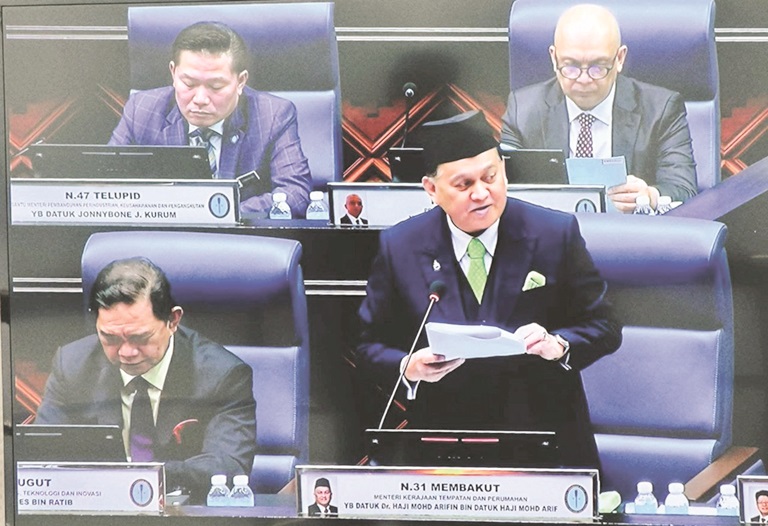
THE State Legislative Assembly on Thursday passed the Majlis Hal Ehwal Anak Negeri Sabah (Amendment) Bill 2026, strengthening the body’s role as part of the State Government’s wider reform of native institutions.
The Bill was tabled by Local Government and Housing Minister Datuk Mohd Arifin Mohd Arif (pic), who said the amendments would reinforce the Majlis Hal Ehwal Anak Negeri Sabah (MHEANS) as the State Government’s principal advisory body on native customary affairs without changing its core function.
“The proposed amendment is not meant to change the basic function of MHEANS as an advisory body to the State Government,” he said.
“Instead, this amendment aims to strengthen the position and role of MHEANS so it can continue carrying out its function more effectively within the native institution reform framework currently being implemented by the state government.”
Mohd Arifin said the Bill was a consequential amendment linked to the Native Court Enactment 2026 and the District Chief, Native Chief and Village Head Enactment 2026, with all three forming part of the same reform package.
Under the reforms, MHEANS will continue advising the government on native customary affairs and law, while the Native Court will exercise judicial functions and a newly created Adat Officer post will handle investigations and enforcement.
Among the key amendments, the Bill creates the Adat Officer position to receive and investigate reports of breaches of native customary law, expands MHEANS’ role to advise the government on customary education, and empowers the council to recommend candidates for appointment as Elders to the Chief Justice.
The power of appointment will remain with the Chief Justice under the Native Court Enactment 2026.
The Bill also increases the number of appointed MHEANS members from six to not more than nine and adds the Director of the Sabah Native Affairs Department, or an authorised representative, as an ex officio member to strengthen coordination and broaden representation across Sabah’s ethnic communities.
Mohd Arifin said Adat Officers would be appointed from qualified state civil servants with knowledge of native customary law. They would receive and investigate reports, handle cases referred to them and initiate, conduct or discontinue proceedings before the Native Court.
He stressed that Adat Officers would not perform judicial functions.
“It is important to clarify that an Adat Officer is not a judge and will not hear or decide cases,” he said, adding that the separation of investigative and judicial responsibilities would safeguard the independence of the Native Court.
He expressed hope the reforms would lead to wider recognition and practice of native customary law in Sabah.
“This role is important so that adat is not just preserved as heritage but also understood and passed down to the next generation,” he said.
Seven assemblymen namely Pantai Manis, Inanam, Paginatan, Moyog, Tamparuli, Bugaya and Sulabayan debated the Bill before it was passed by the Assembly.


.png)