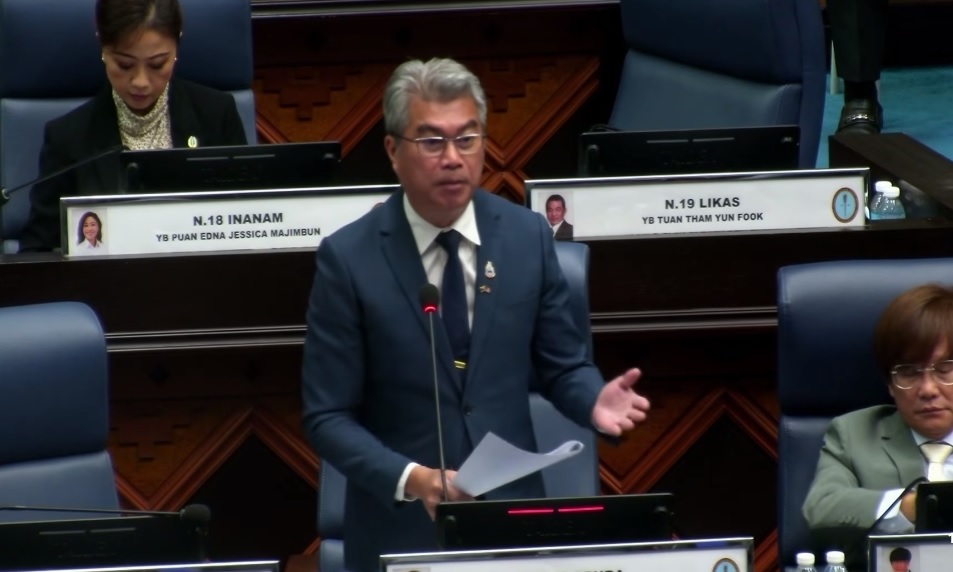
ELOPURA assemblyman Calvin Chong says he cannot support the supplementary supply bill without clarity on how much will be channelled to development projects in Sandakan.
“I cannot support it because it is still unclear how much Sandakan will receive.
“I am not trying to oppose the government. I only hope for a clearer budget for the people of Sandakan,” he said while debating the Supplementary Supply Bill 2026 at the Sabah legislative assembly sitting here on Tuesday (July 21).
Chong (Warisan-Elopura) said he had raised Sandakan’s needs in the House every year, but residents still did not know which projects would be prioritised or when they would begin.
He called for a priority list of five major Sandakan projects, with target dates covering approval, procurement, contractor appointment and implementation.
Chong also urged the government to review the diesel subsidy policy for Sabah, citing its long travelling distances, vast rural areas, limited public transport and dependence on diesel-powered vehicles.
Advertisement

He said the purchase limits affected rural parents sending their children to school, tourism operators, generator owners and operators of community-run hearses.
“Sabah is one of the country’s main oil and gas-producing states, yet its people are also being affected by the limits on subsidised diesel purchases,” he said.
He called for an exemption, greater purchasing flexibility or a special category for those with genuine needs.
On healthcare, Chong sought an update on the proposed new building for the Duchess of Kent Hospital, which serves Sandakan, Beluran, Kinabatangan and surrounding areas.
He said residents had been waiting since 2023 for certainty over the project, while the hospital continued to face overcrowding, long waiting times, inadequate facilities and shortages of doctors and specialists.
“People do not merely want allocations announced on paper. They want to see real improvements in the healthcare services they receive,” he said.
Chong asked how much of the additional RM225,000 allocated to the state Health Ministry would go to the hospital and when construction of the new building would begin.
On water supply, he said Sandakan residents sometimes waited five to 10 days for supply to be restored after repeated pipe bursts.
Noting that the Sabah Water Department received an additional RM201.03mil, he asked how much would be allocated to Sandakan.
“Almost every week, Sandakan faces a burst pipe. Once one location is repaired, another leak or burst occurs elsewhere,” he said.
Chong sought plans to upgrade treatment facilities and increase capacity at Segaliud or Bukit Garam to stabilise supply and water pressure.
On Sandakan Port, he said frequent crane breakdowns and a shortage of outbound cargo were raising logistics costs and weakening its competitiveness.
“Containers come into Sandakan, but very few leave with cargo. Ships may have to carry empty containers back or leave without a return load,” he said.
Chong asked whether the cranes and other port facilities would be replaced or upgraded.
He also sought updates on an electric vehicle-related project in Sandakan, saying the identified site remained vacant despite its announcement last year.
On the Esteel project, Chong asked whether its environmental impact assessment report had been approved, why there had been little visible progress and how many Sabahans were employed by the company.
He also highlighted 17 older housing developments in Elopura, including Sri Taman, International Flats and Kim Fung Flats, which he said had no functioning management corporations.
Residents were therefore left without a clear channel for complaints over clogged drains, parking problems, stray animals, rubbish and damaged streetlights.
“The reality is that some of these places do not have a functioning management corporation,” he said.
Chong asked whether the state would temporarily take over maintenance at such housing schemes and when more affordable housing would be built in Sandakan.


.png)