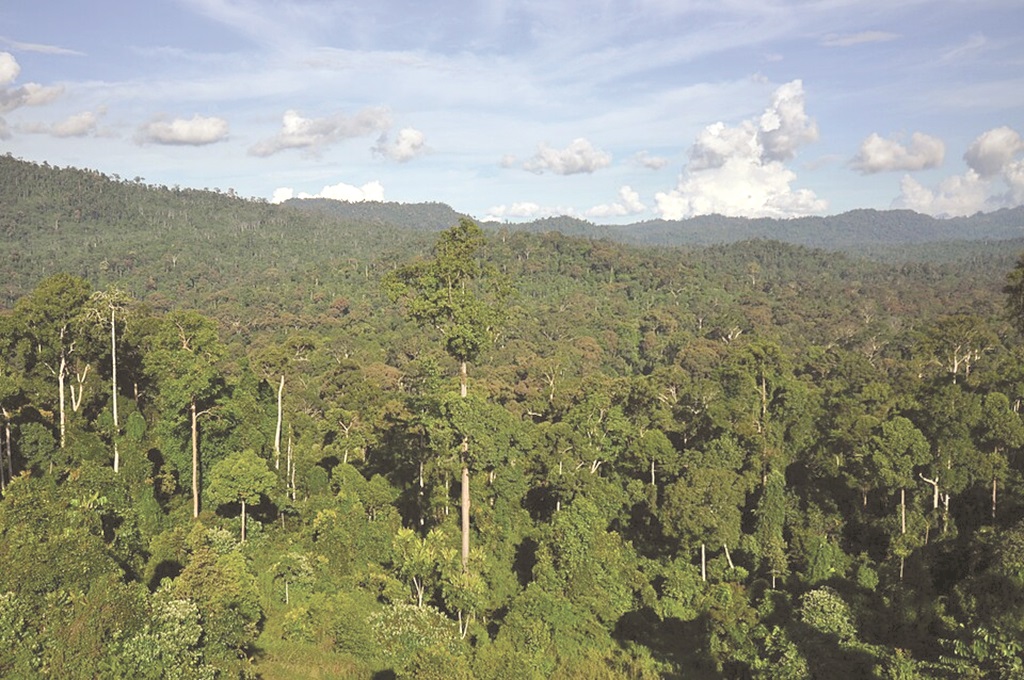
WHEN people think of Sabah, they often picture majestic Mount Kinabalu, ancient rainforests, orangutans, and beautiful islands. But Sabah offers something even more valuable to the world and it is one of nature’s greatest allies in fighting climate change.
Covering approximately 73,904 square kilometres on the northern part of Borneo, Sabah is Malaysia’s second-largest state. Remarkably, about 63pc of its land remains forested, making it one of the country’s largest natural carbon sinks.

In simple terms, Sabah’s forests absorb more carbon dioxide (CO₂) from the atmosphere than the state emits, helping to slow global warming while providing invaluable environmental services.
Nature: Sabah’s Greatest Climate Asset
Forests are often called the “lungs of the Earth,” but they are also among the planet’s most effective carbon storage systems.
Through photosynthesis, trees absorb carbon dioxide in which the principal greenhouse gas driving climate change and store carbon in their trunks, branches, roots, leaves, and surrounding soils. This natural process helps regulate the Earth’s climate.
Sabah’s extensive tropical rainforests, mangrove ecosystems, and peatlands are particularly effective at capturing and storing carbon over long periods. Among these, mangrove forests are exceptionally valuable.
They can store significantly more carbon per hectare than many inland forests while simultaneously protecting coastlines from erosion, reducing storm surges, supporting fisheries, and preserving rich biodiversity.
By safeguarding these ecosystems, Sabah is not only conserving wildlife and protecting water resources but also providing one of the world’s most effective nature-based solutions to climate change.
Preparing for a Changing Climate
Climate change is no longer a distant problem. Its effects are already being felt across Sabah. Many communities are experiencing more frequent floods, prolonged dry spells, rising temperatures, coastal erosion, and increasing pressure on water resources.
These changes affect agriculture, public health, infrastructure, and livelihoods.
To prepare for these challenges, Sabah is investing in climate adaptation measures such as improving flood management, strengthening water resource planning, protecting vulnerable coastal areas, developing climate-resilient infrastructure, and enhancing disaster preparedness.
These efforts help communities become more resilient to future climate risks.
What Is Carbon Trading?
One of the most exciting and promising opportunities for Sabah is carbon trading.
Imagine a company that wants to reduce its environmental impact but cannot immediately eliminate all of its carbon emissions. It can purchase carbon credits from projects that remove or prevent greenhouse gas emissions elsewhere.
In Sabah, carbon credits can be created through activities, for example, conserving natural forests, replanting degraded forests, restoring mangroves, protecting peatlands, and practising sustainable forest management.
Every verified carbon credit represents a measurable reduction or removal of carbon dioxide from the atmosphere.
When these credits are sold through recognised carbon markets, the income can support forest conservation, environmental protection, and local community development.
Sabah has already made history by producing Malaysia’s first Verra-certified forest carbon credits that were traded through the Bursa Carbon Exchange, demonstrating that conservation and economic development can go hand in hand.
Strong Laws Build Confidence
Successful carbon trading depends on transparency, accountability and public confidence or trust.
Recognising this, Sabah introduced the Sabah Climate Change and Carbon Governance Enactment 2025, establishing one of Malaysia’s most comprehensive legal frameworks for climate governance.
The framework provides clear rules for carbon projects, greenhouse gas reporting, climate planning, carbon rights, and environmental oversight.
It also supports transparent governance through dedicated institutions and a state climate fund.
Strong governance gives investors’ confidence while ensuring that climate projects deliver real environmental benefits.
Protecting Indigenous Communities
Climate action should benefit everyone. Sabah’s approach places strong emphasis on respecting the rights of Indigenous peoples and Native Customary Rights (NCR) landholders.
Carbon projects are encouraged to involve local communities through consultation, participation, fair benefit-sharing, and respect for customary land rights.
This ensures that conservation supports both environmental protection and community well-being.
Creating Green Jobs and New Opportunities
Climate action is not only about protecting nature, but it is also about creating economic opportunities.
As the green economy grows, Sabah has the potential to attract new investments and create jobs in areas such as forest restoration project, environmental monitoring programme, ecotourism, sustainable agriculture, environmental consulting, Scientific research and green technology.
Young people can also look forward to careers in satellite monitoring, climate science, biodiversity conservation, carbon accounting, and environmental data analysis.
These emerging industries can diversify Sabah’s economy while protecting its natural heritage.
Supporting Malaysia’s Climate Goals
Sabah’s forests are not only important for the state and are vital for Malaysia.
By protecting its forests and expanding nature-based climate solutions, Sabah plays a significant role in helping Malaysia achieve its commitments under the Paris Agreement to reduce greenhouse gas emissions and move towards a more sustainable future.
Every hectare of forest conserved contributes to national and global climate efforts.
Challenges Ahead
Although the opportunities are enormous, several challenges remain.
Carbon projects must be transparent and scientifically credible. Carbon credits should be accurately measured and carefully monitored to avoid double counting.
Strong governance, skilled professionals, and fair benefit-sharing are essential to maintain public trust and attract responsible investment.
Most importantly, economic development and environmental conservation must move forward together.
A Shared Responsibility
Sabah has been blessed with extraordinary natural resources that benefit not only its people but also the entire world. Its forests, mangroves, rivers, and biodiversity are powerful natural solutions to climate change.
With responsible governance, scientific innovation, community participation, and sustainable development, Sabah has the opportunity to become a regional leader in climate action and carbon trading.
Protecting Sabah’s natural environment is more than conserving beautiful landscapes. And it is an investment in a healthier climate, a stronger economy, and a better future for generations to come.