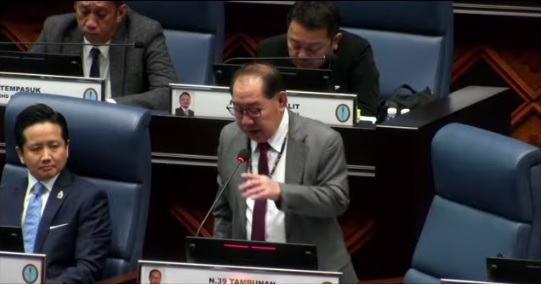
TAMBUNAN Assemblyman Datuk Seri Dr Jeffrey Kitingan has proposed the formation of a bipartisan select committee in the State Legislative Assembly to pursue Sabah’s full rights under the Malaysia Agreement 1963 (MA63), questioning the Federal Government’s continued reliance on interim revenue payments instead of fulfilling its constitutional obligations.
Speaking during the debate on the Supplementary Supply Bill 2026 on Monday, Jeffrey questioned why the Federal Government continued making interim payments to Sabah despite a court ruling declaring the practice invalid.
Advertisement

“Why does the Federal Government continue to make interim revenue payments to Sabah despite a court ruling declaring the practice invalid?” he asked.
“If the court has already made a decision, already made an order, why are we not complying with that order? Does the government not respect the court’s decision?” he said.
Jeffrey said the interim payments, including the RM1.5 billion announced during the Kaamatan Festival, had become an annual practice that served to placate Sabah rather than resolve the State’s constitutional entitlement to 40 per cent of net revenue collected by the Federation.
“This interim payment seems to have become a yearly practice, no longer focused on payment according to the Constitution but more like bait to keep us content,” he said.
Advertisement

“If we do not push for it, we do not even get the interim payment. If we do not raise our voices, there is no special Cabinet committee on MA63 at all.”
He said the government had previously indicated it would invoke a constitutional provision to appoint an independent assessor should the 40 per cent revenue entitlement remain unpaid, and questioned why this mechanism had yet to be activated.
“This year, next year, or when? Why has this not been activated before this?” he asked, describing the repeated interim payments as a means for the Federal Government to avoid meeting its constitutional responsibilities.
Jeffrey also argued that Sabah was owed more than just the 40 per cent revenue share. He said the State had yet to receive any portion of the 10 per cent export duty on petroleum, which he estimated to be worth about RM1 billion annually, based on petroleum export values exceeding RM10 billion.
“This is zero, not paid at all,” he said.
He added that the 10 per cent import duty on petroleum products had been replaced in 2007 with a much smaller fixed payment following an Asean tariff removal agreement that was never implemented.
According to Jeffrey, Sabah currently receives between RM120 million and RM270 million annually instead of the estimated RM1 billion it should be entitled to.
He said these unresolved financial issues, together with other outstanding MA63 matters, raised serious questions about the continued relevance of both the Federal Constitution and the Malaysia Agreement after 63 years.
“An agreement left unfulfilled for this long is, logically and legally, an agreement that has become void on its own,” he said.
Jeffrey estimated that the Federal Government currently collects at least RM50 billion in revenue from Sabah, with the State’s full 40 per cent share amounting to about RM20 billion.
Combined with Sabah’s own annual revenue of between RM6 billion and RM7 billion, he said the State would have a budget exceeding RM26 billion, surpassing Sarawak’s.
“This would solve many of our problems. Water, roads, poverty, underdevelopment and so on,” he said, adding that Sabah would no longer need to seek supplementary allocations each year if its constitutional rights were honoured.
“Let us work together for something more important than us, more important than any ministry, more important than any department, more important than any individual leader, for Sabah,” he said.
Jeffrey further suggested that if Sabah failed to secure its rights through existing government channels, the State should consider legal action against Britain or bring the matter before the International Court of Justice.
“I hope this is also something we will consider one day, should we fail to claim our rights under the Constitution and MA63,” he said.
While supporting the Supplementary Supply Bill in principle, Jeffrey questioned the scale of the additional expenditure, noting that it represented about 25 per cent of the State budget, with nearly 70 per cent allocated to statutory body contributions and general treasury services.
“Why is this supplementary supply so large? Is this to pay for something that is so urgent? Is this an allocation to pay for something new?” he asked.
He questioned whether some of the expenditure could instead be deferred to the State Budget scheduled to be tabled in October.
“Why not focus instead on agricultural needs, farm roads, flood mitigation and village roads?” he said.
Jeffrey also noted the RM27 million allocation for the Department of Irrigation and Drainage and expressed hope that it would include funding for flood mitigation projects in Tambunan that had already received Cabinet approval but had yet to be implemented.