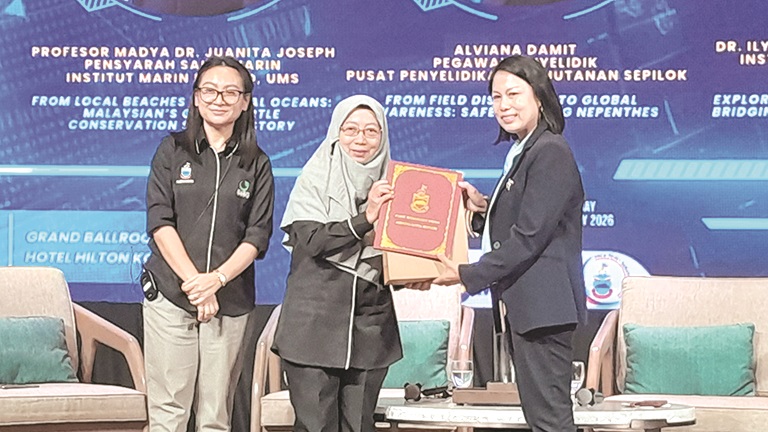
Kota Kinabalu: Nearly a century of sea turtle conservation in Sabah, strengthened by more than three decades of scientific research, has helped protect migratory turtle populations while shaping conservation policies across Malaysia and the wider Indo-Pacific region.
Universiti Malaysia Sabah’s (UMS) Institute of Marine Borneo Deputy Dean (Academic and International), Assoc Prof Dr Juanita Joseph, said conservation efforts in Sabah had evolved from protecting nesting beaches to using advanced genetic research to guide evidence-based policies.
“We have been conducting turtle research in Sabah for more than 30 years. We have learned about their biology — where they nest, where they feed and what habitats they depend on.
“The scientific data becomes evidence that helps us improve habitat management. We translate it into standard operating procedures and data that can be used by government agencies, NGOs, resort owners and the public,” she said during a panel discussion at the recent International Biodiversity Day celebration.
Juanita said Sabah’s conservation journey began in the 1920s under the British North Borneo Administration.
“After independence, the Sabah government continued these efforts, and in the 1970s, important nesting islands in Sandakan were gazetted as Turtle Islands Park,” she said.
Advertisement

Research expanded significantly in the 1990s and has since entered a new phase driven by collaboration among local communities, researchers, NGOs and government agencies.
She said the forum’s theme, “Acting Locally for Global Impact”, aptly reflected sea turtle conservation because the animals spend their lives migrating across international waters.
“When turtle eggs hatch on Sabah’s beaches, the hatchlings enter the ocean and cross several national boundaries. They may be born in Sabah, but their feeding grounds may be in Vietnam, Indonesia, Thailand and elsewhere,” she said.
Genetic studies by her team have revealed how closely connected turtle populations are throughout the region.
Turtles that nest in Sandakan do not necessarily feed there. Many migrate to feeding grounds in Semporna and Brunei Bay, while others travel as far as Thailand, Indonesia and the Philippines.
Likewise, turtles feeding in Semporna often return to nest in Sandakan, while some originate from nesting populations as distant as Micronesia.
Sea turtle feeding grounds are marine areas where turtles obtain the food needed for growth, survival and reproduction, while nesting grounds are sandy beaches where adult females come ashore to lay eggs before returning to the sea.
These habitats are closely linked because healthy feeding grounds provide females with the energy required to migrate and reproduce successfully.
“Through genetic research, we discovered that these turtles are not ours alone. A turtle feeding in Semporna may actually have hatched in Micronesia. That is where international cooperation begins,” she said, adding that the findings have strengthened cross-border conservation efforts and reinforced Sabah’s role in protecting shared marine biodiversity.
Juanita said modern conservation is increasingly guided by scientific evidence rather than assumptions.
She cited hatchery management at Pulau Bakungan Kecil, where researchers regulate nest temperatures after discovering that incubation temperature determines the sex of hatchlings.
“Warmer temperatures produce females, while cooler temperatures produce males.
“As a result, we manage hatcheries differently. Some nests are shaded while others remain exposed because we now base our management on scientific facts,” she said.
Researchers also excavate nests after hatching to assess hatching success and identify disease or other factors affecting survival, allowing conservation managers to refine breeding practices.
Beyond research, Juanita stressed the importance of community engagement, saying education is key to ensuring long-term conservation success.
She said UMS regularly conducts outreach programmes to teach children and local communities about marine biodiversity and conservation.
One of her greatest achievements, she added, has been translating scientific findings into practical community action.
“We also conduct awareness and education programmes with local communities. In Sabah, we are very fortunate because everyone works together,” she said, citing Kudat and Semporna as examples where communities now play leading roles in sea turtle conservation with guidance from researchers.
Many communities have also developed ecotourism activities, allowing visitors to witness hatchling releases while generating additional income and raising awareness about marine conservation.
Juanita described Sabah’s Turtle Islands Park as one of the world’s longest-running sea turtle conservation programmes and a globally recognised conservation model.
Since 1970, the number of turtle nests recorded on the islands has tripled, with annual nesting now exceeding 20,000 nests.
She attributed the programme’s success to cooperation among Sabah Parks, the State Wildlife Department, universities, NGOs, private-sector partners and local communities.
Juanita urged Malaysians, including those living far from the coast, to contribute through simple everyday actions such as refusing to consume turtle eggs, reducing single-use plastics and avoiding littering.
“These local actions collectively create significant global impacts on biodiversity conservation, particularly for Sabah’s marine ecosystems.
“If we cannot directly protect the ocean, then let us protect the environment around us,” she said.


.png)