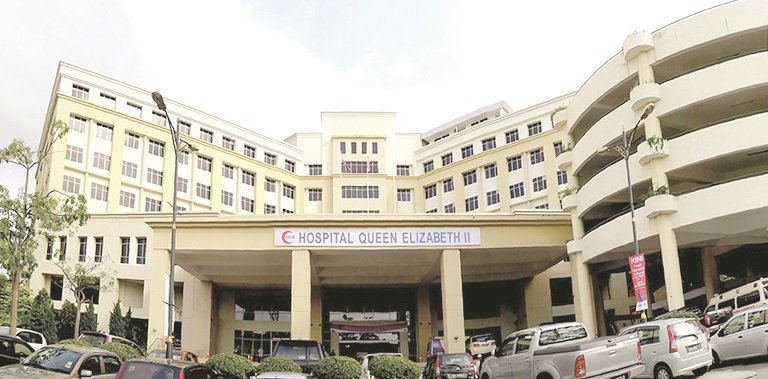
Kota Kinabalu: Nominated assemblyman Datuk Chin Shu Ying has called for creation of approximately 830 additional positions at Queen Elizabeth Hospital II (HQE II), while warning that manpower shortages are preventing the hospital from operating at full capacity.
Speaking during the debate on the Supplementary Supply Bill 2026 at the Sabah State Legislative Assembly, here Tuesday, he said such expansion is critical to support the state’s long-term plans to develop HQE II into the Sabah Heart Centre.
He said the HQE II hospital, which serves as Sabah’s specialist hospital and primary referral centre for cardiology, cardiothoracic and other specialist services, currently has 1,454 approved positions designed to accommodate 400 beds.
However, he said the hospital’s ability to provide the best possible services is now facing increasingly serious challenges due to manpower shortages.
“To ensure that HQE II can operate optimally in line with its 400-bed capacity, and to sustainably support the development of the Sabah Heart Centre over the next 10 to 20 years, the hospital requires a phased increase in staffing to reach 2,284 positions.
“This means there is a need to create approximately 830 additional positions to meet the hospital’s actual operational requirements,” he said.
Advertisement

Chin said HQE II not only caters to patients from Kota Kinabalu but also serves as the main referral centre for Sabah and receives cases from the Federal Territory of Labuan.
He said the hospital’s staffing structure no longer reflected present realities, because number of patients continuing to rise alongside increasingly complex cases that require intensive care and advanced medical technology.
“This situation has led to a shrinking staff-to-patient ratio as the workload of doctors, nurses, allied health professionals and support staff continues to increase day by day.
“What is even more concerning is that although HQE II has an official capacity of 400 beds, only 284 beds can currently be fully operational. This means that more than a quarter of the hospital’s capacity cannot be utilised due to insufficient staffing,” he said.
According to Chin, the hospital’s Bed Occupancy Rate (BOR) consistently exceeds 80 per cent, while annual patient admissions stand at between 12,000 and 12,500.
Therefore, he said investments in infrastructure and medical equipment would be of limited value without a sufficient workforce to support them.
“A hospital cannot function on buildings and machines alone. Hospitals require doctors, nurses, pharmacists, therapists, laboratory technologists, radiographers and an adequate healthcare workforce to operate the system.
“Therefore, increasing staffing positions is not a luxury but a fundamental necessity,” he said.
Chin said the government’s aspiration to establish HQE II as the Sabah Heart Centre is commendable but stressed that equal emphasis must be placed on providing human capital development.
“I fully support this aspiration. However, we must recognise that developing a heart centre is not merely about constructing buildings or purchasing angiography machines and modern cardiac surgery equipment.
“More importantly, it is about ensuring there is an adequate and highly skilled workforce to operate these facilities. Without sufficient human resources, investments in infrastructure cannot be fully utilised,” he said.
He urged the State Government to work closely with the Federal Government, particularly the Ministry of Health, to ensure the request for additional positions is prioritised.
“This is not merely about meeting the needs of a hospital, but an investment in the future of Sabah’s healthcare system.
“If we truly want Sabah to have a Heart Centre on par with the country’s leading cardiac centres, we must ensure that human capital development is accorded the same level of importance as physical development,” he added.
Chin said Sabah’s vast geographical landscape and growing population, coupled with rising demand for cardiac treatment and chronic disease management, underscored the need for long-term healthcare planning.
“The health of the people is not a cost, but an investment in the future of the state,” he said.


.png)