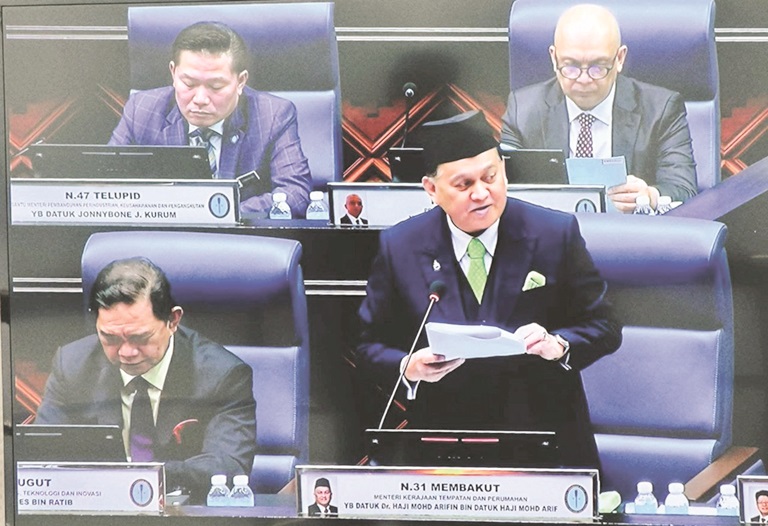
Kota Kinabalu: Sabah has made a historical milestone by enacting the first legislation in Malaysia specifically governing the administration of Muslim estates under the jurisdiction and powers of the Syariah Courts.
The State Assembly on Wednesday passed the Muslim Succession Enactment 2026, which pioneers Malaysia’s Syariah Court-based legislation on Muslim estate administration.
Speaker Datuk Seri Kadzim M.Yahya announced the passing of the Bill after majority of the August House members agreed to the establishment of the new law.
State Local Government and Housing Minister Datuk Dr Mohd Arifin Mohd Arif, who tabled the Bill, said the enactment provides a clear and holistic legal framework for the management and distribution of Muslim estates in accordance with Hukum Syarak, while safeguarding the rights of heirs and other interested parties.
“This Bill marks a historic milestone. It is the first law in Malaysia specifically dedicated to the administration of Muslim estates under the jurisdiction and authority of the Syariah Courts,” he said in his winding-up speech,
Dr Mohd Arifin said the administration of estates is not merely a matter of asset distribution but it is a Fardu Kifayah (communal religious obligation) involving the rights of the deceased, the rights of heirs and religious obligations.
Advertisement

“This Bill ensures that every phase of estate administration—from the determination of heirs, settlement of debts, execution of wills, to the distribution of inheritance according to faraid— is carried out fairly, equitably and in compliance with Syariah principles.
“It also provides legal clarity for converts to Islam (mualaf) to manage their assets early by encouraging estate planning during their lifetime through instruments such as hibah (gifts), wills (wasiat), or any other means permitted under Islamic law,” he said.
He said in cases where a mualaf dies without making prior estate arrangements, the Syariah Court would be empowered to administer and distribute the estate in accordance with Hukum Syarak without disregarding the interests of non-Muslim family members.
“Non-Muslim family members of a deceased mualaf are given the opportunity and right to appear before the Syariah Court to state their interests in the deceased’s estate,” he said.
Under the Bill, he said the Syariah Court will also have the authority to hear claims involving debts, jointly acquired property (harta sepencarian) and other legitimate interests of non-Muslim family members, ensuring disputes are resolved fairly while preserving harmonious family relationships.
“The legislation further seeks to protect vulnerable groups, including children, persons with disabilities or incapacity and missing persons (mafqud), whose inheritance rights are often at risk,” he said.
Dr Mohd Arifin said there had been cases of estate assets being misappropriated because heirs were minors or could not be located.
“Through this Bill, strict safeguards and regulatory mechanisms are introduced to ensure that the rights of these individuals are protected and that they are not unjustly treated,” he said.
He said the Bill also establishes clear enforcement powers and provides for offences relating to Muslim estates, including falsifying heirship documents, concealing estate assets and infringing upon the inheritance rights of other heirs.
Those found committing such offences may face legal action under the proposed enactment, which is intended to curb estate-related misconduct that has long been a source of family disputes, he said.
Dr Mohd Arifin said the Muslim Succession Bill 2026 would not only strengthen Sabah’s Syariah judicial system but also deliver greater justice and legal certainty in the administration of Muslim estates in the State.
“The essence and primary objective of this Bill is to provide a strong and holistic legal framework, based on the principles of Hukum Syarak, for the administration of Muslim estates,” he said.


.png)