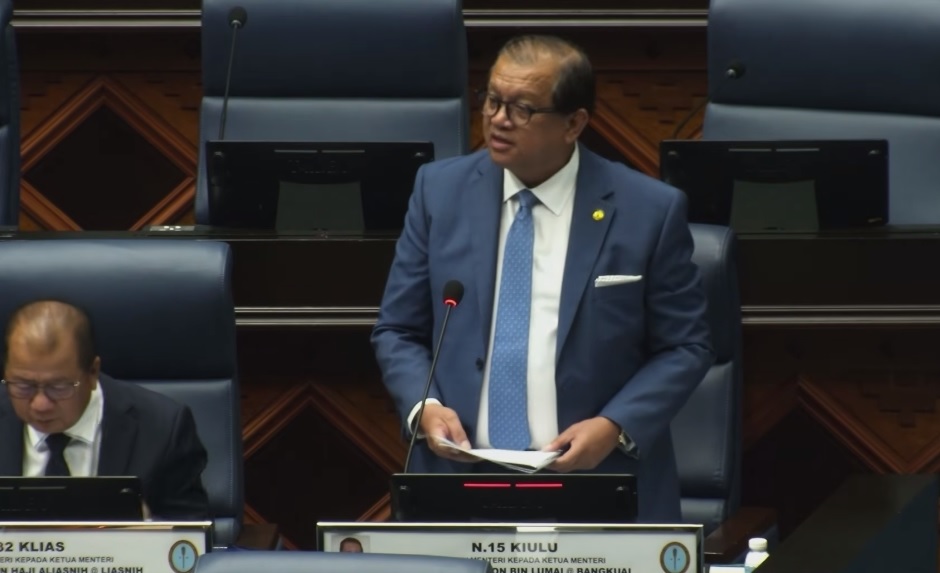
Kota Kinabalu: The Sabah Government is firm in its stance that the implementation of the Malaysia Border Control and Protection Agency Act 2024 (Act 860) must not erode the State’s immigration autonomy, the State Legislative Assembly was told Wednesday.
Assistant Minister to the Chief Minister Datuk Joniston Bangkuai said while the Act falls under Federal jurisdiction, the State’s position is clear: its implementation by the AKPS must not compromise the State’s autonomous rights under the Malaysia Agreement 1963 (MA63).
Responding to a question from Datuk Seri Wilfred Madius Tangau (GRS-Tamparuli), Joniston said Sabah’s immigration powers under Article V of MA63 are “non-negotiable” because the formation of Malaysia under MA63 was subject to the establishment of Sabah’s and Sarawak’s immigration powers.
He said the State Government had conveyed its position in an official letter to the Prime Minister, stressing that the Sabah Immigration Department should remain the agency responsible for controlling the State’s entry points and that the issuance of Not-To-Land (NTL) notices should continue to be under the department’s jurisdiction.
“The Sabah Government also emphasises that constitutional safeguards protecting Sabah’s position must always be preserved to ensure there is no erosion of the State’s special rights, immigration autonomy and the powers of the State authority,” he said.
On May 13, Chief Minister Datuk Seri Hajiji Noor said the State Government had decided to defer the policy and implementation of the Act until it receives assurances that Sabah’s special rights, immigration autonomy and State authority will not be affected.
Advertisement

He stressed that Sabah and Sarawak’s immigration autonomy is non-negotiable, noting that the formation of Malaysia under MA63 was premised on both states being granted autonomous immigration powers.
Meanwhile, a supplementary question on whether Sabah had given its consent to the AKPS Act 2024 prompted a brief exchange over the Federal Government’s legislative process involving the State.
Madius asked whether the State Government had consented to the Act when it was tabled in Parliament, adding that if no consent had been given, he supported Sabah’s decision to defer its implementation.
“I support the State Government’s action if the Bill was passed without Sabah’s consent because matters affecting Sabah’s rights should not proceed without the State’s agreement,” he said.
Madius then claimed that several Federal laws had previously been passed without Sabah’s consent, prompting Speaker Datuk Seri Kadzim M Yahya to describe the allegation as “a very sweeping statement” and urge him to retract or rephrase it, saying it was inappropriate to suggest bad faith without proof.
In response, Madius maintained he could substantiate his claims and cited the 1994 amendment to Article 122A of the Federal Constitution, the Petroleum Development Act 1974 and the Territorial Sea Act 2012 as examples which, in his view, did not receive Sabah’s consent, adding that he had repeatedly sought clarification in Parliament on the legal status of laws passed without such consent.
Madius also said he believed the Federal Government should not merely consult Sabah but obtain the State Government’s consent on matters affecting the State’s rights under Article 161E of the Federal Constitution.
When asked by the Speaker what Sabah Members of Parliament had said when the legislation was passed, Madius replied that the response had consistently been that the matter could be taken to court to determine whether the laws could be enforced.
He added that a legal challenge concerning the amendment to Article 122A of the Federal Constitution on the Yang di-Pertua Negeri’s powers to appoint judges had already been filed in Sabah to determine its legal position.
Replying, Joniston said while he understood the issue of consent, the more important consideration in the context of the AKPS was the State Government’s commitment to defending Sabah’s rights if they were affected.
“At the end of the day, what is important is that the State Government will continue to protect whatever rights we must defend,” he said.


.png)