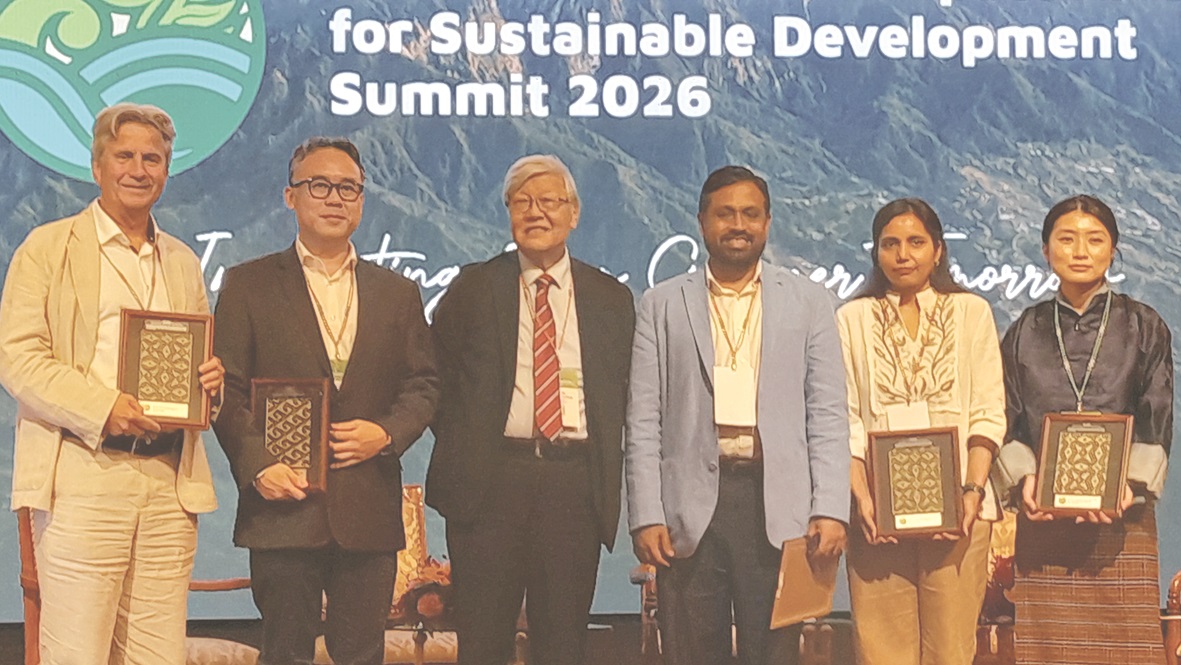
Kota Kinabalu: Sabah has the potential to become a global pioneer in participatory and digitally enabled development by empowering communities to design and shape their own solutions instead of relying solely on conventional top-down planning, said University of Glasgow Professor (Emeritus) of Sustainability and Complex Systems John Crawford.
Speaking at the Sabah Asia-Pacific Impact Investing for Sustainable Development Summit 2026, Crawford said today’s interconnected challenges — including climate change, biodiversity loss, food security, economic resilience and social inequality — are too complex to be addressed through traditional policy approaches alone.
Advertisement

He urged Sabah to adopt a development model centred on continuous learning, community participation and digital collaboration.
“The problems we face today are not single issues that can be solved independently. They are interconnected, constantly changing and inherently unpredictable,” he said.
Crawford said governments should move away from attempting to create fixed long-term solutions and instead embrace adaptive approaches that allow communities to experiment, learn and continuously improve.
Rather than waiting for perfect policies, communities should implement local solutions, monitor outcomes and adjust their approaches based on what works, he said.
“In a complex world, adaptability is more valuable than certainty. Success depends less on producing the ‘right’ plan from the outset than on building systems capable of learning and evolving as conditions change,” he said.
Crawford said digital infrastructure should go beyond providing connectivity or delivering government services. Instead, digital platforms should serve as collaborative spaces where communities can share data, successful practices, lessons from unsuccessful initiatives and locally developed innovations.
He described the concept as a “Creative Commons for participatory place-based development”, where communities collectively build knowledge and accelerate innovation.
“Rather than being passive recipients of government programmes, citizens become active participants in testing, refining and improving solutions. Their experiences and feedback become an essential source of knowledge,” he said.
However, Crawford stressed that technology alone would not be enough. Sabah should also invest in training “network connectors” — facilitators who can bring communities together, encourage collaboration, support knowledge sharing and strengthen local capacity.
“Technology connects systems, but people connect communities,” he said, adding that both elements are necessary to create resilient development ecosystems.
Crawford also proposed the establishment of an independent coordinating institution, potentially led by a university, to manage the digital platform, train facilitators and bring together governments, businesses, investors, non-governmental organisations and local communities.
He said universities are well positioned to serve as neutral institutions that can sustain long-term collaboration across sectors, providing continuity beyond political and electoral cycles while ensuring successful ideas, data and lessons learned are preserved and improved over time.
To illustrate the model, Crawford highlighted an ongoing project in Glasgow that supports the city’s transition towards net zero.
Instead of policymakers determining development priorities, residents were first asked what a thriving city would look like. Their aspirations were then translated into measurable indicators covering social wellbeing, environmental sustainability and economic prosperity.
These indicators now form community dashboards that allow residents to monitor progress and develop their own local initiatives, he said.
“Glasgow’s 26 communities are each implementing locally appropriate solutions while learning from one another through shared measurement and ongoing collaboration,” he said.
He also highlighted a United Kingdom agricultural network supporting farmers in transitioning to regenerative agriculture, where farmers test different approaches under local conditions, share experiences and collectively identify effective solutions rather than following centrally imposed methods.
Crawford said he initially believed large-scale environmental change could be achieved by coordinating some of the world’s largest corporations around soil restoration, an initiative that attracted international interest, including engagement from the World Economic Forum and major investment groups.
However, mathematical modelling and discussions with complex systems experts later convinced him that transformational change could not be achieved through centralised planning alone.
He also questioned conventional policymaking, arguing that governments often develop long-term plans without adequately assessing whether policies deliver their intended outcomes.
Using the United Kingdom as an example, he said only a small proportion of policies are formally evaluated after implementation, limiting opportunities for learning and improvement.
For Sabah, Crawford believes embracing complexity rather than attempting to simplify it could provide an opportunity to move beyond conventional development models.
By combining participatory governance, collaborative digital infrastructure and continuous learning, he said Sabah could position itself as an international example of bottom-up development capable of responding more effectively to rapidly changing global challenges.