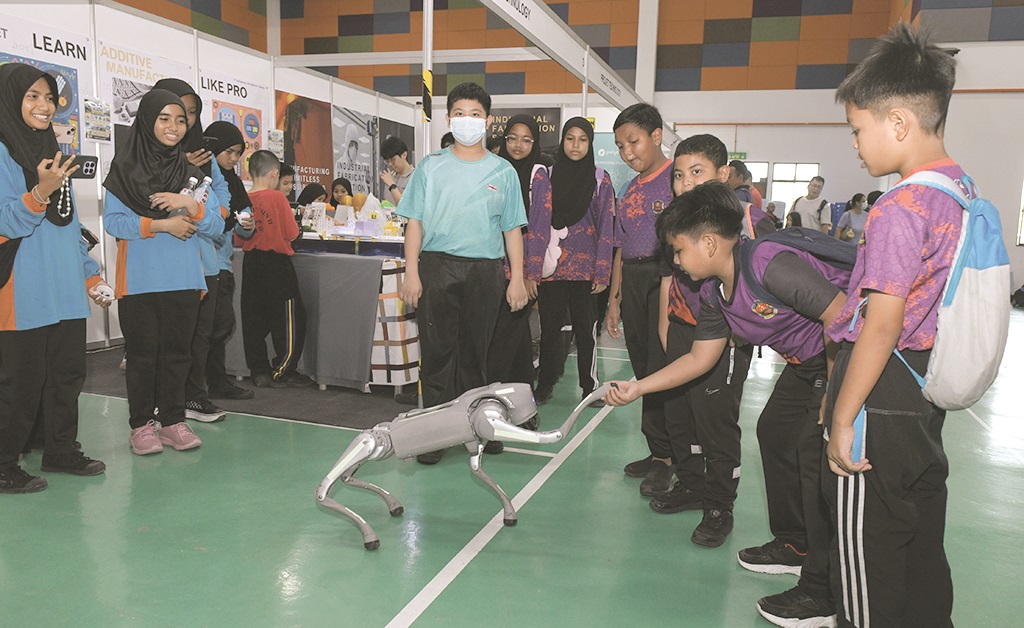
SABAH has taken an important step towards building a stronger future by proposing the establishment of 25 Science, Technology, Engineering and Mathematics (STEM) Centres throughout the state, with a total investment of RM195 million.
If realised, this initiative has the potential to make Sabah the leading STEM education hub in East Malaysia. This is not simply a project to build new learning centres. It is an investment in our young people and in Sabah’s future.
Advertisement

The world is changing faster than ever before. Artificial Intelligence (AI), robotics, drones, automation and digital technology are transforming the way we live, learn and work.
The jobs of tomorrow will require new knowledge and new skills. To remain competitive, Sabah must prepare today’s students to become tomorrow’s engineers, scientists, innovators and technology entrepreneurs.
The proposed STEM Centres will give students the opportunity to explore exciting fields such as AI, robotics, programming, the Internet of Things (IoT), green technology and digital innovation.
More importantly, they will encourage young people to ask questions, solve problems and think creatively. These are the qualities that will help drive the vision of Sabah Maju Jaya 2.0 (SMJ 2.0).
However, buildings and equipment alone will not guarantee success. The real success of this initiative will depend on how well we inspire young people to discover their talents and develop a passion for learning. Engineering is one profession that deserves greater attention.
Many students know what doctors, teachers and lawyers do, but few fully understand the important role of engineers. In reality, engineers shape almost every aspect of modern life.
They design our roads and bridges, provide clean water, generate electricity, develop communication systems, build hospitals and schools, and create technologies that improve our quality of life.
Engineering is not just about constructing buildings. It is about solving problems and improving lives.
For Sabah, this is especially important. Our state continues to face many development challenges, including improving water supply, reducing flood risks, strengthening rural connectivity, expanding renewable energy, protecting our rich natural environment and accelerating digital transformation.
Every one of these priorities requires capable engineers, scientists and technology professionals.
The engineers who will solve these challenges in the next 20 or 30 years may well be sitting in our primary and secondary school classrooms today.
That is why STEM education matters.
Students learn best when they are actively involved. Building a robot, programming a simple computer game, flying a drone, designing a model bridge or creating an environmental solution is often far more inspiring than simply reading from a textbook.
Hands-on learning encourages creativity, teamwork, communication and critical thinking – skills that every future engineer and innovator will need. Teachers will also play a vital role.
As technology continues to advance rapidly, continuous professional development will help teachers stay updated with emerging fields such as AI, renewable energy, smart infrastructure and digital engineering. Well-supported teachers will inspire confident and capable students.
Industry participation is equally important. Engineering companies, technology firms, universities and government agencies can work closely with the STEM Centres by providing mentorship, industrial visits, innovation competitions, internships and practical learning opportunities.
Such collaboration helps students connect classroom learning with real-world applications and broadens their understanding of future career opportunities.
One of the most encouraging aspects of the proposal is the plan to establish STEM Centres throughout Sabah, including rural and interior districts. Talent is not limited by geography.
Given the right opportunities, students from every district can excel and contribute to the state’s future. Every child, regardless of where they live, should have the chance to discover their potential.
The RM195 million investment should therefore be viewed not simply as the cost of constructing new facilities, but as a long-term investment in Sabah’s people.
Every student inspired to pursue science, engineering or technology today could become tomorrow’s innovator, researcher, entrepreneur or engineering leader.
A strong STEM ecosystem cannot be built by the government alone. It requires the support of schools, universities, industries, professional bodies, parents and the wider community. Everyone has a role to play in encouraging young people to explore, create and innovate.
The greatest investment any state can make is not in its buildings, but in its people. By nurturing the next generation of engineers, scientists and innovators, Sabah is laying the foundation for a future that is smarter, more resilient and more prosperous.
If we work together, the vision of making Sabah the leading STEM education hub in East Malaysia can become a reality. More importantly, we will equip our young people with the knowledge, skills and confidence to solve tomorrow’s challenges and build a better Sabah for generations to come.