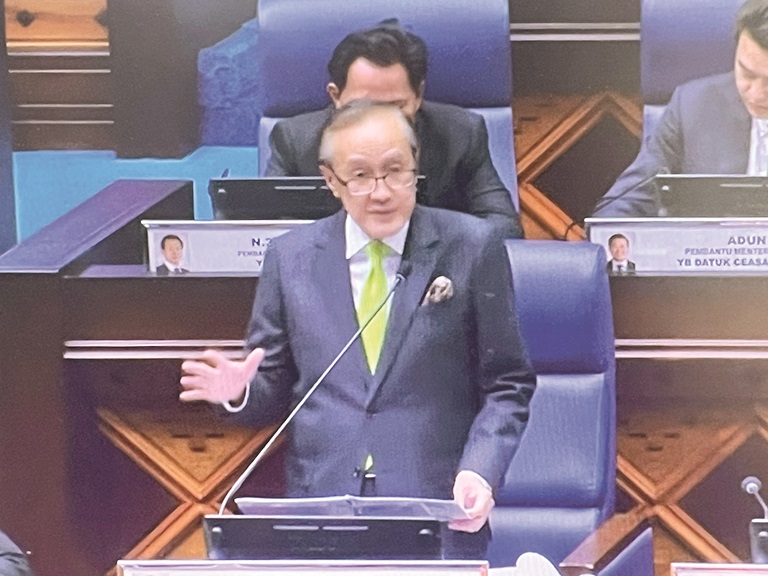
Kota Kinabalu: The Sabah Government’s financial management and accounting adjustment system has been in place for more than two decades and has never been queried by the National Audit Department, said State Finance Minister Datuk Seri Masidi Manjun.
He said the State Government continues to use the same system because it has consistently complied with financial regulations and legal requirements.
Advertisement

“We have been using the same system for decades. It is the same system that has been practised for a very long time.
“And Sabah has received zero audit queries for more than 20 years. Our accounts have never been questioned by the National Audit Department.
“So, we must be doing something right,” he said when winding up the debate on the Supplementary Supply Bill 2026 during the State Legislative Assembly sitting, Tuesday.
He was responding to queries from Datuk Seri Mohd Shafie Apdal (Warisan-Senallang).
Advertisement

Masidi, who is also Deputy Chief Minister II, said the additional RM856 million allocation under the Contributions to Statutory Funds component in the Supplementary Supply Bill 2026 was part of an accounting adjustment exercise and did not involve any cash outflow.
He explained that the primary purpose of the allocation was to ensure all government transactions were properly regularised and complied with legal requirements.
“The most important underlying purpose is what is referred to as an accounting adjustment. It concerns the way we manage government accounts and that is why we are here.
“We want all transactions to be legal and carried out in accordance with the laws and regulations that have already been established,” he said.
According to him, of the RM856 million allocation, RM700 million was contributed to the Development Fund, RM66 million to the State Government Trust Fund and RM90 million to the Road and Bridge Operations and Maintenance Trust Fund.
He said the Road and Bridge Operations and Maintenance Trust Fund is used to undertake road and bridge maintenance works throughout Sabah, covering State Roads, Urban Roads, Housing Estate Roads, Village Roads and Agricultural Roads registered under the Marris/MyInfra system.
Masidi also clarified that the contributions to the statutory funds did not involve any distribution to Government-Linked Companies (GLCs) or State statutory
bodies.
He added that the development allocation contained in CMD.2 was included within the breakdown under Contributions to Statutory Funds outlined in CMD.1.
On the need for additional allocations, Masidi said the preparation of the annual budget is based on projected revenue expected to be received in the following year and involves a comprehensive review and assessment by the Finance Ministry.
He said factors contributing to requests for additional allocations include rising operating costs, weaknesses in initial planning, project implementation delays, changes in project scope and external factors such as inflation and policy changes.
“The Government has carried out a detailed assessment of the justifications submitted by ministries and departments, as well as their programme and project implementation records, before considering these additional allocations,” he said.
He added that all ministries and departments had implemented various measures to optimise the use of existing allocations, including cost-saving initiatives and the reallocation of less critical expenditure before seeking additional funding.
Meanwhile, Masidi said key factors contributing to delays in development projects include site-related issues, weaknesses in planning and design preparation at the early stages, including the need for Variation Orders during construction.
According to him, volatility in building material prices due to global market factors, contractors’ cash flow constraints, unstable ground conditions requiring additional engineering works and delays in utility relocation have also contributed to project delays.
He said the Government takes the issue seriously and has strengthened its monitoring mechanisms through the Sabah Economic and Development Project Information System for reporting the physical and financial progress of projects.
In addition, the Government has optimised the role of the State and District Development Action Committees and continues to convene Development Project Steering Committee meetings at the Ministry and departmental levels to address implementation issues.
Masidi said the effectiveness of development expenditure is measured not only by the amount of money spent but also by the outcomes and impact achieved through project implementation.
He said the State Economic Planning Unit (Upen) is responsible for setting project allocation ceilings and monitoring project progress, while the Finance Ministry oversees financial management and expenditure performance to ensure allocations are utilised prudently, efficiently and effectively.
The State Legislative Assembly passed the Supplementary Supply Bill 2026.


.png)