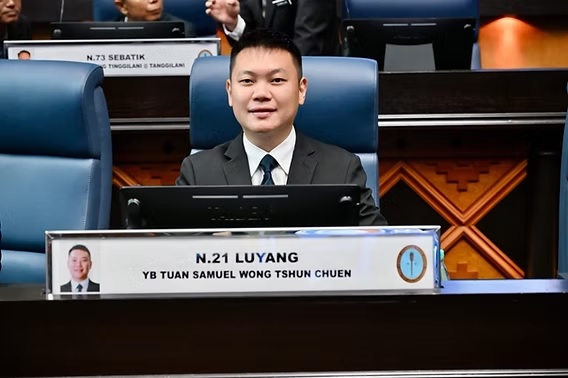
LUYANG Assemblyman Samuel Wong said every year thousands of young Sabahans graduate only to leave for the peninsula or abroad, thus, he proposes a study tracking why graduates are not staying back in Sabah.
“Thousands of Sabahan students graduate from universities, colleges and TVET institutions each year but often struggle to find opportunities matching their skills locally,” he said.
“They have the knowledge, skills and great potential. But the question is whether Sabah’s economy today can offer opportunities that match their talent,” he said when debating the Supplementary Supply Bill 2026, Tuesday.
“If this trend continues, Sabah will not only lose skilled workers. We will lose future entrepreneurs, future professionals and future leaders,” he said.
He proposed a Graduate and Talent Mobility Study to determine how many Sabahan graduates return to work in the State.
“Without reliable data, it is difficult to formulate effective policies,” he said.
Advertisement

He also proposed a Workforce and Industry Alignment Framework linking the government, universities, TVET institutions and industry players.
“We should not only prepare our youths for jobs, but we must also prepare Sabah with industries that are ready for our youths,” he said.
“When more high-value industries grow, more graduates will choose to stay in Sabah. When more local talent stays in Sabah, more companies will have the confidence to invest,” he said.
Additionally, he pointed out that for Sabah’s young musicians, filmmakers and animators, talent alone rarely builds a career at home, thus, he wants clearer outcomes from new skills and creative economy funding.
He questioned the RM2 million additional allocation to the Sabah Skills Development Centre, asking how many graduates found employment or started their own businesses after training.
“The success of a training centre is not measured by the number of certificates issued, but by how many graduates secure jobs and increase their income,” he said.
He also raised the RM500,000 additional allocation to the Sabah Creative Economy and Innovation Centre.
“Today Sabah has many talented young people in music, film, performing arts, animation, graphic design, photography, handicraft, digital content and esports. But many are forced to migrate because opportunities to build a career in Sabah are still limited,” he said.
He asked what the target was for the new allocation and how many creative entrepreneurs it would help support.
He also noted that behind every medal a young Sabahan athlete wins at Sukma should be a plan for life after sport, thus, he called for better support for retiring athletes.
He questioned what outcomes the government expects from a RM20 million additional allocation to the Sabah State Sports Council.
“Will more young athletes be identified and mentored? Will training facilities be upgraded? Will more quality coaches be produced? And will Sabah’s achievements at Sukma and national championships continue to improve?” he said.
“Every ringgit invested in sports should produce healthier communities and future champions for Sabah,” he said, pointing out that athlete development should not stop once medals are won.
“What plans does the government have to help athletes after they retire? How do we help them become coaches, sports managers, officials or entrepreneurs in the sports industry?” he said.


.png)