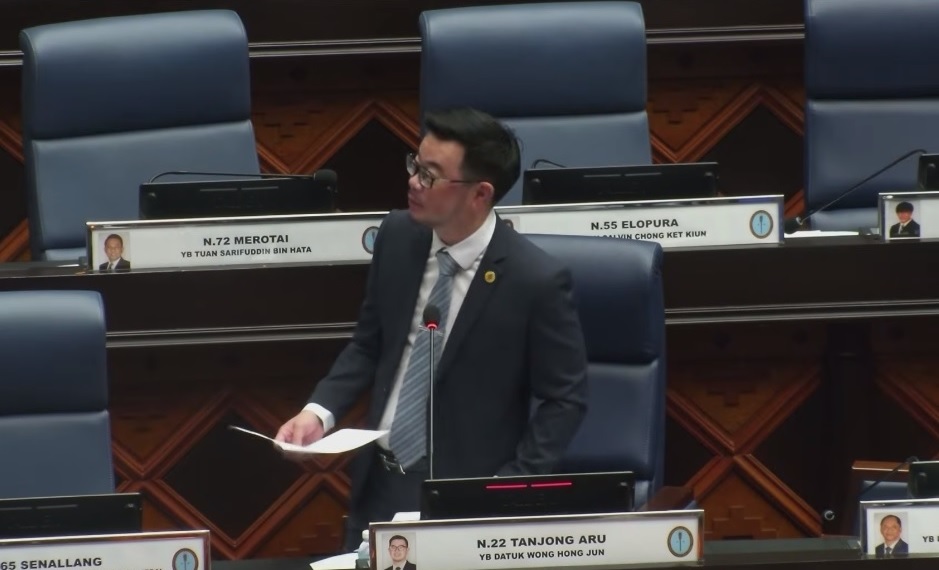
Kota Kinabalu: Tanjung Aru Assemblyman Datuk Junz Wong wants the State Government to hold those responsible for delays at Sabah’s main container port accountable after businesses were left footing extra charges caused by congestion outside their control.
“Why should Sabah’s business community bear storage charges, transport charges and various other extra charges when the delay stems from capacity constraints or weaknesses in the port system that are outside their control,” he said when debating the Sabah Ports Authority (Amendment) Enactment 2026 Bill, Wednesday.
He asked whether the government was ready to introduce a mechanism to waive or compensate such charges once a delay was proven to originate from the port system itself.
He noted the Teluk Sepanggar port expansion project had been granted five extensions of time, which he said was no small matter.
“Who is the contractor responsible for the delay, what is the cause of each extension of time and did the government impose liquidated and ascertained damages,” he said.
He said the party responsible for the delay must be held accountable, particularly since the delay had been cited as the main reason for the port congestion.
Advertisement

Wong noted that the Sabah Ports Authority had confirmed it monitored port operational performance every month, but questioned why no formal performance targets had been disclosed, including average berth waiting time, container dwell time, yard utilisation rate, quay crane productivity and truck turnaround time.
“Without clear performance targets, how can we determine whether this operator is truly meeting the government’s expectations,” he said, adding that monitoring alone was not enough and performance had to be measured against agreed targets.
He noted the Industry, Entrepreneurship and Transport Minister had confirmed container dwell time had risen from about four days to five days, and asked at what point the government would consider port performance no longer acceptable, and what contractual action could then be taken against the operator, DP World Sabah.
He called on the ministry to publish a monthly port performance report covering average berth waiting time, container dwell time, yard utilisation rate, quay crane productivity, truck turnaround time, equipment availability, berth utilisation rate, total container throughput and corrective measures being carried out.
“Transparency will increase confidence, it is not something to be feared,” he said.
He said he supported the bill and had no objection but said accountability must be clarified to the same degree once that responsibility was defined.
He said his debate was not meant to reject foreign investment or to place blame on any party before all facts were obtained, adding that responsibility did not lie with the current minister, who was new to the portfolio and needed to find a solution.
“When a strategic asset of Sabah such as the ports, which involves cooperation between the public and private sectors, is concerned, the level of transparency, accountability and performance must be higher, not looser,” he said.
He said the real question moving forward was not what had happened, but who would resolve the problem, when it would be resolved within a set time frame, how success would be measured and who would be held accountable if targets were not met.
“That is the answer awaited by Sabah’s business community, that is the answer awaited by the people of Sabah, and that is the answer this honourable House has a right to demand,” he said.


.png)