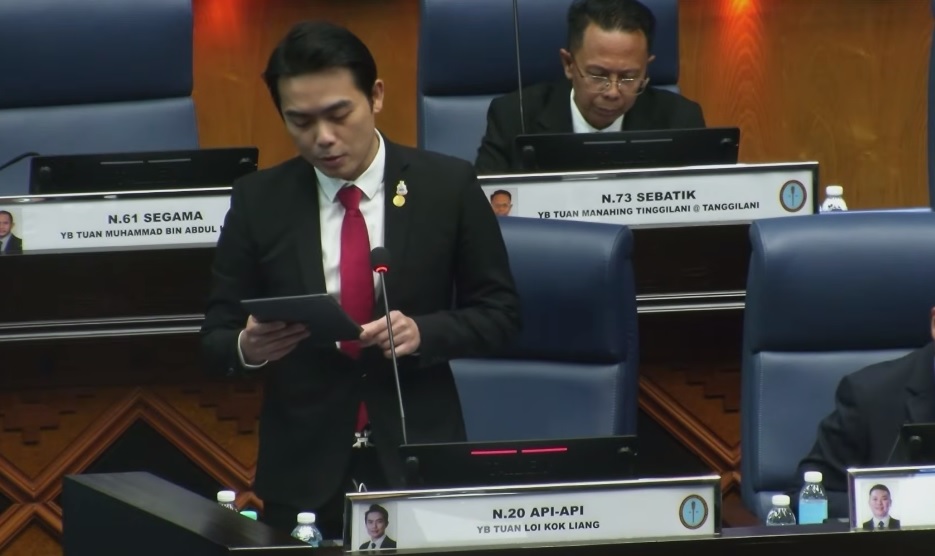
WARISAN-Api Api Assemblyman Loi Kok Liang (pic) said water supply problems in Kota Kinabalu remain unresolved despite repeated allocations for repairs and maintenance.
While acknowledging the need for maintenance and repair works, he questioned whether the government was investing in permanent solutions or merely continuing to fund recurring problems.
He said this when debating the Supplementary Supply Bill at the State Legislative Assembly sitting.
“Are we increasing allocations merely to continue repairing problems, or are we investing so that these problems will no longer recur?” he asked.
Loi said KK Plaza, Segama and surrounding areas had been hit by prolonged water disruptions, with supply yet to be fully restored.
“Almost every day, my team and I have been on the ground monitoring the repair works. We followed the progress and maintained direct communication with Sabah Water Department officers and workers,” he said.
Advertisement

He thanked the department’s personnel, including water tanker drivers, for working long hours under difficult conditions to restore the water supply.
Loi said they were initially informed that a damaged valve was the cause. However, after two or three days of repairs, the supply was still not restored.
He recalled a worker telling him: “YB, it appears the problem is not here. We may need to dig at another location.”
A pipe then burst near Suria Sabah, but repairs there also failed to restore the water supply.
“Until today, repair works are still ongoing near KK Plaza and The Shore at another newly excavated site,” he said.
Loi said the issue was not the commitment of frontline workers but the system they had to work with.
“When one location is repaired but the supply is still not restored, and workers have to excavate another site to find the actual cause, we must ask whether there is a faster and more accurate way to identify the source of the problem,” he said.
He urged the government to invest in technology, modern detection systems and specialised expertise to speed up fault detection.
“The purpose of maintenance is not to continue spending more money repairing the same problems repeatedly. The purpose is to ensure that one day we no longer have to repair the same problems.
“If we reduce repeated repair works, we will save public funds. Part of the savings can then be channelled to assist those genuinely affected by water disruptions,” he said.
Loi said a budget hotel operator in his constituency had spent almost RM2,000 buying water to keep the business operating during the recent disruption.
He proposed a compensation or assistance mechanism for traders and residents who suffered losses from prolonged water disruptions.
Loi also questioned the allocation of RM70 million for the use of aircraft and helicopters for official travel, comprising RM66 million and an additional RM4.5 million.
“If the government can provide such a large allocation for official purposes, why can’t it consider setting aside a small amount to help traders and residents who suffer losses due to failures in basic infrastructure?” he asked.
Loi also urged the government to improve basic infrastructure in Kota Kinabalu city centre after a child from China was recently injured after falling into a large hole on a pedestrian walkway in Kampung Air.
He said repeated repairs to the same infrastructure raised concerns over the quality of work and called on Kota Kinabalu City Hall to review the performance of contractors.
Loi also highlighted frequent sewerage manhole overflows in Kampung Air, Gaya Street and Bandaran, saying they affected residents and businesses while creating a poor impression among tourists visiting the state capital.
He noted that the Sabah Sewerage Services Department had received an additional RM9.3 million, mainly for maintenance, repairs and operational contracts.
Loi sought an update on the implementation of geospatial and in-vessel technology previously announced to improve sewerage services.
He also asked whether the new desludging truck announced during the previous sitting had been delivered and put into operation.
If demand remained high, he said the government should consider adding another desludging truck or increasing capacity to reduce waiting times.
Loi also raised the Sabah People’s Insurance Scheme, noting that although it was not included in the Supplementary Supply Bill, the policy remained in force under its three-year coverage.
He questioned why the government had not continued efforts to remind Sabahans that they were covered under the scheme.
“I visited an elderly man who broke his leg after falling at home. His family, including his children and grandchildren, did not know he was covered. My office helped him submit an insurance claim,” he said.
Loi said many eligible Sabahans were still unaware of the scheme.
He cited a written reply from the Finance Ministry stating that, as of July 7, 2026, the scheme had received 226 claims.
Of these, 136 claims were approved, 32 rejected and 58 were still under review, with total compensation paid amounting to RM1,411,500.
Loi said only about RM1.4 million had been paid over the past 14 months.
Assuming more people became aware of the scheme and annual claims doubled to RM3 million, he said the amount would still be far below the annual premium of about RM17 million.
“This raises the question of whether the RM50 million was money well spent or a waste of public funds,” he said.
Loi said if the government had accepted the proposal by the Merotai assemblyman to establish its own accident assistance scheme instead of purchasing an insurance policy, it could have saved about RM14 million a year.
“That RM14 million could have been used to address many issues affecting the rakyat,” he said.


.png)