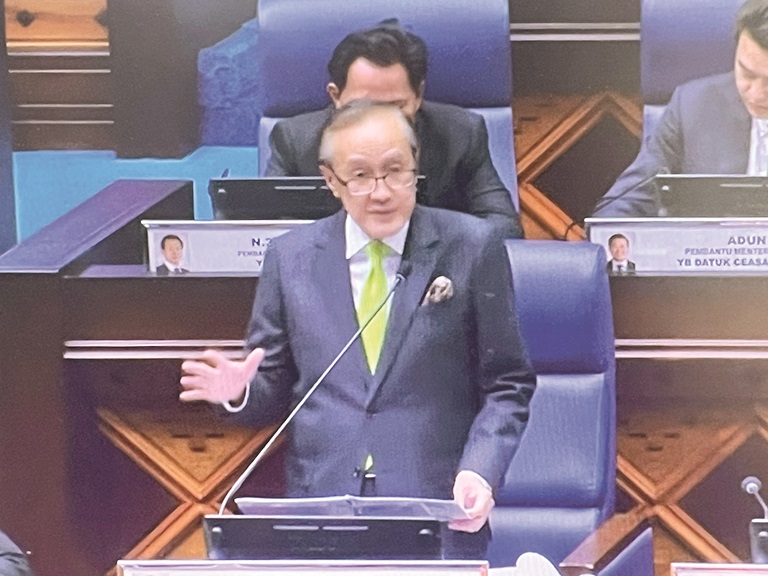
Kota Kinabalu: The tabling of the RM1.612 billion Supplementary Estimates should not be interpreted as a failure or weakness in the planning of Sabah’s 2026 Budget, but rather as evidence of the Government’s ability to respond to emerging needs while maintaining strict fiscal discipline.
Finance Minister Datuk Seri Masidi Manjun said the Supplementary Estimates are a financial mechanism provided for under government financial management
procedures to accommodate expenditure requirements that could not be fully determined during the preparation of the annual budget, or new requirements that arise after the budget has been approved.
“The tabling of the Supplementary Estimates on this occasion should not be interpreted as a failure or weakness in the planning of Budget 2026, which was presented in December 2025.
“The annual budget was prepared based on the policies, priorities, revenue projections, expenditure requirements and the best available information at the time,” he said when winding up the debate on the Supplementary Supply Bill 2026 during the State Legislative Assembly sitting here Tuesday.
He said every request for additional allocation must undergo a thorough assessment process based on actual needs, spending performance, the Government’s financial capacity and its importance to service delivery and public welfare.
Advertisement

“The Supplementary Estimates presented reflect the Government’s ability to respond responsibly to changing circumstances without compromising the principles of fiscal discipline, accountability and good financial governance,” he said.
Masidi also said that the Development Fund Account deficit raised by several Assemblymen was different from a deficit in development projects.
He said the deficit in the Development Fund Account had existed for decades and had repeatedly been highlighted by the National Audit Department, which had urged the State Government to reduce it. The situation was inherited from previous administrations.
“Contributions to the Development Fund are therefore made to reduce the deficit in the account,” he said.
He said noted that the Federal Government’s Development Fund also recorded a deficit of RM10.217 billion in 2023, demonstrating that such deficits are common in government financial management and do not mean that development projects themselves are running at a deficit.
On concerns over why operating expenditure continues to exceed development expenditure, Masidi said the situation has existed for many years because Sabah’s revenue base was historically limited, requiring expenditure to be managed according to the State’s financial capacity.
However, he said Sabah’s stronger financial position now enables the Government to increase the development allocation ceiling under the 13th Malaysia Plan (13MP) to RM12 billion over five years, compared to only RM4 billion under the 12MP.
“This demonstrates the Government’s commitment to strengthening the State’s development agenda,” he said.
He added that the ratio of Supply Expenditure to Development Expenditure stood at 80:20 in 2025 but has been improved to 76:24 this year, reflecting a significant increase in the share allocated to development spending.
According to him, Supply Expenditure remains higher because a large portion of government assets, including buildings, roads, bridges, drainage systems, slopes, water pipelines and sewerage systems, are now in the maintenance phase, with such spending classified as Supply Expenditure.
“To further increase the proportion of development expenditure, the Government requires a larger revenue surplus so that more funds can be channelled towards new development programmes in the future,” he said.
Masidi said the State Government continues to practise prudent and disciplined fiscal management by ensuring that all spending is based on the State’s financial capability.
He revealed that the actual requirement to fund both supply and development expenditure for 2026 amounts to RM7.97 billion, while projected revenue stands at only about RM6.4 billion.
“The principle of ‘Spend what you have, not what you don’t have’ remains the guiding philosophy of the Sabah Government in managing the State’s finances.
“It is this financial discipline that has enabled the Government to increase the State’s reserves to more than RM7 billion by the end of 2025,” he said.
He said the balance of the Consolidated Revenue Account, which stood at only about RM70 million in 1998, had increased to RM7.6 billion by the end of 2025 through disciplined and prudent financial management.
Masidi said in determining supplementary allocations, the Government takes into account current revenue projections, and any increase in revenue collection will be used as a basis for determining additional spending requirements until the end of the financial year.
“The Sabah Government’s aspiration is clear, to build a State Government with a strong, self-reliant and resilient financial position, so that Sabah’s development can be implemented sustainably without being overly dependent on the goodwill of the Federal Government,” he said.


.png)